SaaS marketing is the process of acquiring, activating, retaining, and expanding subscribers for subscription-based software. SaaS marketing centers on recurring revenue and frames every decision around lifetime value rather than one-time sales. The goal is a long-term customer relationship that drives monthly or annual growth. The meaning, purpose, types, and effective strategies of SaaS marketing connect through the recurring revenue model, which governs customer lifecycle management from acquisition to retention and expansion. SaaS marketing orchestrates trials, conversions, retention, and expansion to sustain subscription income.
Effective SaaS marketing strategies include inbound marketing, content marketing, and account-based marketing, each serving a different stage of the customer path. Inbound marketing attracts prospects through useful content, content marketing builds authority and trust, and account-based marketing targets high-value accounts with personalized campaigns. Data analysis, market research, and a focus on customer lifetime value support these strategies and make SaaS marketing a system that grows revenue and lowers churn.
What does SaaS marketing mean?
SaaS marketing is the specialized practice of promoting subscription-based software services. Traditional marketing focuses on one-time sales, while SaaS marketing spans the full customer lifecycle: acquiring users, activating them, retaining them, and expanding their use of the service. SaaS marketing works to raise lifetime value through ongoing customer relationships.
SaaS marketing covers awareness-building, trial optimization, onboarding, and upselling. Each stage needs distinct messaging for the customer's position in the lifecycle. During the awareness stage, educational content attracts prospects. During the retention stage, engagement tactics reduce churn and raise satisfaction.
Subscription revenue serves as the organizing principle of SaaS marketing. The recurring revenue model demands a focus on retention and expansion, since both sustain and grow the business. SaaS marketing keeps customers seeing continuous value, which drives renewals and adoption of more features. Aligning every activity to lifetime value gives a SaaS company predictable, compounding revenue growth.
What is a SaaS?
SaaS, or Software as a Service, is a cloud-delivered model where users reach software over the internet. Traditional software needs installation on local devices, while SaaS runs through a web browser or mobile app and removes local maintenance. The delivery model supports recurring revenue because users subscribe monthly or annually rather than buy a one-time license. SaaS turns software from a product into an ongoing service relationship built on retention and lifetime value. SaaS also supports fast updates and scaling, which gives businesses flexibility and lowers upfront cost. The model asks for marketing that builds long-term relationships and shows continual value to subscribers.
What is the purpose of SaaS marketing?
The purpose of SaaS marketing is to drive trials, conversions, retention, and expansion revenue across the customer lifecycle. SaaS marketing guides prospects from first interest to loyal subscriber, which means attracting them to try the software, converting them to paying customers, keeping them over time, and prompting them to expand or upgrade.
Traditional product marketing centers on a single sale, while SaaS marketing builds long-term relationships. SaaS companies run on recurring revenue, where retention and lifetime value weigh as much as first acquisition. SaaS marketing strategies support every stage of the customer path, from onboarding and nurturing to upselling and customer success.
SaaS marketing connects to the channels that serve these goals. Content marketing and SEO attract and educate prospects, while product-led growth reduces friction in trial-to-paid conversion. Email and lifecycle campaigns drive engagement and retention, and account-based marketing targets high-value accounts for expansion. Each channel aligns to the goal of raising customer lifetime value and lowering acquisition cost for sustained growth.
How is SaaS marketing different from traditional marketing?
SaaS marketing differs from traditional marketing because SaaS sells ongoing access to subscription software rather than a one-time purchase. SaaS marketing weighs retention and expansion revenue as heavily as acquisition. The subscription starts a customer relationship rather than ends it, so retention tactics prevent churn and prompt upsells and cross-sells. Traditional marketing often measures success by the first transaction. SaaS marketing needs continuous engagement and support to raise lifetime value, which makes post-sale activity as important as acquisition.
What are the types of SaaS marketing?
SaaS marketing divides into channel-based disciplines, each serving a different stage of the customer path. The channels address specific buyer motions and funnel stages, as listed below.
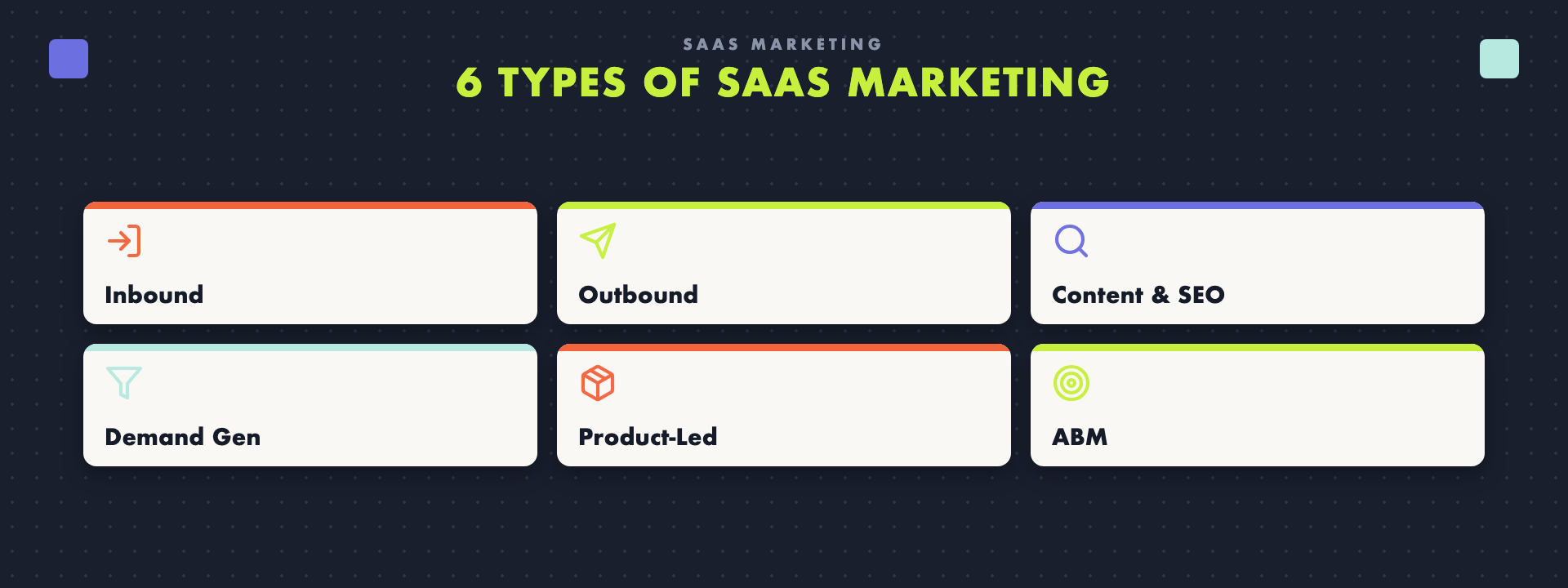
- Inbound marketing attracts prospects through useful content. Inbound serves the top of the funnel, where self-service buyers research on their own, and builds awareness and trust.
- Outbound marketing reaches prospects through direct outreach. Outbound targets specific accounts with personalized campaigns and suits B2B SaaS with long cycles and buying committees.
- Content marketing and SEO build authority and organic discoverability. The pair produces educational content across the path and drives organic traffic that supports other channels.
- Demand generation and paid advertising create and capture demand through paid channels. The pair works across the funnel through targeted campaigns on Google Ads and social platforms.
- Product-led marketing uses the product as the acquisition vehicle. Product-led motion drives activation, retention, and expansion by letting users feel the product's value and suits self-serve models.
- Account-based marketing targets high-value accounts with personalized campaigns. ABM aligns sales and marketing to reach decision-makers and returns strong results for B2B SaaS with complex sales.
These channels work together, and effective strategies sequence and layer them across the customer path to raise lifetime value, cut churn, and grow recurring revenue.
Inbound marketing for SaaS
Inbound marketing for SaaS acquires and retains customers by supplying useful content and experiences matched to buyer needs. Inbound serves the top and middle of the funnel and targets prospects in the awareness and consideration stages. Educational content, thought leadership, and optimized experiences attract software buyers who search for solutions.
Inbound marketing for SaaS produces qualified leads that grow into loyal customers. Inbound also supports retention by reinforcing value after the sale through case studies, webinars, and product documentation. Inbound connects to recurring revenue because it builds trust before conversion, lowers acquisition cost, and forms long-term relationships that drive expansion and renewal.
Outbound marketing for SaaS
Outbound marketing for SaaS targets prospects through direct outreach and works best in the awareness and consideration stages. Outbound techniques include cold email, cold calling, LinkedIn outreach, and paid advertising. These methods generate qualified leads and speed pipeline velocity in B2B SaaS, where deal sizes justify direct outreach.
Intent data and precise targeting raise outbound effectiveness. Segmenting contacts by technographics and firmographics improves response and conversion. Outbound reaches decision-makers with high relevance and fills the pipeline with accounts that match the ideal customer profile, which drives recurring revenue. Outbound complements content-driven strategies by engaging buyers earlier and holding MRR growth even before brand awareness matures.
Content Marketing and SEO for SaaS
Content marketing and SEO help a SaaS company attract, convert, and retain customers. Content marketing produces useful, product-focused content that educates users and builds trust. SEO makes that content discoverable, drives organic traffic, and reduces reliance on paid advertising. Content marketing and SEO deliver four outcomes, as listed below.
- User education: Content marketing explains product features and benefits, which helps users decide and moves the buyer path from awareness to purchase.
- Trust building: Steady, high-quality content marks a SaaS company as an industry authority and converts prospects into long-term subscribers.
- Objection handling: Content marketing answers buyer objections with clear, factual information and eases concerns toward conversion.
- Competitor differentiation: Sharp content shows a SaaS product's distinct features and sets it apart in a crowded market.
SEO supports content marketing by optimizing for search engines so content reaches the target audience. Strong SEO uses high-intent keywords, optimized headings, and internal links. Content marketing and SEO together drive organic lead generation and grow recurring revenue.
Demand Generation and Paid Advertising for SaaS
Demand generation and paid advertising attract high-intent buyers and speed revenue growth. Both capture interest across the customer path and move prospects toward conversion.
Demand generation builds awareness and interest through targeted campaigns and educational content. Multi-touch sequences guide prospects through awareness and consideration. Useful content warms prospects before any conversion ask and makes them readier for trials and demo requests.
Paid advertising places a SaaS product in front of users who search for solutions. Google Ads and LinkedIn Ads target high-intent keywords and decision-maker personas and speed the buyer path through the funnel. Retargeting re-engages users who showed interest and holds brand presence through consideration. Paid advertising drives immediate revenue and supports MRR and ARR growth.
Together, demand generation and paid advertising scale acquisition while improving payback periods.
Product-Led and Lifecycle Marketing for SaaS
Product-led and lifecycle marketing drive acquisition and retention for SaaS. Product-led growth uses the software as the acquisition tool through free trials, freemium models, and self-service onboarding, which let users feel value before any financial commitment. Direct product engagement reduces funnel friction and drives organic growth.
Lifecycle marketing runs personalized communication across the customer path. Targeted messages through email and in-app notifications respond to user behavior and guide customers from awareness through onboarding, retention, and expansion. Lifecycle marketing raises engagement, cuts churn, and grows lifetime value. Together, the two form a growth engine where every interaction adds to recurring revenue.
Account-Based Marketing for SaaS
Account-based marketing (ABM) for SaaS targets high-value accounts rather than individual leads. In ABM, marketing and sales build personalized campaigns for named accounts and treat each account as its own market. ABM suits B2B SaaS, where a purchase involves several stakeholders.
ABM grows recurring revenue by concentrating effort on the accounts with the highest value. In a survey by ITSMA, 87 percent of marketers reported that account-based marketing delivers a higher ROI than other marketing strategies. Quality over quantity reduces waste and shortens sales cycles. Personalized content and outreach raise conversion and build strong relationships that support retention and expansion. ABM demands resources but aligns with recurring revenue by focusing on accounts that promise durable growth.
What Are the most Effective SaaS Marketing Strategy?
The most effective SaaS marketing strategies are content marketing and SEO, ABM and paid channels such as PPC and social advertising, and product-led growth and lifecycle email marketing, which balance acquisition, retention, and expansion to drive recurring revenue. These marketing strategies favor long-term engagement over quick sales so MRR and ARR grow at a steady pace. A strong approach sequences channels across the customer lifecycle, from awareness to retention and expansion.
What are the key components of a SaaS marketing strategy?
The key components of a SaaS marketing strategy are defined buyer personas, a clear grasp of the problem the product solves, a map of growth bottlenecks across the customer path, channel selection, and success metrics such as activation rate, retention rate, CAC, and LTV, which together drive recurring revenue. Defined buyer personas guide targeting by naming the needs and behaviors of the audience. A clear grasp of the problem the SaaS product solves best shapes messaging and positioning. A map of growth bottlenecks across the customer path shows where conversion and retention stall.
Channel selection is another component and matches marketing effort to the growth model and acquisition motion. Selection names the platforms and tactics that reach prospects at each funnel stage. Success metrics such as activation rate, retention rate, CAC, and LTV measure the strategy and guide optimization.
These components reinforce each other: audience insight shapes channel choices, channel performance exposes bottlenecks, and metrics guide improvement. Churn analysis might reveal onboarding gaps that trigger content adjustments. The loop ties every activity to measurable recurring revenue and turns a set of tactics into a system for predictable growth.
What is the importance of SaaS marketing plan?
A documented SaaS marketing plan turns strategic goals into predictable, executable actions that serve recurring revenue. Linking each activity to a revenue goal keeps effort aligned with MRR and ARR targets. The plan connects strategy to operation and lets teams match campaigns to buying stages and improve outcomes over time.
The plan matters more under the subscription model because coordination spans long customer paths and many touchpoints before conversion and renewal. A full plan documents buyer personas, competitive positioning, channel priorities, budget allocation, and the behavioral triggers that move users from trial to paid to expansion. Documentation keeps teams consistent as they scale, speeds onboarding of new members, and pinpoints weak stages. The plan connects strategic components to the SaaS marketing funnel so awareness, activation, retention, and expansion run as one system.
What is a SaaS marketing funnel?
A SaaS marketing funnel is a structured path that guides prospects from awareness to expansion. Traditional funnels end at purchase, while the SaaS funnel extends past conversion into activation, retention, and expansion. Marketing teams manage each phase: attracting prospects through content and paid channels at the top, nurturing trials and demos in the middle, and driving adoption and expansion at the bottom. The full path ties marketing to long-term loyalty and recurring revenue and gives weight to each lifecycle stage.
How to Choose the Right SaaS Marketing Strategy?
Choosing the right SaaS marketing strategy weighs the company's growth stage, business model, and budget. Early-stage SaaS companies gain from content marketing, SEO, and founder-led outreach, which build organic momentum without heavy ad spend and establish topical authority on limited resources. As a SaaS company scales, the mix adds paid channels such as PPC, social ads, and ABM that accelerate pipeline and target higher-value accounts.
The business model shapes channel selection. Self-serve B2C SaaS products suit product-led growth, conversion rate optimization, social advertising, and retargeting for short decision cycles and individual buyers. B2B SaaS with long cycles and buying committees needs content across multiple stages, ABM for enterprise accounts, email nurture sequences, and sales enablement for complex evaluation. Budget goes first to the biggest bottleneck, whether awareness, mid-funnel conversion, onboarding activation, or retention and expansion.
What are the best channels for SaaS marketing?
The best channels for SaaS marketing match each stage of the customer path and return strong results, as listed below.
- Content marketing and SEO: The pair drives top-of-funnel awareness and trust. SEO raises organic traffic, with cases where visits grew from 6,000 to 35,000 within a year.
- Paid advertising: Google Ads and LinkedIn capture high-intent leads in the mid-to-bottom funnel, generate demand fast, and support retargeting.
- Email marketing: Email works across the lifecycle, nurtures leads, supports onboarding, and lifts retention through personalized content matched to behavior.
- Product-led channels: Free trials and freemium models raise conversion by letting prospects feel the product at low risk and activate users toward a subscription.
- Referral and influencer marketing: Trust from satisfied customers and industry voices drives acquisition, since 88 percent of consumers trust recommendations from people they know, according to Nielsen's Global Trust in Advertising study.
- Account-based marketing: For B2B SaaS, ABM targets high-value accounts with personalized campaigns and delivers a higher ROI for 87 percent of marketers who use it.
- Partnerships and integrations: Work with complementary products extends a SaaS offering and opens distribution within existing workflows.
Each channel is selected and sequenced by the SaaS model and audience for a smooth path from awareness to activation, retention, and expansion.
Who can help you on building a SaaS Marketing strategy?
Building a SaaS marketing strategy runs through in-house teams, freelance specialists, or specialized agencies. Each option suits a different growth stage and resource level, as listed below.
- In-house teams: An in-house team suits an established SaaS company with capital and brings deep product knowledge and brand alignment for a dedicated department.
- Freelance specialists: A freelancer supplies flexibility and niche skill at low cost for an early-stage startup and fills gaps in SEO, content, or paid advertising without a full-time hire.
- Specialized agencies: A SaaS marketing agency brings cross-functional skill and proven frameworks for a scaling company, runs several channels at once, and suits a business past product-market fit that wants to expand fast.
The right path depends on growth stage, budget, internal capability, and the complexity of the strategy.
How to Choose a SaaS Marketing Agency
Selecting a SaaS marketing agency weighs criteria that signal genuine expertise in subscription software marketing. A strong agency shows command of SaaS metrics such as CAC, LTV, churn rate, and MRR growth, backed by case studies with retention gains and experience across funnel stages.
For key criteria on how to choose a SaaS marketing agency, confirm the agency specializes in your SaaS category and can supply case studies with real numbers from companies at your stage. The agency measures success in pipeline and revenue rather than traffic or impressions. Senior leaders who pitch the agency run your account rather than hand it to junior staff. The agency offers pilot projects before long-term contracts and holds a clear attribution model for multi-touch enterprise deals.
For evidence of expertise, look for case studies with retention gains and shorter payback periods stated in specific metrics. A strong agency challenges your strategy rather than only validates it and stands ready to run a 90-day onboarding that starts with an audit and positioning review before major campaigns. The choice aligns with your growth stage and objectives, since the agency's skill in customizing channel selection and messaging drives long-term success.
When to Hire a SaaS Marketing Agency?
Hiring a SaaS marketing agency fits when growth signals and capacity limits appear together. A key signal arrives when MRR sits between $50K and $100K, which justifies specialized skill. An in-house team that lacks bandwidth across channels signals the same. Other signals include a CAC ratio worse than 1:3 LTV to CAC, payback beyond 12 months, or a push toward rapid scaling that needs proven frameworks over trial and error.
Growth stage shapes the decision. An early-stage SaaS company gains most once it holds product-market fit but needs to speed acquisition and build repeatable systems. A mid-stage company hires when expanding into new channels or optimizing funnels. Internal capacity matters too: a team consumed by daily execution gains immediate cross-functional skill in content, paid acquisition, conversion optimization, and automation without several full-time hires.
Why choose SaaS marketing agency for SaaS Marketing?
Choosing a SaaS marketing agency speeds business outcomes by optimizing channels and growing recurring revenue. At SaaS Marketing Agency, we work exclusively with subscription software companies, so we frame every campaign around the metrics that decide growth — CAC, LTV, ARR, and the LTV:CAC ratio — rather than vanity traffic. We lower CAC and raise LTV and ARR by running integrated campaigns across content, SEO, paid acquisition, and lifecycle nurture as one connected system rather than disconnected tactics.
Our experience across many SaaS clients and growth stages lets us build channel mixes and funnel tactics that compound MRR and ARR over time. We serve the core SaaS marketing goal: a scalable engine that acquires and retains customers with efficiency and turns your marketing spend into durable subscription revenue. When you work with us, you get a partner that owns outcomes across the full lifecycle, from first-touch acquisition through retention and expansion.
Why is SaaS marketing important for Recurring Revenue?
SaaS marketing grows recurring revenue by raising MRR and ARR through customer acquisition and retention. Traditional sales models chase one-time deals, while SaaS marketing sustains and grows revenue by raising each subscriber's lifetime value. Marketing efficiency sets the payback period, the time to recoup acquisition cost. Strong SaaS marketing reduces churn, drives upgrades, and builds advocacy, which compounds recurring revenue growth.
What are the metrics to measure SaaS marketing success campaign?
Metrics that measure SaaS marketing success include CAC, LTV, churn rate, and MRR. The LTV to CAC ratio guides strategic decisions and shows whether acquisition cost is justified by the revenue a customer produces over time. Tracking these metrics keeps marketing tied to durable growth by balancing acquisition and retention.
What are the benefits of SaaS marketing?
SaaS marketing delivers benefits that strengthen recurring revenue, as listed below.
- Predictable, scalable acquisition: Unit economics improve over time as channels mature, CAC falls, LTV rises, and margins widen.
- A self-reinforcing growth engine: Content assets, SEO authority, and brand reputation keep producing leads without proportional cost increases.
- Higher revenue per customer: Upsells, cross-sells, and lower churn raise value across the full lifecycle from acquisition through expansion.
- Precise measurement: The subscription model lets marketers track which channels drive high-LTV customers and refine spend.
- Compounding advocacy: Referral programs and customer advocacy turn satisfied users into a low-cost acquisition channel that strengthens over time.
What are the challenges of SaaS marketing?
SaaS marketing faces distinct challenges that demand specialized skill, as listed below.
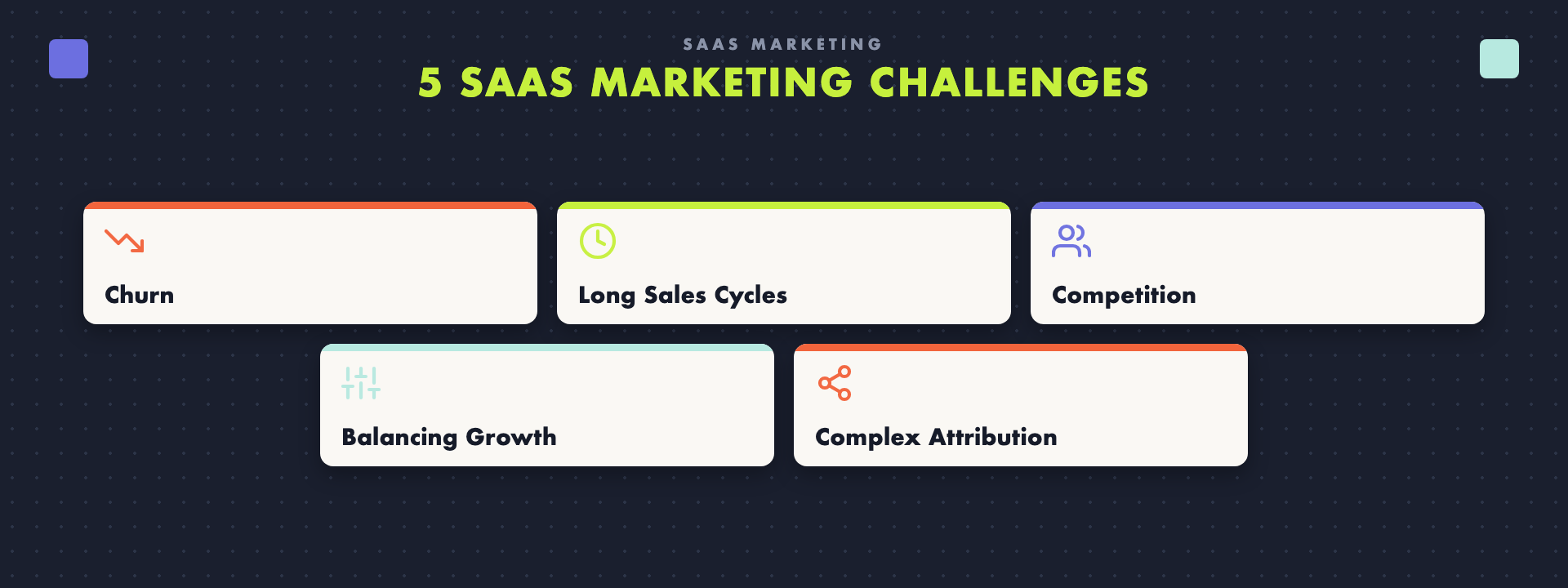
- Churn management: Retention drives recurring revenue and lifetime value, and small churn increases erode MRR and ARR over time.
- Long sales cycles: B2B SaaS prospects touch many points across extended decisions, which complicates attribution and demands sustained nurture.
- Intense competition: A flood of SaaS products in every category pushes marketers toward narrow audiences with smaller addressable markets.
- Balancing acquisition and retention: SaaS marketing weighs both with equal force and asks marketers to command the full lifecycle from trial through expansion.
- Complex attribution: Non-linear paths across content, search, social ads, and retargeting make it hard to measure which effort drives revenue and to optimize spend.
Is SaaS marketing hard?
Yes, SaaS marketing is complex. The difficulty comes from the intangible nature of cloud software and the need to balance acquisition, retention, and expansion. Long sales cycles and strong competition add to the load. Skill in data-driven persona definition, content strategy, and marketing automation reduces the complexity.
How B2B and B2C SaaS Marketing Differ
B2B and B2C SaaS marketing differ in audience and buying process. B2B SaaS marketing targets business buying committees with several stakeholders and long sales cycles and builds relationships through LinkedIn, webinars, and whitepapers. B2C SaaS marketing targets individual self-serve users who decide fast and relies on performance ads, influencers, and App Store Optimization for immediate conversion.
Deal size and cycle length shape the channel mix. B2B deals run larger, reaching a median of about 84 days, according to 2026 B2B SaaS sales-cycle benchmarks, which asks for lead nurture over time. B2C cycles finish within hours or days and favor channels that speed decisions. Both share goals of growing revenue and improving churn rate and retention.
What is SaaS marketing in the B2B sector?
B2B SaaS marketing targets business buying committees rather than individual consumers and addresses several decision-makers within an organization. B2B SaaS marketing handles long sales cycles, higher contract values, and complex evaluation that spans departments. Channels and content educate and nurture influencers from end users to C-level executives through extended consideration. B2B SaaS marketing uses account-based marketing, enterprise content, and sales enablement that justify ROI and answer organizational needs rather than individual preference.
What is B2C SaaS marketing?
B2C SaaS marketing targets individual self-serve users who decide on their own. B2C SaaS marketing reaches end users so they sign up, trial, and convert without complex approval. Dominant channels include social advertising, content optimized for organic search, and influencer partnerships. These methods favor low-friction conversion paths and short cycles for immediate activation and adoption.
Examples of SaaS Marketing
Examples of SaaS marketing show how companies use specific strategies to grow acquisition and retention across lifecycle stages, as listed below.
- Navattic and Storylane: Both replace gated PDFs with interactive product demos on landing pages, which raises conversion through immediate product access. The example shows a Product-Led strategy at the bottom-of-funnel stage.
- Dropbox: Dropbox runs a freemium model with Referral and Product-Led strategies at the acquisition stage, using viral loops that turn users into advocates.
- Airbnb: Airbnb runs a referral loop where referrer and referee both receive travel credits, a Referral and Email tactic at the activation stage that lifts growth and retention.
- HubSpot: HubSpot runs Inbound and Content marketing at the awareness stage through storytelling and influencer partnerships that build trust and organic reach.
- Notion: Notion runs a community-first approach with template sharing and user advocacy, a Community tactic at the retention stage that deepens engagement and cuts churn.
Each example names a channel and a funnel stage and points back to recurring revenue growth.
What are AI trends in SaaS marketing?
AI trends reshape SaaS marketing through stronger acquisition, retention, and personalization. Autonomous AI agents automate workflows like campaign orchestration and cut manual effort by up to 50 percent. Hyper-personalization reads real-time user intent to serve context-aware content and lifts conversions by 70 percent. Predictive churn modeling scores accounts on churn probability and triggers proactive re-engagement. These advances improve acquisition through faster lead scoring and retention through risk prediction and personalized playbooks.
How is AI used in SaaS marketing?
AI in SaaS marketing raises personalization and automates marketing functions. SaaS teams apply AI across channels for hyper-personalized experiences and use intent data and segmentation to improve cold email. AI supports content creation, automates customer-path mapping, and strengthens SEO through behavior analysis. Predictive analytics drives churn reduction and lead scoring, while behavior-driven email responds to user actions across the lifecycle. AI lets SaaS marketers scale personalized experiences and strengthens the link between marketing and recurring revenue.
What is the future of SaaS marketing?
The future of SaaS marketing rests on durable recurring growth. That growth holds through sophisticated channels, precise metrics, and advanced AI. These elements let a SaaS company automate workflows, raise lifetime value, and personalize customer interaction across the buyer path. Marketing shifts from a cost center into the primary engine of predictable, compounding recurring revenue.

About the team
SaaS Marketing Agency Digital Team
The in-house team at SaaS Marketing Agency Digital. We architect growth systems for B2B SaaS companies from Series A through pre-IPO.