B2B SaaS marketing is the process of acquiring and retaining business subscribers across a multi-stakeholder buying cycle. B2C marketing serves individual consumers and one-time transactions, while B2B SaaS marketing runs on buying committees and recurring revenue. The difference asks for a focus on long-term relationships and value delivery over immediate sales.
B2B SaaS marketing covers the strategic work of building a predictable pipeline that drives Annual Recurring Revenue (ARR). The work sets clear goals and strategies, selects marketing channels, and runs campaigns that fit the needs of several decision-makers. The goal keeps every activity tied to the pipeline-to-ARR thread, from market definition through execution to channel selection.
A strong B2B SaaS marketing strategy uses committee-based decisions and weighs sustainable growth over individual buying. Aligning acquisition with expansion keeps pipeline coverage driving predictable revenue and sets a growth model where marketing efficiency sets the ceiling for expansion. The integrated approach reinforces the recurring revenue model that defines SaaS.
What Is B2B SaaS Marketing?
B2B SaaS marketing is the strategic practice of acquiring, converting, and retaining business subscribers through a subscription model built on recurring revenue. B2B SaaS marketing addresses multi-stakeholder buying committees rather than individual consumers. B2B SaaS marketing spans the full customer lifecycle, from awareness to long-term retention, and weighs ongoing relationships over one-time transactions.
B2B SaaS marketing covers acquisition, conversion, and retention for business subscribers. During acquisition, marketing reaches and educates several decision-makers within target organizations to build awareness and a qualified pipeline. Conversion supports long cycles by nurturing stakeholders from end users to C-level executives, each with distinct concerns. After conversion, marketing supports onboarding, adoption, expansion, and renewal, which moves MRR and Customer Lifetime Value (LTV).
Two attributes define B2B SaaS marketing: committee-based buying and the recurring revenue model. In B2C SaaS, individual consumers decide alone, while B2B buyers span IT, finance, operations, and executive leadership and need messaging that answers each pain point and success criterion. The recurring revenue model measures success by the quality and length of customer relationships, which makes CAC and net revenue retention core indicators.
How does B2B SaaS marketing differ from B2C SaaS marketing?
B2B SaaS marketing differs from B2C SaaS marketing in the buyer, the cycle length, and the deal size. In B2B, a buying committee of end users, technical evaluators, procurement, and executives makes the decision rather than an individual consumer. Committee buying extends the cycle, often weeks to months, as stakeholders weigh the solution against technical requirements, business outcomes, security standards, and budget. B2B deal sizes run larger, from thousands to millions in annual recurring revenue, against the lower-priced individual subscriptions of B2C.
The shift from individual decisions to committee buying shapes how B2B SaaS marketing runs. Marketers build distinct messaging for each stakeholder: ROI for executives, technical capability for IT, ease of use for end users, and compliance for security officers. The multi-stakeholder reality asks for longer nurture cycles, deeper content, and more relationship-building than the transactional approach of B2C SaaS. These buyer dynamics form the foundation for the core purpose of B2B SaaS marketing: predictable pipeline and recurring revenue across a complex, relationship-driven path.
What is the purpose of B2B SaaS marketing?
The purpose of B2B SaaS marketing is to build a predictable pipeline and generate Annual Recurring Revenue (ARR). The goal spans the full lifecycle from acquisition through expansion and holds long-term value for business subscribers. B2B SaaS marketing acquires customers and retains them by raising lifetime value through engagement and expansion.
The work attracts qualified prospects, converts them to paying customers, and nurtures them to cut churn. Aligning marketing to the subscription model builds recurring revenue streams. The purpose connects to the main goals of B2B SaaS marketing: demand generation, acquisition, retention, and expansion. Each goal adds to a repeatable process that fuels predictable growth.
B2B SaaS marketing keeps every initiative tied to a sustainable growth path. Metrics like CAC, MRR growth, and pipeline coverage measure success and forecast growth. The structure aligns marketing strategy with financial objectives so marketing stays coupled to the business's long-term goals.
What are the main goals of B2B SaaS marketing?
B2B SaaS marketing pursues several goals that drive sustainable growth and tie to revenue, as listed below.
- Pipeline generation: Attract and nurture high-potential leads through committee decisions for a steady flow of sales-qualified opportunities.
- Customer acquisition: Convert prospects into paying customers by raising conversion rates and managing CAC for profitable expansion.
- Account expansion: Grow revenue within existing accounts through upsells, cross-sells, and feature adoption, which raises MRR and ARR.
- Customer retention: Cut churn and raise LTV by showing product value and driving customer success, which builds a stable revenue base.
Together the goals form a growth engine for predictable recurring revenue. Strong pipeline coverage drives new customer growth, efficient acquisition protects margins, expansion multiplies account value, and high retention secures long-term profit.
Why is B2B SaaS marketing important for growth?
B2B SaaS marketing drives growth because it sets the efficiency that caps a SaaS company's growth. In a subscription model, marketing sets how well a company scales by balancing acquisition cost against lifetime value. Efficient marketing builds a predictable pipeline for consistent revenue and accurate forecasting. Pipeline coverage gives sales teams a steady flow of qualified leads to meet revenue targets, which lets a company allocate resources with confidence. Without strong marketing fundamentals, even the best product fails to reach its potential, since it cannot convert market opportunity into sustained revenue. B2B SaaS marketing serves as the foundation that aligns targeting, budgeting, and execution for long-term success.
How to Build a B2B SaaS Marketing Strategy
Building a B2B SaaS marketing strategy follows a structured sequence that aligns with business goals and efficient resource use. The process starts by defining the Ideal Customer Profile (ICP) and buyer personas, the foundation for later decisions. A clear grasp of the audience lets a team build messaging and positioning that fit stakeholder needs.
Once the ICP and personas are set, the next phase selects marketing channels. Channels match where the audience spends time and follow funnel alignment from awareness to expansion. After channel selection, focus shifts to setting and allocating the budget so resources drive the strongest return. Measurement systems then track performance and surface improvements. Regular optimization on those insights holds strategy effectiveness and drives predictable pipeline coverage and ARR.
Defining Your ICP and Buyer Personas
Defining the Ideal Customer Profile (ICP) and buyer personas is the foundation of a B2B SaaS strategy. The ICP names the companies that gain the most value from the solution by attributes such as industry, company size, and revenue range. Buyer personas represent the stakeholders inside those companies who shape purchasing, with their roles, motivations, and pain points.
This step produces inputs for later decisions. A clear ICP guides account-based marketing, channel selection, and budget allocation and keeps effort on target accounts. Detailed personas inform messaging, content, and sales enablement and sharpen communication with each stakeholder. The clarity supports the next step: positioning and messaging that fit both organizations and their decision-makers.
Positioning and Messaging for B2B SaaS
Positioning and messaging in B2B SaaS define and communicate a product's value in the market. Positioning sets how the market sees a product against competitors by naming who the product serves, the benefits it delivers, and what sets it apart. Positioning starts with a precise target customer defined by role, company stage, and pain points. A positioning statement captures these elements: "For [Ideal Customer Profile], [Product] is the [Category] that [Primary Point of Difference], unlike [Primary Alternative], which [Contrast], because [Proof]."
Messaging turns positioning into communication across channels. Messaging states value propositions and answers the needs of technical evaluators, economic buyers, and end users. The framework keeps messaging consistent yet adaptable per segment, weighs benefits over features, and pairs emotional appeal with rational argument. Strong messaging aligns with budget allocation and content creation, which raises pipeline generation and recurring revenue.
Setting and Allocating a B2B SaaS Marketing Budget
Setting and allocating a B2B SaaS marketing budget aligns money with revenue goals and growth stage. Early-stage SaaS companies allocate 20 to 40 percent of revenue to marketing, while growth-stage firms spend around 10 to 20 percent. The budget spreads across funnel stages: 30 to 40 percent for awareness, 30 to 40 percent for consideration, and 20 to 30 percent for conversion, with 5 to 10 percent held for retention and expansion.
For the awareness stage, 30 to 40 percent of the budget raises brand visibility through broad-reach channels such as paid advertising and content marketing that attract leads and build recognition. For the consideration stage, 30 to 40 percent nurtures leads through targeted campaigns, webinars, and personalized content that answer pain points and show value. For the conversion stage, 20 to 30 percent closes deals and onboards customers through sales enablement tools, personalized demos, and trial offers. For retention and expansion, 5 to 10 percent supports customer success, loyalty programs, and upsells that sustain revenue and raise lifetime value.
Budget allocation needs regular review and flexibility. Measuring performance against cost per lead and conversion rates lets a company shift budget to the highest-impact activities, which keeps marketing aligned with business objectives and drives predictable pipeline growth and ARR.
How to Build a B2B saas marketing plan
Building a B2B SaaS marketing plan creates a structured roadmap that aligns strategic goals with actions. The plan drives predictable pipeline and recurring revenue through coordinated activities. Each lifecycle stage, from acquisition to retention, gets specific campaigns, timelines, and resources.
The plan starts by setting clear objectives tied to revenue, such as Marketing Qualified Leads (MQLs), Sales Qualified Leads (SQLs), and CAC, which guide channel and content choices. The plan then names the ICP by defining the companies that gain most, including industry, size, and needs. Next, the plan selects channels that match how buyers discover and evaluate products so the message reaches the right decision-makers. The plan then builds messaging that answers each stakeholder's concerns. Finally, the plan sets feedback loops that optimize effort on performance data in real time. The steps bridge high-level strategy and daily execution and drive qualified demand that sales converts into ARR.
What are the key components of a B2B SaaS marketing strategy?
A complete B2B SaaS marketing strategy holds several connected components that drive predictable pipeline and recurring revenue. Each component holds a role and reinforces the others, as listed below.
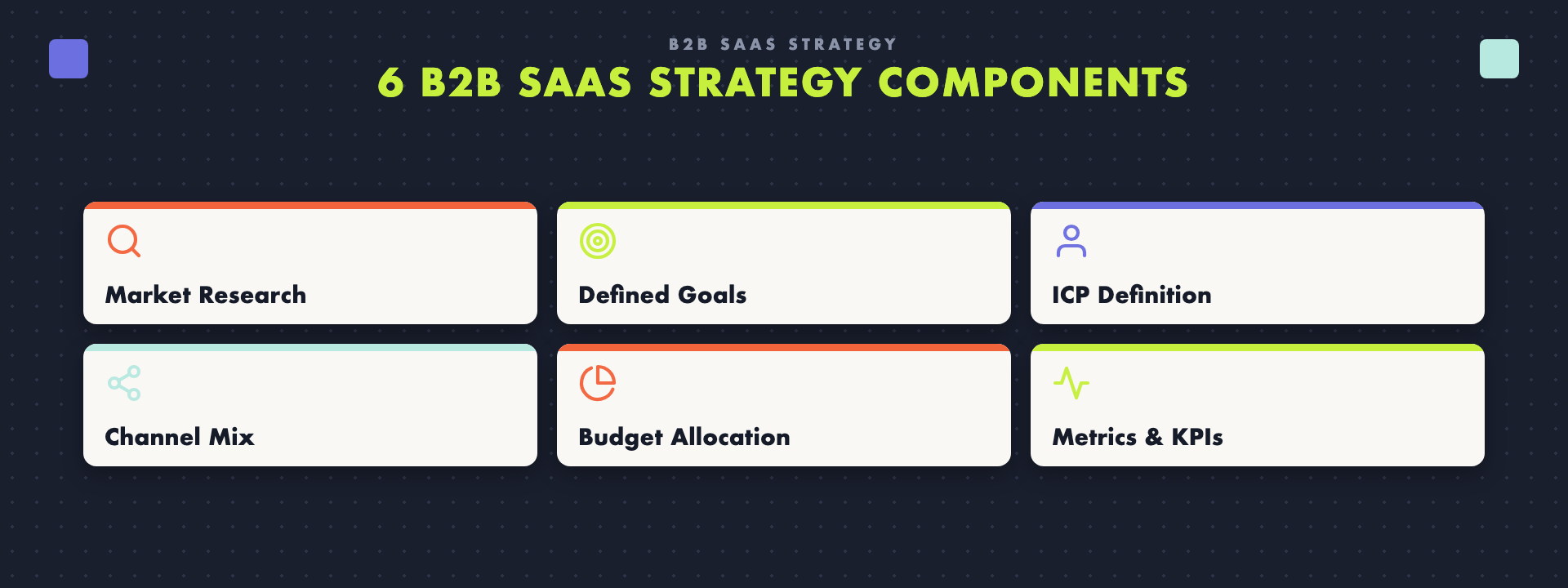
- Market research: Market research grounds the strategy by gathering data on audiences, buyer roles, and pain points, which informs every later component.
- Defined goals and objectives: Clear goals turn business needs into targets such as lead volume or conversion rate and guide resource allocation.
- Target market and ICP definition: A defined ICP keeps tactics on customers with the highest lifetime value and shapes messaging and channel choice.
- Strategic marketing channel mix: A planned channel mix orchestrates inbound and outbound across the funnel and speeds pipeline through content, SEO, and paid advertising.
- Budget and resource allocation: Budget and resource allocation fund high-impact activities with the money and people to reach the goals.
- Marketing metrics and KPIs: Metrics track progress against targets like churn rate and lifetime value and feed a loop that refines upstream decisions.
Integrating these components builds a closed-loop system where each element informs the others, which keeps marketing efficient, measurable, and able to sustain growth across the lifecycle.
Market Research in B2B SaaS Marketing
Market research in B2B SaaS marketing gathers and analyzes data on customer needs, industry trends, and competition. Market research guides target account selection, value proposition, and go-to-market alignment. Market research needs customer interviews, buying-committee mapping, and a grasp of pain points across decision-makers.
Market research produces a layered view of the market, including high-value segments, committee decision-makers, and specific pain points. These insights define the ICP and keep messaging matched to audience needs. Market research closes the gap between assumptions and reality so marketing goals rest on genuine opportunities.
Marketing Goals and Objectives in B2B SaaS
Marketing goals and objectives in B2B SaaS drive revenue growth and engagement. The goals guide the full lifecycle from first contact to retention, as listed below.
- Building brand awareness: Raise visibility and recognition in the target market.
- Generating leads: Attract prospects through targeted marketing.
- Acquiring customers: Convert leads into paying customers through effective sales.
- Retaining users: Hold satisfaction and loyalty to cut churn.
- Increasing engagement: Drive active interaction with the product.
Each goal aligns with business objectives and follows SMART criteria: Specific, Measurable, Attainable, Relevant, and Time-based. The alignment keeps marketing focused and raises acquisition, retention, and revenue.
Target Market and ICP Definition in B2B SaaS
Defining the target market and Ideal Customer Profile (ICP) in B2B SaaS keeps marketing on the most promising prospects. The target market names the segment of businesses that gain most from the product by industry, company size, and revenue potential. The definition aligns strategy with business objectives and keeps resources efficient.
The ICP details the ideal company through firmographic data such as industry and size, plus psychographic insight like pain points and buying triggers. The ICP guides effort toward organizations with the highest chance of conversion and retention, which raises return on investment.
Both the target market and ICP let a B2B SaaS company segment its audience, avoid poor-fit leads, and match messaging to the ideal organization's needs. The segmentation makes campaigns more targeted, which raises conversion and sustains growth.
Marketing Channel Mix for B2B SaaS
The marketing channel mix for B2B SaaS selects channels that reach and engage business customers across the buying path. A strong mix balances broad-reach channels with targeted approaches to raise pipeline generation and drive recurring revenue. Channel selection accounts for multi-stakeholder committees and engages decision-makers at each evaluation stage.
Short-term channels deliver fast impact: paid search captures demand from search queries, and outbound marketing engages enterprise accounts through personalized outreach. Medium-term channels build over a yearly cycle: paid social raises awareness on platforms like LinkedIn, and account-based marketing (ABM) targets high-value accounts with matched campaigns. Long-term channels compound: SEO raises organic visibility through optimized content, and content marketing builds thought leadership and nurtures leads over time. A structured mix covers immediate and future revenue without overextending resources and reinforces messaging across stakeholder groups.
Budget and Resource Allocation in B2B SaaS Marketing
Budget and resource allocation in B2B SaaS marketing distributes money and people across channels to raise pipeline generation and ARR. Allocation sets how much to invest in content, SEO, paid acquisition, and ABM by expected return and priority.
Strong allocation balances CAC against LTV for sustainable spend relative to recurring revenue. B2B SaaS companies allocate 35 to 50 percent of revenue to marketing during early growth and shift to 10 to 12 percent at maturity. About 30 to 50 percent of the marketing budget goes to people and tools, such as salaries, martech, and contractors.
Allocation follows a funnel-priority model: about 30 to 40 percent for awareness, 30 to 40 percent for consideration, 20 to 30 percent for conversion, and 5 to 10 percent for retention and expansion, which puts spend where revenue leaks or acceleration is needed. A 10 to 15 percent flexible reserve funds ad-hoc opportunities and tests for mid-period reallocation on performance data. The approach connects to metrics and KPIs that measure whether resources deliver the pipeline coverage and revenue that drive predictable growth.
Marketing Metrics and KPIs in B2B SaaS Strategy
Marketing metrics and KPIs in B2B SaaS strategy measure marketing effectiveness and revenue impact. The metrics show which strategies drive acquisition, retention, and expansion. The key metrics are listed below.
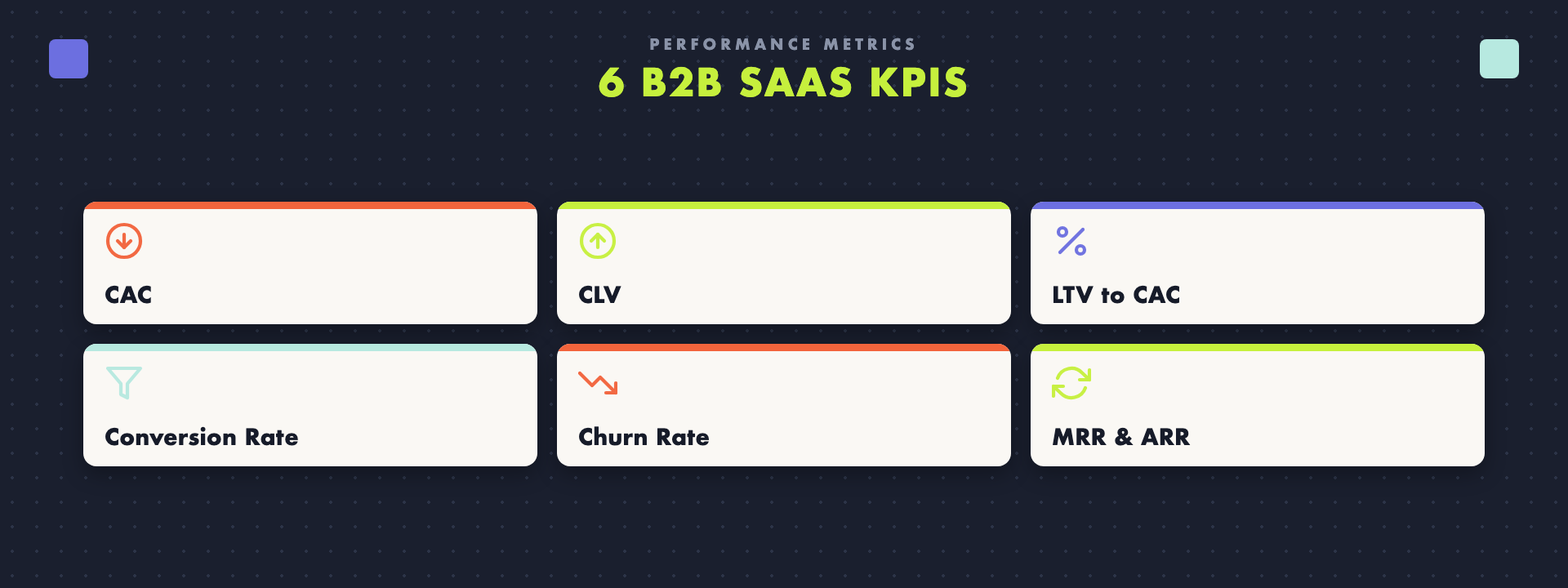
- Customer Acquisition Cost (CAC): The average cost to acquire a customer, which shows marketing spend efficiency.
- Customer Lifetime Value (CLV): The total expected revenue from a customer, which shows long-term profitability.
- CLV:CAC ratio: A healthy ratio runs 3:1 to 5:1, a range David Skok and OpenView identify as the SaaS sweet spot where customer value far exceeds acquisition cost.
- Lead-to-customer conversion rate: The share of leads that become customers, with an average of 5 to 10 percent.
- Marketing Qualified Leads (MQLs): The volume and cost of MQLs, which show lead quality.
- Website conversion rate: Often 2 to 5 percent, which shows how well a site converts visitors.
- Churn rate: A strong rate stays under 5 percent annually, which the Recurly Churn Report puts near a 3.5 percent median for B2B SaaS.
- Monthly and Annual Recurring Revenue (MRR/ARR): The recurring revenue from subscriptions, which supports forecasting.
Together the metrics validate marketing efficiency, forecast earnings, and drive growth across acquisition, revenue, and retention.
What Are the Main B2B SaaS Marketing Channels?
B2B SaaS marketing channels drive pipeline, engage decision-makers, and secure recurring revenue. The channels differ from B2C by serving long cycles and several stakeholders. The primary channels are listed below.
- Content marketing and SEO: The pair builds authority and attracts prospects at the awareness stage through content that educates buyers and builds trust.
- Paid media: Google Ads and LinkedIn Ads target high-intent prospects and speed engagement through matched messages.
- Account-based marketing (ABM): ABM runs personalized campaigns for high-value accounts and reaches several stakeholders during consideration and decision.
- Email and lifecycle marketing: The pair nurtures leads through personalized communication and supports retention and expansion across the path.
Each channel serves a distinct buyer motion and funnel stage, from awareness to decision and retention. The integrated approach fits the complex B2B sales process and drives growth and recurring revenue.
Content Marketing and SEO for B2B SaaS
Content marketing and SEO drive the B2B SaaS pipeline through strategic, educational content assets. The pair serves the top-of-funnel awareness stage and mid-funnel evaluation and targets ICPs who research solutions. The outcome is high-intent traffic that converts into MQLs through optimized landing pages and clear calls-to-action, which builds the foundation for recurring revenue by establishing trust and lowering buyer risk early.
Content marketing connects to recurring revenue by removing barriers through social proof, testimonials, and implementation guides, which speeds sales cycle velocity and raises demo request quality. A focus on product-led content and original research over generic blogs keeps SEO influencing purchase decisions and driving measurable revenue.
Demand Generation and Paid Acquisition
Demand generation and paid acquisition work together to build a predictable pipeline and speed revenue. Demand generation builds awareness and interest through targeted campaigns, while paid acquisition delivers immediate visibility.
Demand generation creates interest through content marketing, webinars, and SEO that educate and engage. Nurturing leads with useful content builds recognition and trust, targets early-stage buyers, and holds a steady flow of MQLs to nurture into opportunities.
Paid acquisition uses Google Ads and LinkedIn to reach specific audiences fast and works well for mid-to-late funnel stakeholders such as decision-makers and technical evaluators. Paid acquisition gives immediate exposure, validates messaging and segments, and holds lead flow during growth or expansion. A focus on high-intent keywords and precise targeting raises lead quality and shortens cycles, which grows recurring revenue.
Account-Based Marketing for B2B SaaS
Account-based marketing (ABM) for B2B SaaS targets specific high-value accounts. ABM treats each account as its own market and customizes campaigns for several stakeholders within an organization. ABM aligns sales and marketing to engage decision-makers through personalized content and coordinated messaging across channels. The key features of ABM are listed below.
- High-value targeting: ABM focuses on accounts with the highest revenue potential and long-term value, which keeps resources efficient.
- Personalized campaigns: Each account gets matched messages and content that fit the organization's needs.
- Multi-channel engagement: ABM uses email, social media, and events to reach stakeholders at different levels of the target organization.
- Sales-marketing alignment: ABM relies on close sales and marketing collaboration for consistent messaging and account management.
- Impact on recurring revenue: A focus on high-lifetime-value accounts drives predictable growth and retention.
ABM raises the effectiveness of marketing by focusing on specific, high-value accounts, which drives pipeline impact and supports sustainable growth.
Email, Lifecycle, and Sales Enablement
Email, lifecycle marketing, and sales enablement each hold a role in nurturing relationships and driving recurring revenue.
Email marketing uses behavior data such as opens and clicks to trigger automated sequences that personalize engagement. Email supports the path from onboarding through retention through welcome series, trial education, and post-conversion tips that highlight new features and drive continued use.
Lifecycle marketing delivers targeted content across awareness, consideration, purchase, retention, and expansion. Automating communication on user behavior and account signals raises revenue from existing customers, cuts churn, and surfaces upsell openings, which adds to recurring revenue.
Sales enablement equips sales teams with materials that answer objections and speed decisions. Sales enablement aligns marketing and sales by supplying account executives with collateral, competitive intelligence, and buyer insight matched to each committee member, which converts MQLs into sales-qualified opportunities and supports retention.
Together the channels reinforce each other, shorten time-to-purchase, and expand revenue from current accounts. Mapping lifecycle stages and building behavior-based triggers lets a B2B SaaS company orchestrate automation that delivers value at every stage.
How B2B SaaS Companies Execute Marketing Strategy
B2B SaaS companies execute marketing strategy through in-house teams or outsourced agencies. In-house execution suits companies with set budgets and mature processes, gives direct control, and aligns with company values, though it needs investment in hiring and training. Outsourced execution suits fast-paced startups or companies in rapid growth. An agency supplies specialized skill and faster execution without full-time hires and brings cross-industry insight and set processes that speed time-to-market and pipeline generation.
The choice between in-house and outsourced depends on company stage and priorities. Bootstrapped companies often start lean in-house on high-ROI channels like content marketing. Venture-backed companies may combine both, holding an in-house core while outsourcing specialized functions like paid acquisition. The execution model shapes future agency partnerships for scaling strategy.
Who can help on planning a full marketing strategy for B2B SaaS?
Planning a full B2B SaaS marketing strategy runs through several execution options matched to growth stage and resources. A company chooses among an in-house team, a fractional Chief Marketing Officer (CMO), or a specialized SaaS marketing agency. An in-house team suits organizations with set budgets and mature products and brings deep product knowledge and control. A fractional CMO suits early-to-growth companies that need flexible leadership without a full-time cost. A specialized agency suits scaling companies that need a full-funnel strategy tied to revenue. Each option matches the company's growth needs and budget maturity, which keeps the execution model translating strategy into predictable pipeline and sustainable growth.
Why Choose SaaS marketing agency for B2B SaaS growth?
Choosing a SaaS marketing agency for B2B SaaS growth brings strategic advantages. An agency operationalizes the strategy by aligning positioning with demand generation, conversion, and revenue measurement, which matters across long cycles and technical committees. A general agency runs disconnected campaigns, while a specialized SaaS marketing agency builds a full-funnel system that creates a qualified pipeline and drives ARR growth, CAC payback gains, and LTV expansion.
A SaaS marketing agency owns outcomes for recurring revenue by managing the full growth-compounding system from acquisition through retention and expansion, which turns marketing spend into measurable pipeline and revenue. An agency applies SaaS unit economics, ABM, lifecycle marketing, and RevOps that fit multi-stakeholder decisions in B2B markets. Deep category expertise speeds positioning shifts, holds messaging consistency across personas, and optimizes the channel mix to drive quality MRR, improve LTV:CAC, and cut churn.

About the team
SaaS Marketing Agency Digital Team
The in-house team at SaaS Marketing Agency Digital. We architect growth systems for B2B SaaS companies from Series A through pre-IPO.