The most effective SaaS marketing strategies in 2026 compound recurring revenue through efficient acquisition and retention. A high-impact strategy differs from a tactic because the strategy connects to measurable business outcomes such as Net Revenue Retention (NRR) and the LTV:CAC ratio. A tactic drives isolated traffic, while a strategy addresses the full customer path, from positioning and qualified acquisition to onboarding friction and viral loops, and builds a framework where growth accelerates over time.
The fifteen ranked strategies are listed below.
- SaaS SEO and Programmatic Content
- Content Marketing and Thought Leadership
- Product-Led Growth and Freemium Funnels
- Demand Generation Across Channels
- Paid Search and Paid Social Advertising
- Account-Based Marketing for Enterprise Deals
- Email and Lifecycle Marketing
- Conversion Rate Optimization
- Community, Influencer, and Partnership Marketing
- Customer Marketing for Retention and Expansion
- Sales Enablement and Marketing Alignment
- Webinars, Events, and Virtual Field Marketing
- Video Marketing and Product Storytelling
- Marketing Analytics and Attribution Modeling
- AI-Powered Personalization and Marketing Automation
The strategies shift by business model: PLG dominates self-serve markets, while ABM and sales-led motions suit committee-driven enterprises. Prioritization depends on growth stage, from early-stage content and product conversations to growth-stage advocacy and community building. Aligning strategy effectiveness from the list through clear criteria to prioritization shows SaaS leaders which motions suit specific market constraints and resource levels, so the chosen mix fuels compounding growth rather than vanity metrics.
1. SaaS SEO and Programmatic Content
SaaS SEO and programmatic content form a scalable growth strategy for Software as a Service companies. SaaS SEO drives subscriber acquisition by producing many targeted pages that capture organic traffic. SaaS SEO focuses on long-tail keywords like "CRM for real estate agents" or "Salesforce and Slack integration" and attracts prospects who search for specific solutions.
SaaS SEO moves key SaaS metrics such as CAC and trial-to-customer conversion rate. High-quality, data-driven content lowers CAC and raises conversion. SaaS SEO works hardest in the awareness and consideration stages, where it produces steady traffic, supports retargeting, and drives trial sign-ups and pipeline growth.
2. Content Marketing and Thought Leadership
Content marketing and thought leadership are growth motions in SaaS marketing. The pair builds authority by publishing educational content that marks the brand as an industry expert. Content marketing acquires subscribers by answering problem-based queries with in-depth guides, webinars, and expert insight. Content marketing retains customers by teaching best practices and product capabilities, which reinforces value and cuts churn.
Content marketing moves SaaS metrics like awareness, organic traffic, and engagement, which shape CAC and LTV. Thought leadership speeds enterprise and B2B deals, where committee buying needs extended trust-building. The strategy pays off across early and mid-growth stages by building credibility and compounding value over time. Educational content supports the full funnel and forms the base of durable SaaS growth.
3. Product-Led Growth and Freemium Funnels
Product-led growth (PLG) and freemium funnels drive acquisition by letting prospects feel the product's core value before purchase. PLG makes the product the vehicle for acquisition, conversion, and expansion. PLG lowers acquisition cost through a free tier with feature or usage limits and prompts upgrades when users recognize premium value.
PLG moves the activation rate, the share of signups that reach core functionality. OpenView's Product Benchmarks report puts normal free-trial activation rates in the 20 to 40 percent range, a band strong PLG models work to exceed. PLG pays off during the discovery and diagnostics phase within the first three months, when a team audits the funnel from sign-up to activation and sets baselines for time-to-value and churn. Cutting time-to-value under five minutes moves users from sign-up to product utility fast and raises retention and conversion.
4. Demand Generation Across Channels
Demand generation across channels builds and captures a qualified pipeline by activating many touchpoints across the buyer path. Demand generation acquires subscribers through consistent, high-value messaging on organic and paid channels, including LinkedIn content, search ads, email nurture, webinars, and community partnerships. Reaching accounts at different evaluation stages makes every interaction add to account engagement.
Demand generation moves Marketing Qualified Leads (MQLs) and pipeline velocity by turning interactions into sales-ready opportunities. The payoff lands at the mid-to-late funnel, where coordinated campaigns convert engaged accounts by reinforcing trust and product relevance. Success rests on account penetration, the count of engaged contacts within a target account. Matching the channel mix to average contract value (ACV), sales cycle, and ideal customer profile (ICP) shapes the return.
5. Paid Search and Paid Social Advertising
Paid search and paid social advertising speed acquisition by targeting high-intent buyers on search and social platforms. Paid search captures demand from users who search for solutions and turns intent keywords into leads and trials, including competitor terms, category phrases, and bottom-of-funnel queries. Paid social extends awareness and consideration beyond search through precise targeting by demographics, job titles, behaviors, and engagement signals. Retargeting re-engages visitors who left signup flows or pricing pages.
Paid channels move CAC and MRR by shortening time-to-conversion and scaling the pipeline. Paid channels pay off earliest in the growth stage, once product-market fit holds and unit economics justify spend, and supply immediate traffic and controlled experiments that organic strategies cannot match at speed. Both channels need steady optimization of targeting, bidding, ad copy, and conversion funnels as competition rises and platform algorithms change.
6. Account-Based Marketing for Enterprise Deals
Account-based marketing (ABM) targets high-value enterprise accounts through personalized, multi-touch campaigns. ABM aligns marketing and sales around named companies rather than broad segments. ABM concentrates resources on accounts with the highest revenue potential and longest lifetime value and treats each account as its own market.
ABM acquires enterprise subscribers by coordinating touchpoints across the buying committee. ABM moves pipeline value and average contract value (ACV). ABM pays off during growth and scale-up stages, when enterprise deals justify the higher cost per account, and suits B2B SaaS with annual contract values above $50K.
ABM needs tight sales and marketing alignment to personalize at the account level through intent data, personalized landing pages, direct mail, executive briefings, and account-specific content that answers each company's pain points. ABM returns the highest ROI on accounts that match ideal customer profile criteria, backed by sales development resources that convert engaged accounts into pipeline.
7. Email and Lifecycle Marketing
Email and lifecycle marketing automate communication sequences that nurture leads, activate trial users, and retain customers. Email and lifecycle marketing send personalized messages by user behavior and lifecycle stage and guide users across the SaaS path. The pair moves trial-to-paid conversion, activation rate, and net revenue retention by engaging users at every stage. The strategy works across all growth stages, from lead nurture to expansion campaigns. Segmenting users by product usage and engagement keeps messaging targeted, which drives conversion and cuts churn. Email and lifecycle marketing sustain growth and raise customer lifetime value.
8. Conversion Rate Optimization
Conversion rate optimization (CRO) raises the share of SaaS visitors who complete an action, such as a trial signup or subscription. CRO acquires and retains subscribers by removing friction in user flows and matching messaging to visitor intent. CRO moves visitor-to-trial and trial-to-paid conversion rates and works hardest in the activation and conversion stages, where small gains raise recurring revenue.
CRO raises the value of existing traffic rather than buys new visitors, which makes CRO a cost-efficient growth strategy. CRO tests headlines, call-to-action buttons, form fields, and pricing layouts to find the variants that convert. Session recordings and heatmaps show where prospects drop off and guide targeted fixes. CRO compounds over time, raises the yield of every later marketing effort, and improves the CAC to LTV ratio.
9. Community, Influencer, and Partnership Marketing
Community, influencer, and partnership marketing build trust and reach by placing a SaaS product inside the ecosystems where target customers gather. The strategy acquires subscribers through endorsements and shared value and retains users through community and ongoing support. The strategy moves the activation rate and net revenue retention (NRR) by speeding users to their first "aha" moment and raising loyalty through peer validation.
The strategy pays off in the middle and bottom of the funnel, generates qualified leads through community participation, and drives long-term revenue through advocacy and partnership expansions. Community marketing drives peer-to-peer engagement and user-generated advocacy. Influencer marketing aligns with industry experts who hold the audience's attention, favoring experts over celebrities for B2B SaaS. Partnership marketing extends product utility and market access through integrations and co-marketing that embed the product into existing workflows.
10. Customer Marketing for Retention and Expansion
Customer marketing for retention and expansion grows value from existing subscribers rather than new ones. The strategy cuts churn and raises net revenue retention by engaging current users through communication and value realization. The strategy moves NRR, customer lifetime value (LTV), and expansion MRR by turning satisfied users into advocates and power users.
For retention, the strategy uses proactive engagement, personalized support, and value reinforcement. Retention starts by stating the value proposition so customers understand their milestones. Segmenting by behavior and health scores matches retention effort to individual needs, and faster onboarding moves users to their "aha" moment for higher satisfaction and loyalty.
For expansion, usage data and lifecycle stages surface upsell and cross-sell openings. Segmented nurture campaigns, in-app messaging, and education programs guide users toward more features. Touchpoints such as onboarding milestones and renewal windows surface expansion when customers are ready. The strategy works best where lifetime value far exceeds acquisition cost, in usage-based and tiered pricing models. Strong support and relationships build a retention flywheel that protects economics after acquisition and drives expansion.
11. Sales Enablement and Marketing Alignment
Sales enablement and marketing alignment unify sales and marketing to raise deal velocity and conversion. The strategy hands sales teams marketing-qualified leads with context, battle cards, and content that answer objections and shorten cycles. Sales enablement moves sales cycle length and deal conversion rate by closing gaps between lead generation and revenue through shared data and training.
The strategy pays off during growth and scale-up, when deal volume rises and the cost of misalignment compounds. Sales enablement supplies targeted collateral such as case studies and demo scripts matched to personas and use cases. Service-level agreements between marketing and sales define lead quality thresholds and feedback loops for optimization. The alignment matters most in B2B and enterprise SaaS, where committees and long cycles demand coordinated engagement across stakeholders.
12. Webinars, Events, and Virtual Field Marketing
Webinars, events, and virtual field marketing create high-intent engagement through live and virtual experiences that compress the consideration cycle and speed pipeline velocity. Interactive formats such as product demos, industry workshops, and customer panels place a SaaS product in a problem-solving context rather than a sales pitch.
The strategy acquires qualified leads by engaging prospects with useful content that then informs segmentation and follow-up. Webinars and events trade value both ways: attendees gain tactical knowledge, and marketers capture signals like questions asked and features explored. The strategy moves pipeline conversion and raises average contract value by qualifying intent before sales engagement and building committee consensus.
Webinars, events, and virtual field marketing work best in the mid-to-late funnel for B2B and enterprise SaaS, where educational touchpoints lower perceived risk and speed closure. Success rests on follow-up architecture. The event generates interest, but structured nurture sequences, personalized outreach on engagement data, and sales hand-off protocols decide whether registrants convert. The system moves prospects across the full path from awareness to advocacy.
13. Video Marketing and Product Storytelling
Video marketing and product storytelling grow SaaS by turning complex features into visual narratives. The strategy acquires subscribers by showing product value through explainer videos, product demos, and customer success stories. Video moves engagement and conversion, above all at the decision stage.
Video retains users through onboarding videos, feature announcements, and educational content that cut time-to-value. Video pays off in product-led growth models where self-service buyers need clear functionality. Video works well in complex B2B scenarios where visual proof speeds decisions. YouTube, LinkedIn, and landing-page video extend reach and raise signups.
14. Marketing Analytics and Attribution Modeling
Marketing analytics and attribution modeling measure performance across touchpoints to optimize spend and find the channels that drive revenue. The strategy acquires subscribers by moving budget toward high-performing channels and retains them by finding touchpoints that predict long-term value. Attribution modeling moves CAC and the LTV:CAC ratio by replacing last-click attribution with multi-touch models that account for the non-linear SaaS buyer path across content, paid channels, product trials, and sales.
The strategy pays off across all stages and becomes needed at scale, when monthly spend passes six figures and attribution complexity makes intuition unreliable. Strong analytics capture the full path from anonymous visitor through many touchpoints to closed subscription and show which investments drive recurring revenue over vanity metrics. Multi-touch attribution accounts for long cycles and committee buying in B2B SaaS, where one customer touches many assets before converting.
15. AI-Powered Personalization and Marketing Automation
AI-powered personalization and marketing automation use machine learning to build customized experiences. The strategy adapts content in real time on user behavior, intent signals, and context. AI-powered personalization raises conversion and customer lifetime value (LTV).
AI-powered personalization acquires and retains subscribers by customizing emails, landing pages, and product interfaces so messages match individual needs, which lowers churn through relevant content. AI-powered personalization raises conversion and retention through timely, personalized experiences that raise satisfaction and engagement.
AI-powered personalization pays off most at the scale stage, when strong data infrastructure supports AI-driven insight and hyper-personalization across the customer path, which lets a SaaS company serve large volumes while keeping interactions personal. Success needs a data audit and investment in AI-ready infrastructure, plus cross-department work for a unified customer view. Done well, AI-powered personalization lifts revenue by 5 to 15 percent and marketing ROI by up to 30 percent, according to McKinsey.
What are SaaS marketing strategies?
SaaS marketing strategies are systematic, long-term approaches that acquire, activate, retain, and expand a subscription customer base while improving the LTV:CAC ratio. One-off tactics produce isolated results, while strategies are repeatable frameworks that compound over time and build predictable revenue through coordinated work across channels and lifecycle stages. Strategies integrate product experience, content distribution, demand generation, and customer success into growth motions that fit recurring revenue.
SaaS marketing strategies differ from tactics in scope, timeframe, and compounding effect. A tactic launches a single LinkedIn ad or publishes one comparison post, while a strategy connects those tactics into a system, such as a content engine that builds SEO authority, nurtures leads through email, and converts trials through product-led onboarding. Tactics deliver point-in-time results, while strategies build durable advantages that improve efficiency at scale. Tactics answer "what should we do this week," while strategies answer "how do we grow recurring revenue over 12 to 36 months."
The distinction matters when connecting strategy to measurable goals. SaaS marketing strategies serve four objectives: acquisition (new users into the funnel), activation (trial or freemium users to paid), retention (lower churn and held subscriptions), and expansion (more revenue per customer through upsells and cross-sells). Each strategy weighs these goals by growth stage, business model, and market position, but all improve the ratio of lifetime value to acquisition cost for capital-efficient growth in MRR and ARR.
What are the main goals of SaaS marketing?
The main goals of SaaS marketing are acquisition, activation, retention, and expansion. Acquisition attracts qualified prospects through channels like SEO and paid advertising. Activation moves new users to value fast so they convert from trial to paid. Retention keeps subscribers engaged and cuts churn through lifecycle marketing and customer success. Expansion grows revenue from existing customers through upsells and cross-sells.
These goals drive recurring revenue growth. Acquisition and activation lower CAC and speed time-to-value, while retention extends customer lifetime and raises LTV. Expansion grows revenue from existing relationships without a matching rise in acquisition spend. Together, the goals form the foundation of a go-to-market strategy and guide marketing toward compounding growth across the lifecycle.
What are the most effective go-to-market strategies for SaaS?
The most effective go-to-market (GTM) strategies for SaaS are product-led growth (PLG), sales-led GTM, and hybrid models, which match distribution models to market and buyer behavior. Product-led growth (PLG) drives user adoption through free trials, freemium tiers, and self-service onboarding and suits products with low complexity and broad appeal. Sales-led GTM uses direct sales and structured demos and suits complex, high-value solutions that need customization and executive buy-in. Hybrid models combine both, using PLG to generate leads and sales teams to close enterprise deals.
Each GTM strategy suits a different market and shapes which marketing strategies return. PLG excels for SMBs, prosumer markets, or developer tools where viral growth and low friction win. Sales-led approaches dominate enterprise software and regulated industries, where long cycles justify higher acquisition cost. Mid-market companies often run hybrid strategies to balance product virality with sales capacity. The GTM strategy that fits your market and stage sets the marketing strategy hierarchy.
The bridge from GTM to execution is that B2B SaaS marketing must fit committee buying and long evaluation, which asks for ROI proof across several decision-makers with deeper content and different nurture than consumer approaches.
What are the most effective B2B SaaS marketing strategies?
B2B SaaS marketing strategies handle committee-based buying in enterprise and mid-market. The strategies educate several stakeholders, build trust, and prove ROI to technical, financial, and executive decision-makers. The strongest strategies are listed below.
- Account-based marketing (ABM): ABM personalizes campaigns to high-value accounts and aligns sales and marketing on messages that fit each stakeholder's pain points, treating an account as a market of one.
- SEO-driven content: SEO-driven content raises visibility and authority by answering the needs of technical evaluators and economic buyers and builds trust through case studies and ROI calculators.
- Demand generation across channels: Demand generation nurtures prospects from awareness to consideration through outreach and community and engages the full buying group so no single-threaded deal stalls.
Committee buying shapes the B2B mix because a purchase involves several personas with distinct concerns. Strategies deliver persona-specific messaging, full product education, and cross-department consensus. Aligning marketing and sales into one experience speeds deal velocity and raises average deal size, which sits at the core of a complete B2B SaaS marketing strategy.
B2B vs B2C SaaS Strategy Differences
B2B and B2C SaaS strategies differ in their approach to the buying process. B2B strategies serve committee decisions and engage several stakeholders across departments through ABM, sales enablement, and enterprise content that answers technical requirements and ROI. The B2B cycle runs longer, from weeks to months, because it builds consensus among decision-makers.
B2C strategies favor self-serve conversion and individual activation through frictionless onboarding, viral growth mechanics, and conversion rate optimization that move users from trial to paid fast. The B2C cycle runs shorter, from instant decisions to a few days, since individual buyers decide on immediate needs and experience.
Both models share goals of strong user experience and retention. High-quality content, clear value propositions, and customer success raise lifetime value and cut churn in both. B2B strategies add thought leadership, webinars, and partnerships, while B2C strategies add paid social retargeting, influencer marketing, and product-led funnels. Each model needs its own strategies to show value and reduce friction on the user path.
What Makes a SaaS Marketing Strategy Effective in 2026?
An effective SaaS marketing strategy in 2026 improves the LTV:CAC ratio at scale, which means more lifetime value from each customer at a lower acquisition cost. The strategy connects acquisition, activation, and retention to compound recurring revenue. The strategy targets high-intent demand over broad traffic, matches content to buyer stages to build trust early, and lowers CAC through data-led channel prioritization.
Several criteria qualify a strategy as effective. First, the strategy is repeatable and scalable and holds results as budget grows. Second, the strategy matches how buyers discover, evaluate, and purchase software rather than forces a set funnel. Third, the strategy compounds, as SEO content drives traffic months after publication and retained customers refer others. Fourth, the strategy fits the business model, since a $10-per-month self-serve tool differs from a $100K enterprise solution. Fifth, the strategy is measurable, since without clear attribution to pipeline, revenue, or retention, promising tactics stay unvalidated.
The criteria connect to business-model differences. The same strategy runs with different emphasis, channels, and metrics for a product-led motion, a sales-led enterprise model, or a hybrid.
How SaaS Marketing Strategies Differ by Business Model
SaaS marketing strategies differ by business model because the model sets acquisition and retention tactics. In a product-led growth (PLG) model, the product drives acquisition, activation, retention, and expansion. PLG uses free trials or freemium funnels so users feel value before purchase and favors community building, content marketing, and in-app onboarding for fast self-serve adoption.
A sales-led growth (SLG) model relies on direct sales and relationships to build pipeline and suits complex products where a sales team guides the customer. SLG favors ABM, sales enablement, and executive relationships to handle committee buying. Both models compound recurring revenue, but PLG puts the product experience first, while SLG puts skilled selling through dedicated teams first.
The business model sets how customers discover, evaluate, and buy. A low-touch, self-serve product at $20 per month needs different strategies than an enterprise platform with six-figure contracts. The model sets which channels lead, how hard to invest at each funnel stage, and where to concentrate resources for the strongest return.
PLG vs Sales-Led Strategy Priorities
Product-led growth (PLG) and sales-led growth (SLG) favor different marketing approaches. PLG focuses on self-service activation and in-product engagement through freemium funnels, product-led SEO, and conversion rate optimization, which let users feel value before human contact, lower acquisition cost, and scale volume.
SLG focuses on relationships and guided evaluation through account-based marketing, sales enablement, and demand generation for complex buying. SLG nurtures relationships and supplies education for several stakeholders. PLG optimizes friction-free trials, while SLG builds trust and coordinated touchpoints. The distinction guides the strategy mix by product complexity and annual contract value.
How to Prioritize SaaS Marketing Strategies by Growth Stage
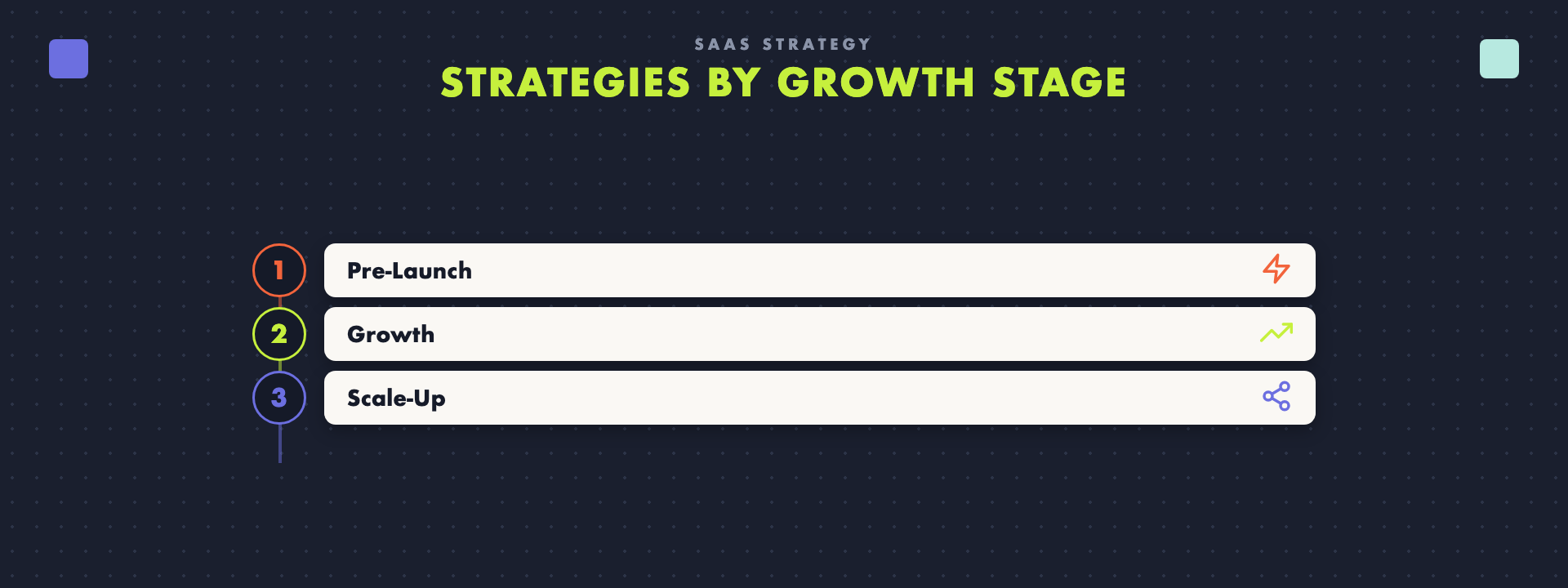
Prioritizing SaaS marketing strategies by growth stage matches company maturity and resources to the strategies that fit each stage. In the pre-launch or idea stage, a company favors strategies that need time over capital, such as content marketing, SEO, and direct outreach, which build awareness without heavy paid spend.
During the growth stage, focus shifts to scalable acquisition. Paid media, LinkedIn content, and refined email nurture expand the customer base and market presence. The stage gains from strategies that scale to a wider audience while holding cost efficiency.
In the scale-up stage, emphasis moves to retention and expansion. Advanced lifecycle marketing and conversion rate optimization (CRO) raise lifetime value against acquisition cost. The stage needs coordinated ABM and AI-powered personalization to sustain growth and hold retention. Matching strategies to each stage builds a marketing plan that evolves from establishing trust to scaling revenue.
What Is the best SaaS Marketing Strategy for Pre-Launch and Idea Stage?
The best SaaS marketing strategies for the pre-launch and idea stage are founder-led content marketing, a targeted waitlist, and direct outreach to early adopters, which prioritize validation and audience building. Founder-led marketing uses the founder's insight to engage users on LinkedIn and Twitter, builds trust, and refines the value proposition through real conversations.
A targeted waitlist identifies and engages early adopters who supply feedback, which collects insight into customer needs for product refinement. Direct outreach to early adopters validates the concept before scaling. These strategies fit pre-launch budgets and lay the groundwork for activating the waitlist and launching the core product.
What Is the best SaaS Marketing Strategy for the Growth Stage?
The best growth-stage strategy is multi-channel demand generation. The approach leads with high-intent SEO and content marketing alongside targeted paid search and social advertising to speed pipeline and conversion. These channels move users to their first "aha" moment fast, shorten payback, and raise trial-to-paid conversion.
In the growth stage, running inbound and outbound across the full funnel scales acquisition while holding the 3:1 LTV:CAC ratio that David Skok established as the minimum for viable SaaS unit economics. The strategy pays off in conversion and retention through product-led content such as comparison pages and implementation guides that influence closed-won revenue. Lifecycle marketing drives retention and expansion and aligns SEO and content with buyer stages to capture high-intent demand.
What Is the best SaaS Marketing Strategy for the Scale-Up Stage?
At the scale-up stage, the best strategy is multi-channel orchestration. The approach expands successful channels and integrates account-based marketing (ABM) and customer marketing to drive net revenue retention (NRR). Focus moves from pure acquisition to raising lifetime value against acquisition cost so revenue grows faster than cost.
ABM targets high-value enterprise accounts and lets teams run personalized campaigns with tight sales-marketing alignment to close large deals. Lifecycle and customer marketing cut churn and fuel expansion revenue by retaining and growing the existing base, which costs less than new acquisition. CRO raises efficiency across the funnel by improving user flows and reducing friction, which turns small gains into revenue.
These strategies fit the scale-up stage by holding capital efficiency while accelerating growth and stay measurable, repeatable, and efficient at rising volume.
How to Combine Strategies Into a Multi-Channel SaaS Marketing Plan
Combining strategies into a multi-channel SaaS marketing plan builds a system where each tactic reinforces the others across funnel stages. The plan makes strategies complement rather than compete and guides prospects from awareness to retention. The plan sequences strategies to prevent channel cannibalization and aligns content and paid effort to buyer stages, as listed below.
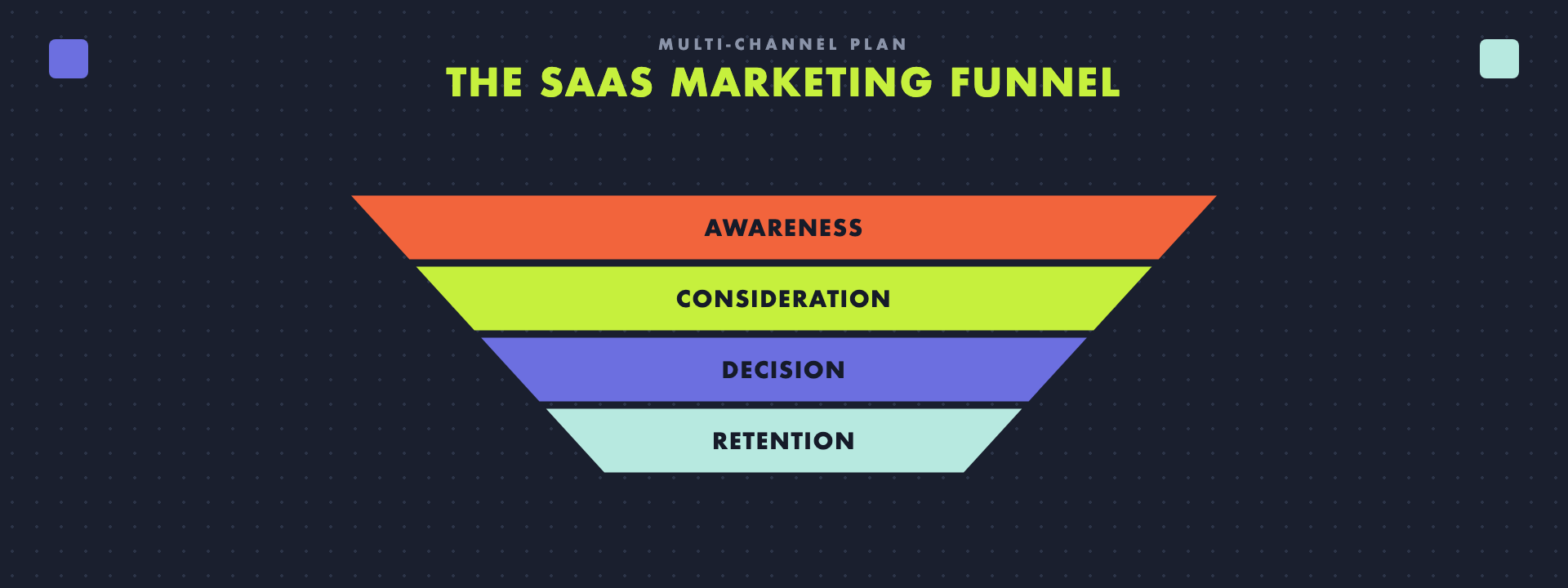
- Awareness stage: Content marketing and SEO build interest through topical authority and organic traffic and mark the brand as a subject authority at the top of the funnel.
- Consideration stage: Paid search and ABM target high-intent prospects and convert qualified leads, while retargeting re-engages interested users who have not converted.
- Decision stage: CRO and product-led growth raise user experience and smooth the move from trial to purchase by reducing friction.
- Retention stage: Email marketing and customer success nurture existing customers, build loyalty, and cut churn, with lifecycle campaigns matched to hold engagement.
Integrating these strategies builds a smooth customer path that raises lifetime value while lowering acquisition cost. The structure connects planning to agency execution so every effort adds to consistent, scalable growth.
Who can help on planning your SaaS marketing strategy?
Planning a SaaS marketing strategy runs through several execution options: an in-house team, specialized consultants, or a dedicated SaaS marketing agency. Each option suits a different growth stage, as listed below.
- In-house teams: An in-house team suits scale-up and mature companies with set budgets and brings deep product knowledge and cultural alignment, though it needs investment in hiring and training.
- Specialized consultants: A consultant suits growth-stage companies that need strategic guidance without full-time hires and supplies frameworks for specific challenges while internal teams execute.
- SaaS marketing agencies: An agency suits pre-launch and early growth, brings cross-functional skill and set processes without full-time overhead, and runs several channels at once.
The choice depends on the company's stage, resources, and go-to-market complexity. Early-stage companies gain from agency skill, while later-stage companies may prefer in-house teams backed by agencies for specific capabilities.
Why choose SaaS marketing agency for Full SaaS marketing strategy planning?
Choosing a SaaS marketing agency for full strategy planning brings execution and specialized skill. As a SaaS marketing agency, we plan and operationalize strategies by joining data insight with cross-channel execution, so ABM, AI-powered personalization, and lifecycle email run as one system. We bring the infrastructure to measure LTV:CAC gains and improve your payback period. By aligning marketing and sales, we sequence channels to prevent cannibalization while reinforcing the funnel from awareness to retention.
The strategies that gain most from our outside skill need specialized knowledge or sustained discipline. Programmatic SEO and content systems need authority building and AI optimization. ABM needs tight sales alignment and personalized orchestration. CRO needs behavioral analytics and testing frameworks. Attribution modeling connects non-linear paths to revenue. We speed strategies where your internal teams lack capacity, in founder-led content distribution, integration partnerships, and churn reduction, which frees your team to focus on product and customer success while we build the revenue engine.
What are the latest SaaS marketing trends?
The latest SaaS marketing trends in 2026 use advanced technology and integrations to drive growth. AI agents automate marketing workflows for efficiency and precision. Hyper-personalization, powered by predictive customer data, matches experiences to individual needs and raises engagement and retention. Generative Engine Optimization (GEO) optimizes content for AI-driven search and improves visibility. AI in security and sustainability supports real-time threat detection and eco-friendly operations that match modern buyer values. These trends re-anchor SaaS marketing toward compounding growth by weighting retention and expansion over acquisition alone.

About the team
SaaS Marketing Agency Digital Team
The in-house team at SaaS Marketing Agency Digital. We architect growth systems for B2B SaaS companies from Series A through pre-IPO.