Choosing a SaaS marketing agency means aligning the agency's expertise with your growth stage, budget, and channel needs. Selecting the wrong partner wastes resources and stalls the sales pipeline, so the decision depends on a clear understanding of what a SaaS marketing agency is, defined selection criteria, and a step-by-step evaluation. The benefits of hiring a specialized agency, the timing of engagement, the questions to ask, and the warning signs all shape the choice.
Agency-fit starts with preparation: defining goals and constraints. Preparation then moves into evaluating the agency's experience, case studies, and processes, and ends in a confident decision. A structured path from preparation to evaluation to decision helps you avoid mismatches that derail SaaS growth.
What is a SaaS marketing agency?
A SaaS marketing agency is a specialized firm that markets software-as-a-service companies exclusively. A SaaS marketing agency brings expertise in subscription business models, recurring revenue optimization, and product-led growth. A SaaS marketing agency provides retainer-based services that span strategic positioning, demand generation, SEO, content marketing, paid acquisition, conversion rate optimization, lifecycle marketing, and analytics reporting.
The attribute that separates a SaaS marketing agency from a generalist firm is specialization in subscription dynamics. A SaaS marketing agency understands customer lifetime value (LTV), churn mechanics, monthly recurring revenue (MRR) optimization, product-led growth motions, and the long buying cycles of B2B SaaS. This specialization produces value because a SaaS marketing agency speaks in the metrics that decide growth: customer acquisition cost (CAC), CAC payback period, expansion revenue, and pipeline velocity. A SaaS marketing agency designs campaigns with a clear line of sight to revenue rather than impressions or clicks.
What is SaaS marketing?
SaaS marketing is the practice of acquiring and retaining customers for subscription-based Software-as-a-Service products. SaaS marketing builds long-term customer relationships rather than single transactional sales. SaaS marketing uses lifecycle marketing and retention tactics to produce predictable recurring revenue. SEO, content marketing, and email campaigns nurture prospects and reduce churn. The subscription model demands a firm grasp of customer lifetime value and asks marketers to optimize the customer path from awareness through renewal. A SaaS marketing agency specializes in these techniques and supplies expertise that generalist agencies lack.
What makes a SaaS marketing agency different from a general agency?
A SaaS marketing agency differs from a general agency in its grasp of recurring revenue models and product-led growth. A SaaS marketing agency speaks in SaaS-specific metrics such as Customer Acquisition Cost (CAC), Lifetime Value (LTV), and pipeline velocity, which drive subscription models. A general agency often reports broad metrics like impressions, while a SaaS marketing agency reports metrics that move revenue and retention. This focus lets a SaaS marketing agency build targeted campaigns that guide prospects through long buying cycles, optimize product-led growth, and tie marketing activity to revenue.
What are the key criteria for choosing a SaaS marketing agency?
Choosing a SaaS marketing agency starts with a set of criteria that match the agency to your business. Defining these criteria first prevents mismatched engagements. The main factors are listed below.
- SaaS-specific expertise: The agency demonstrates fluency in subscription metrics such as Monthly Recurring Revenue (MRR), CAC, LTV, and churn rate.
- Service alignment and capabilities: The agency offers services that match your channel needs, whether SEO, paid acquisition, product marketing, or conversion optimization.
- Data transparency and reporting: The agency connects marketing activity to revenue through clear attribution and reporting.
- Cultural and operational fit: The agency's communication cadence, responsiveness, and collaboration style suit your team.
These criteria narrow the shortlist to agencies that deliver measurable revenue outcomes and act as a strategic partner rather than a service vendor.
Your SaaS Growth Stage and Marketing Goals
Your SaaS growth stage and marketing goals form the first criterion for selecting an agency. Each growth stage asks for a distinct marketing approach and resource level. An early-stage startup chasing product-market fit needs flexibility, while a growth-stage company needs structured demand generation and conversion optimization. Defining the growth stage narrows the shortlist and removes agencies that do not fit.
Agencies that match your maturity level deliver stronger strategies. Startups gain from agencies that offer flexible engagement models and foundational programs. Established companies gain from agencies with deep vertical experience and scalable processes. This match lets the agency support your lifecycle phase and marketing objectives.
Your Budget and Expected Marketing ROI Timeline
Your budget and expected ROI timeline form the second criterion for selecting a SaaS marketing agency. SaaS marketing retainers range from $5,000 to $20,000 per month. Early-stage companies find services from $1,000, while enterprises negotiate custom rates for full programs.
For budget allocation, early-stage companies commit 80 to 120 percent of revenue to sales and marketing, while mature firms spend 20 to 35 percent. The allocation reflects the growth stage and keeps the engagement sustainable.
For the ROI timeline, revenue impact takes 90 to 180 days because of long sales cycles. Full ROI appears after more than 12 months of steady optimization. Defining budget and ROI timeline first narrows the shortlist to agencies whose pricing and focus match your financial constraints and growth expectations.
The Marketing Channels Your SaaS Actually Needs
The marketing channels your SaaS needs form the third criterion for selecting an agency. The right channels match where buyers discover and evaluate software. Each growth stage asks for specific channels that drive acquisition and retention.
SEO and content marketing build organic traffic and brand authority over time and return results within 6 to 12 months. Paid acquisition through PPC and social ads produces immediate visibility, tests messaging, and validates demand. Conversion rate optimization and web design raise the yield of existing traffic by improving user experience and the conversion path. Lifecycle and email marketing sustain relationships with prospects and customers and work best once a company holds an established user base. Product marketing sets a SaaS offering apart through value propositions and go-to-market plans, while analytics and reporting measure impact and tie activity to revenue.
Choosing channels depends on the SaaS company's growth stage, target audience, and goals. Agencies that specialize in these channels supply strategies that match business objectives and drive durable growth.
How to Choose a SaaS Marketing Agency Step by Step
Choosing a SaaS marketing agency follows a structured sequence from shortlist to signed engagement. Each step gates the next, as listed below.
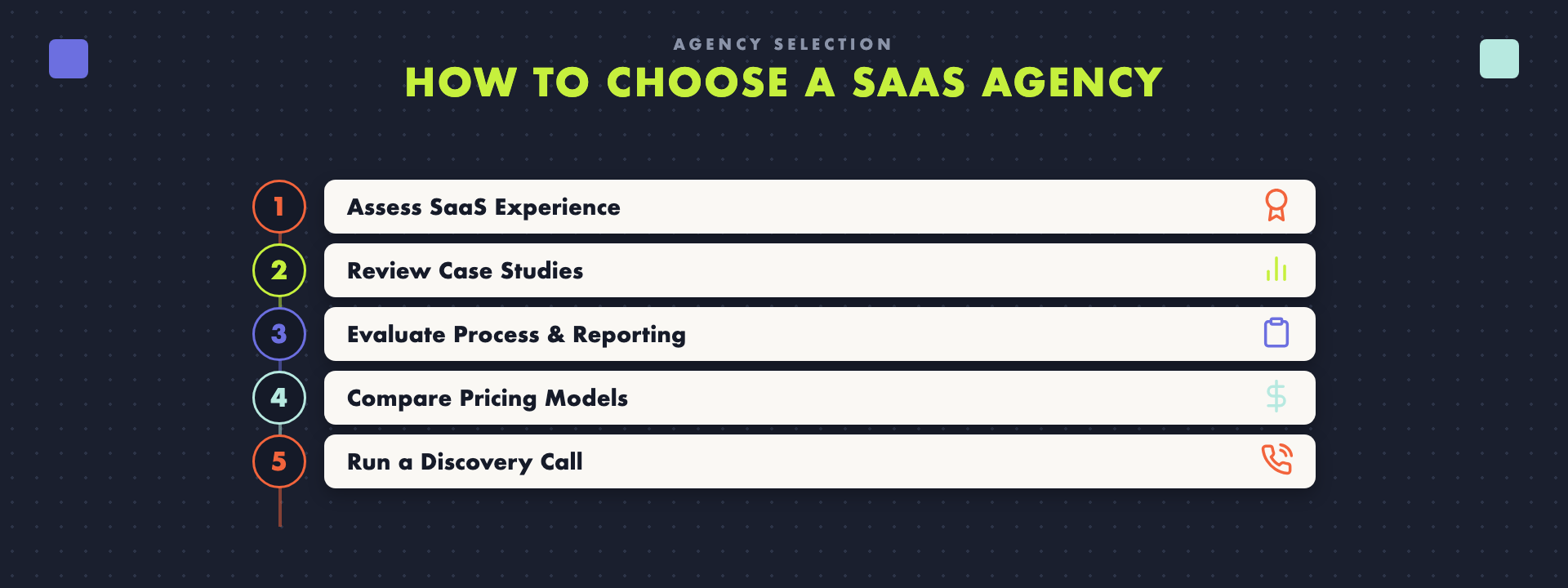
Step 1 — Assess SaaS and Vertical Experience
Assessing a SaaS marketing agency's vertical experience opens the selection sequence. Assessment examines the agency's portfolio for work with businesses at your growth stage, industry, and business model. Evidence of subscription expertise includes case studies that show revenue growth, lower CAC, or higher MRR.
The assessment produces validated case studies, testimonials, and metrics that mark the agency's record with similar SaaS firms. This evidence shows whether the agency's approach matches your needs and lets only proven agencies advance. Step 1 sets the foundation for reviewing detailed case studies in Step 2.
Step 2 — Review Case Studies and Client Results
Reviewing case studies and client results extends the assessment from Step 1. This review examines documented evidence of past performance. Strong case studies show measurable outcomes such as MRR growth, faster pipeline velocity, or lower acquisition cost, which outrank impressions or clicks.
Agencies that present work with recognizable SaaS brands or companies at a similar growth stage show they can produce results in your context. Case studies state the strategic thinking behind the results, not only the tactics. This evidence shows whether the agency advances to the pricing and process evaluation in Step 4.
Step 3 — Evaluate Their Marketing Process and Reporting
Evaluating a SaaS marketing agency's process and reporting confirms alignment with business goals. This evaluation examines strategic planning, execution frameworks, and reporting methods. A strong agency documents its workflows, including sprint cycles, content calendars, and quality checkpoints.
The evaluation weighs transparency and the link between marketing activity and revenue. Evidence includes sample dashboards, campaign timelines, and documented processes that show whether the agency works reactively or strategically. A strong agency tracks leads from Marketing Qualified Leads (MQLs) to Sales Qualified Leads (SQLs) and closed-won deals. This transparency confirms readiness before the pricing comparison.
Step 4 — Compare Pricing and Engagement Models
Comparing pricing and engagement models follows the process evaluation. This comparison shows whether the agency offers a flat monthly retainer, a percentage of ad spend, or a hybrid of base fee and performance incentives. Most SaaS-specific agencies in 2026 run a flat retainer, the model 78 percent of agencies prefer for its budget stability.
Pricing assessment weighs the scope of work: senior strategy, channel execution, creative production, and reporting tied to revenue. Small and mid-sized businesses meet monthly retainers of $3,000 to $10,000, while enterprise engagements run $15,000 to $50,000 by complexity and annual recurring revenue (ARR) tier. This step confirms that the engagement model fits your budget and ROI timeline and surfaces hidden costs for tools or ad spend.
Step 5 — Run a Discovery Call and Assess Team Fit
Running a discovery call and assessing team fit closes the selection sequence. This call shows how well the agency understands your SaaS challenges and whether the approach matches your goals. On the call, present your growth stage, marketing objectives, and obstacles, then watch how the agency asks about your buyer journey, retention metrics, and competitive position.
The discovery call also reveals communication style and team compatibility. The agency's responsiveness, handling of SaaS terminology, and custom proposals signal fit. Agencies that ask about your sales process, churn rate, and acquisition strategy show deeper expertise. This step confirms whether the agency acts as a strategic partner or a tactical vendor.
How to choose a b2b SaaS marketing agency
Choosing a B2B SaaS marketing agency adds criteria for the demands of B2B buying. A B2B SaaS marketing agency handles buying committees and long sales cycles and builds content and campaigns that reach technical evaluators and C-suite executives. A B2B SaaS marketing agency also runs B2B-specific motions such as product-led growth and pipeline acceleration.
A B2B SaaS marketing agency reads finance-driven metrics like CAC and LTV and builds predictable lead-generation systems that combine SEO, content marketing, and paid demand generation — the pillars of a strong B2B SaaS marketing strategy — for a steady flow of high-intent leads. Case studies show measurable gains in lead quality, pipeline, and revenue. Cultural fit and clear communication with internal teams round out the criteria.
The selection process for a B2B SaaS marketing agency weighs proven expertise, predictable systems, and full-funnel strategies backed by revenue-focused reporting on pipeline and retention. Prioritizing partners with demonstrated SaaS specialization matches the choice to growth-stage needs and connects to startup SaaS growth.
How to choose a SaaS marketing agency for startups
Choosing a SaaS marketing agency for startups focuses on criteria for early-stage needs. Startups work under tight budgets and need flexible, adaptable programs. An agency for startups works within budgets of $2,000 to $5,000 per month, which lets a startup test and pivot fast so each marketing dollar moves the company toward product-market fit.
Beyond budget, a startup prioritizes agencies with proven early-stage experience. Early-stage experience covers launching and scaling a business without a full marketing infrastructure. A strong agency applies lean marketing principles, works with founders, adapts to rapid change, and builds foundational systems that scale. The right partner accelerates growth with specialized expertise that suits a resource-constrained business.
What are the benefits of hiring a SaaS marketing agency?
Hiring a SaaS marketing agency delivers advantages over in-house teams or freelancers, as listed below.
- Immediate access to expertise: A SaaS marketing agency supplies subscription-metric and product-led-growth knowledge without a generalist's learning curve.
- Faster time to results: A SaaS marketing agency deploys proven playbooks and channel skill, cutting ramp-up from months to weeks.
- Scalable execution capacity: A SaaS marketing agency flexes across SEO, paid acquisition, and lifecycle marketing without the risk of full-time hires.
- Strategic leadership and accountability: A SaaS marketing agency supplies guidance and data-driven decisions with reporting tied to revenue.
- Access to premium tools: A SaaS marketing agency maintains analytics, reporting, and optimization tools that would cost a single company more to license.
- Cost savings: Outsourcing avoids the annual cost of a full in-house team while keeping expert execution.
These benefits shorten sales cycles, raise lead quality, lower acquisition cost, and build repeatable systems for predictable revenue expansion.
Why choose a specialized SaaS marketing agency?
Choosing a specialized SaaS marketing agency brings advantages over a generalist agency. A specialized agency understands SaaS metrics such as MRR, CAC, and LTV and builds strategies that fit subscription models. A specialized agency runs refined playbooks for long sales cycles and technical buying committees, so each effort adds to pipeline velocity and revenue. Niche knowledge returns higher ROI through faster execution and a shorter learning curve. The decision to hire a SaaS digital marketing agency follows the recognition that growth stage, budget, and channels need expert alignment.
When to hire a SaaS marketing agency?
Hiring a SaaS marketing agency makes sense when growth indicators meet your internal capacity. The right time arrives when monthly recurring revenue (MRR) sits between $50,000 and $100,000 and organic growth begins to plateau. At that point, an agency cost of $5,000 to $20,000 per month stays manageable against the return.
Operational triggers also signal the moment. An in-house team that lacks SEO, paid acquisition, or conversion skill fills the gap faster through an agency than through full-time hires. A marketing leader buried in execution, a funding round, or a product launch each add urgency. The decision also weighs whether you hold product-market fit and defined customer profiles, since an agency amplifies proven messaging rather than discovers it. A 6 to 12 month runway for channels like content marketing keeps the engagement sustainable.
When not to hire a SaaS marketing agency?
Hiring a SaaS marketing agency comes too early when the foundations for marketing execution are missing. Hold off when product-market fit is unproven or the ideal customer profile (ICP) stays unclear. Without defined positioning and messaging, an agency cannot create demand for a product that lacks validated need. Hold off, too, when MRR sits below $10,000 to $20,000 or core features still shift on user feedback, since resources belong in product development and direct customer contact.
Before engaging an agency, build capabilities in-house. Learn your CAC, LTV, and trial-to-paid conversion. Document buyer personas, their pain points, and the stages where prospects stall. Without an internal marketing leader or product marketing function, strategic recommendations lack context and buy-in. An undefined sales process or missing CRM turns agency-led demand generation into wasted spend.
What questions to ask a SaaS marketing agency before hiring?
Asking the right questions before hiring separates specialists from generalists. Each question reveals SaaS understanding and the ability to produce measurable results, as listed below.
- "What is your experience with SaaS businesses at our growth stage and in our vertical?" A strong answer names client examples and outcomes at similar stages.
- "Can you walk us through case studies with results tied to MRR, CAC, LTV, and churn?" A strong answer shows how campaigns moved subscription revenue.
- "How do you approach our SaaS sales process and reduce churn while raising acquisition?" A strong answer shows command of your sales cycle and retention.
- "What is your process for setting goals, tracking performance, and reporting on outcomes?" A strong answer names KPIs and transparent dashboards.
- "What does your communication cadence look like, and who is our day-to-day contact?" A strong answer proposes regular check-ins and names the team.
What questions to ask a SaaS marketing agency during the first call?
During the first call with a SaaS marketing agency, focused questions test fit and process. The key questions are listed below.
- "What business challenge are you hoping to solve?" The question tests the agency's grasp of your goals.
- "How do you define and measure success?" A strong answer states clear metrics and realistic timelines.
- "What is your approach to our SaaS sales process?" The question reveals command of subscription metrics and onboarding.
- "How do you gather and apply customer feedback?" A strong answer outlines a process for folding feedback into campaigns.
Answers that signal genuine expertise include customized strategies, honest expectations, and a collaborative tone.
How much does a SaaS marketing agency cost?
A SaaS marketing agency costs between $2,500 and $20,000 per month for retainer services. Boutique firms start at $5,000 per month, while enterprise partners exceed $100,000 per month. The common model is a monthly flat retainer, though some agencies offer percentage-of-ad-spend or hybrid models. Cost depends on service scope, agency size, SaaS specialization, and marketing complexity. Hidden costs include ad spend, tools, content production, and development outside the base retainer.
What red flags indicate a bad SaaS marketing agency?
A bad SaaS marketing agency shows warning signs that predict poor engagement, as listed below.
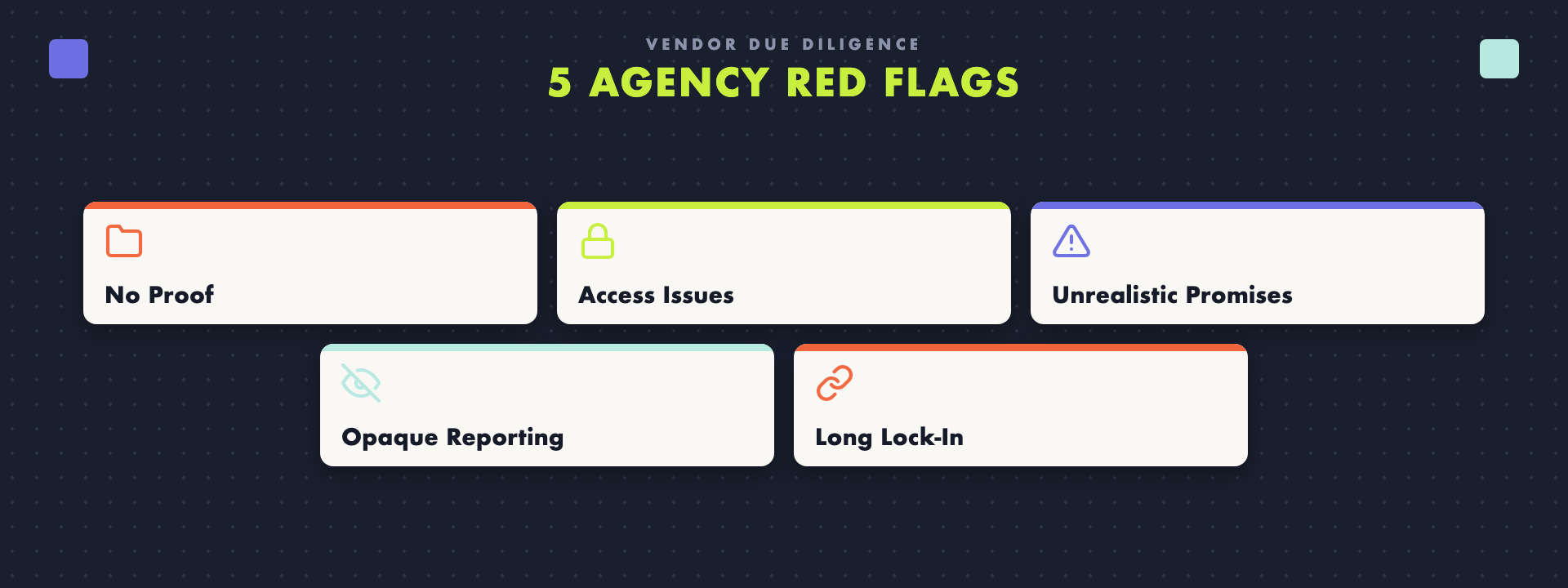
- Missing proof of experience: An agency that withholds case studies or references from similar SaaS businesses may lack the record.
- Ownership and access issues: An agency that keeps you off advertising, analytics, and search console accounts blocks your access to historical data if the partnership ends.
- Unrealistic promises: Guaranteed rankings or quick wins without research point to vanity metrics over revenue.
- Opaque reporting: Vague or late reporting that skips ROI and performance signals poor coordination.
- Long lock-in contracts: A demand for 12-month or longer contracts before results puts the agency's security over yours.
Each warning sign marks a risk of wasted resources, stalled growth, and a failed partnership.
What green flags indicate a good SaaS marketing agency?
A good SaaS marketing agency shows positive signals of competence, as listed below.
- Proven SaaS results: Transparent case studies show real revenue impact and metric gains.
- Fluency in SaaS metrics: The agency discusses LTV:CAC ratios and churn reduction with command.
- Customized strategies: The agency shapes plans around your growth stage and challenges.
- Transparent reporting: Clear attribution ties marketing activity to revenue.
- Strong client references: Testimonials from similar companies confirm sustained value.
- Data-driven decisions: Regular testing and optimization reflect a proactive method.
- Collaborative communication: Defined update cadences and responsive members support the partnership.
- Flexible engagement models: Pilot projects allow validation before full commitment.
- Specialized team skill: Command of SEO, paid acquisition, or lifecycle marketing rounds out the profile.
These signals predict an agency's ability to drive scalable growth and match your revenue goals.
What are common mistakes to avoid when hiring a SaaS marketing agency?
Hiring a SaaS marketing agency asks you to avoid several errors, as listed below.
- Choosing on portfolio alone: Picking an agency on portfolio without verifying SaaS expertise leads to mismatched results.
- Skipping goal alignment: Failing to agree on goals and data-driven KPIs misdirects effort.
- Ignoring unit economics: Overlooking the agency's grasp of CAC and LTV weakens strategic decisions.
- Putting price over ROI: Choosing on price rather than return produces weak outcomes.
- Skipping the discovery phase: Rushing past a pilot or team-fit check invites costly mistakes.
Avoiding these mistakes keeps the agency choice aligned with your growth stage, budget, and channel needs.

About the team
SaaS Marketing Agency Digital Team
The in-house team at SaaS Marketing Agency Digital. We architect growth systems for B2B SaaS companies from Series A through pre-IPO.