The most effective SaaS inbound marketing strategies attract and convert subscribers through owned, compounding assets. Outbound methods interrupt with ads, while inbound marketing pulls in-market buyers by addressing their specific needs and questions. This approach builds durable, low-cost acquisition engines that grow over time. The nine ranked strategies include SEO, blogging, lead magnets, free tools, webinars, email nurturing, product-led growth, community marketing, and conversion optimization. Each strategy feeds a self-reinforcing cycle of organic growth, where owned assets work together to reduce customer acquisition costs and widen market reach.
Inbound marketing carries weight for SaaS companies because it builds sustainable growth loops. Assets such as search-optimized content and educational webinars keep attracting leads long after their creation, while outbound efforts reset with each new campaign. Prioritizing these strategies means focusing on high-intent assets that drive immediate pipeline while investing in long-term content that compounds returns. Sequencing and prioritizing these strategies lets SaaS companies build an inbound engine that delivers ongoing returns, lowers acquisition costs as organic reach expands, and matures owned channels into reliable revenue drivers.
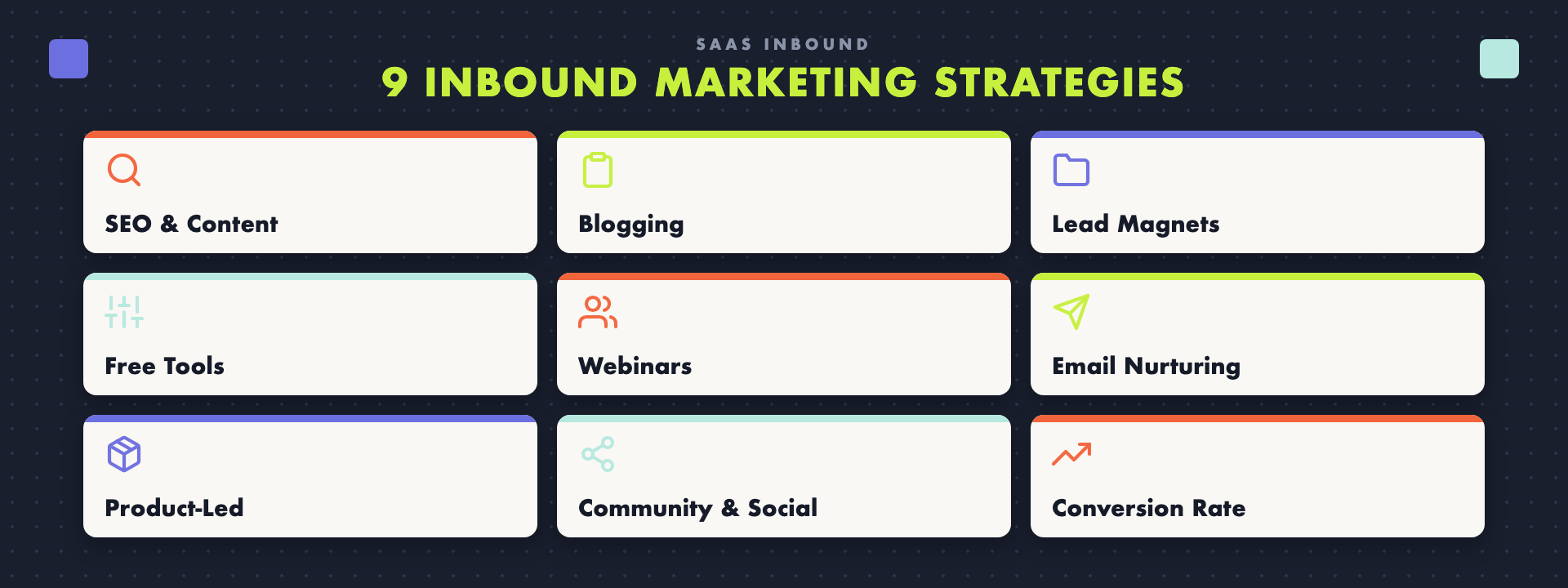
1. SEO and Search-Optimized Content
SEO and search-optimized content are a foundational strategy in SaaS inbound marketing. This approach aligns website content with the search queries prospects use, which drives organic traffic growth. Targeting high-intent keywords, such as "best software" or "pricing," attracts subscribers who are searching for solutions and converts search visibility into website visits and trial sign-ups.
SEO moves key SaaS metrics, particularly Customer Acquisition Cost (CAC) and organic traffic. Lower reliance on paid channels raises compounding growth over time. This strategy supports all funnel stages: awareness through educational content, consideration with solution comparisons, and decision with product-specific landing pages. The compounding nature of SEO builds an appreciating asset that keeps attracting qualified leads.
2. Blogging and Thought Leadership
Blogging and thought leadership are a key SaaS inbound marketing strategy that builds expertise and authority in the industry. This approach creates content that educates buyers about specific problems and decision processes rather than promoting products. Publishing original insights and data-driven analysis attracts subscribers at the awareness and consideration stages and positions the brand as a trusted authority. This strategy raises brand awareness and trust metrics and supports both top-of-funnel (TOFU) and middle-of-funnel (MOFU) engagement.
To run blogging and thought leadership well, SaaS businesses define core thought leadership pillars aligned with their mission and customer pain points. High-value content formats such as LinkedIn articles, webinars, and whitepapers support these pillars. A focus on firsthand insight and data-driven research separates the brand from generic advice and keeps content search-optimized and widely distributed. This compounding strategy builds a durable organic advantage, attracting inbound links and social shares that widen reach and lower customer acquisition costs over time.
3. Lead Magnets and Gated Content
Lead magnets and gated content are strong SaaS inbound strategies that exchange valuable resources for prospect contact information. This approach converts anonymous website visitors into identifiable leads. Lead magnets such as eBooks, whitepapers, templates, guides, and checklists provide immediate, actionable resources that attract prospects researching solutions to their specific problems. These resources show product expertise and thought leadership and capture qualified prospects at the consideration stage of the funnel.
Lead magnets move lead generation and conversion rate metrics by building a qualified database of contacts who have self-identified their interest and pain points through their content selection. Gated content serves the middle-to-bottom funnel stages, where prospects move from problem-aware to solution-aware. Sales and marketing teams then segment and nurture leads based on the specific resources downloaded. The process converts website traffic into pipeline opportunities by asking prospects to exchange business email addresses and qualifying information for premium content. This approach raises lead quality by attracting prospects with genuine interest rather than casual browsers, since form completion signals intent and willingness to engage.
4. Free Tools and Interactive Content
Free tools and interactive content anchor many SaaS inbound marketing strategies. These resources attract prospects by offering immediate value without a sales pitch. Examples include ROI calculators, quizzes, and product configurators, which let users engage actively with the content. This engagement shows the product's utility and qualifies leads by capturing valuable user data.
Free tools move conversion rates and lead quality metrics. Interactive content serves the middle-of-funnel (MOFU) and bottom-of-funnel (BOFU) stages, where prospects compare options. Personalized experiences through interactive elements raise user engagement and guide prospects toward informed decisions. These tools become compounding acquisition assets that drive organic growth through user interaction and data collection.
5. Webinars and Educational Events
Webinars and educational events are an effective inbound marketing strategy for SaaS companies. These events attract in-market prospects through live, interactive content that shows product value and educates prospects on solving domain-specific problems. Webinars move the conversion rate and marketing qualified lead (MQL) metrics by engaging prospects during the consideration and decision stages. This strategy positions SaaS companies as trusted advisors and raises authority and trust among prospects.
The value of webinars extends beyond the live event. On-demand recordings keep attracting and converting prospects long after the initial presentation, which turns a single event into a lasting asset. Effective webinar strategies focus on problem-solving topics, promote events through owned channels, and nurture attendees with follow-up sequences based on engagement levels. This approach suits B2B SaaS companies with complex products, because the educational format bridges awareness and consideration and builds a personal connection with prospects.
6. Email and Lifecycle Nurturing
Email and lifecycle nurturing is a strategic SaaS inbound marketing approach. This strategy automates personalized communication to guide subscribers through the customer journey, from awareness to renewal and expansion. Segmenting audiences by behavior, engagement, and buyer's journey position delivers targeted messages that educate, convert, and retain users. This approach moves key SaaS metrics, including activation rates, trial-to-paid conversion, and customer lifetime value, by keeping prospects engaged with timely content.
Email nurturing serves the consideration and decision stages of the funnel and extends through retention and advocacy. Automated drip campaigns address objections and show product benefits, while triggered emails based on user actions re-engage inactive users and reduce churn. Email marketing returns $42 for every $1 spent, according to Litmus in its 2022 State of Email report, which makes email an efficient inbound channel for compounding customer relationships. Email builds a direct communication channel that compounds as the subscriber base grows, where each new contact is an asset that a team nurtures repeatedly without additional acquisition cost. Effective email nurturing needs list segmentation, strong subject lines, personalized content, mobile-responsive design, and continuous testing to improve performance across the customer lifecycle.
7. Product-Led and Freemium Inbound
Product-led and freemium inbound is a strategy where the product itself drives customer acquisition and conversion. This approach lets users experience core product value through free trials or freemium tiers, so they reach their "aha moment" fast. Removing initial barriers to entry attracts subscribers by showing product differentiators through direct usage rather than traditional marketing messages.
Product-led inbound moves the free-to-paid conversion rate and product-qualified lead (PQL) metrics. The strategy serves the evaluation and decision stages of the funnel, where buyers validate solution fit. Upgrade triggers embedded at high-intent moments, such as hitting usage limits or needing advanced features, convert users into paying customers as they reach sustainable results. The approach compounds over time, since every free user becomes a potential referral source and creates viral loops that lower reliance on paid acquisition and reduce customer acquisition cost (CAC).
8. Community and Social Media Marketing
Community and social media marketing for SaaS engages prospects in spaces where they discuss challenges and solutions. This strategy builds visibility and credibility through authentic dialogue and user-generated content. Community marketing attracts subscribers through thought leadership and peer-to-peer support and guides prospects from awareness to consideration. This approach moves key SaaS metrics, particularly customer retention and lifetime value, by strengthening product value perception and reducing churn. Social platforms such as LinkedIn and dedicated communities such as Slack groups widen content reach and deepen trust. Community engagement serves top- and middle-funnel stages by nurturing relationships that grow into advocacy and referrals. This self-reinforcing growth loop lowers acquisition costs and builds durable brand equity through genuine relationships and social proof.
9. Conversion Rate Optimization
Conversion Rate Optimization (CRO) is the process of raising the percentage of website visitors who complete desired actions, such as signing up for a trial or purchasing a product. CRO improves user experience and aligns page elements with buyer intent to convert more visitors into leads or customers. A focus on optimizing each stage of the SaaS funnel moves metrics such as the trial-to-paid conversion rate and visitor-to-signup rate.
Effective CRO addresses the bottom-of-funnel (BOFU) stage, where prospects evaluate and decide on a purchase. Strategies include A/B testing landing page elements, refining calls-to-action, and streamlining forms to reduce friction. CRO compounds the effectiveness of inbound channels by converting existing traffic from SEO and content marketing at higher rates, which creates compounding returns without raising traffic volume.
What Is SaaS Inbound Marketing?
SaaS inbound marketing is a customer-focused strategy that attracts, engages, and converts prospects through valuable content and targeted engagement. This approach creates content such as blogs, SEO-optimized pages, and social media posts that address customer needs at each stage of the buyer's journey. SaaS inbound marketing spans a broad scope of owned channels, including websites, content marketing, search engine optimization, email campaigns, social media platforms, and community-building initiatives. These channels engage and educate prospects, build brand awareness, and generate qualified leads who are searching for solutions.
A key attribute of SaaS inbound marketing is that its assets compound over time, which creates durable, low-cost acquisition channels that strengthen with age. A well-optimized blog post keeps attracting organic traffic months and years later, while SEO improvements accumulate authority and make future content rank more easily. Email lists grow, backlinks multiply, and brand recognition expands, all building on previous effort to create exponential returns rather than linear growth. This compounding effect makes inbound marketing valuable for SaaS companies with long sales cycles and recurring revenue, where customer lifetime value justifies the upfront investment in evergreen assets.
How does inbound marketing differ from outbound marketing for SaaS?
Inbound marketing for SaaS runs a pull-based strategy that attracts prospects through valuable content and SEO. This method engages people who are searching for solutions, so they enter the sales funnel informed and ready to convert. Outbound marketing runs a push-based approach that reaches prospects through cold calls, emails, or ads, regardless of their current interest or awareness.
A fundamental distinction between these approaches lies in long-term effectiveness. Inbound marketing assets, such as content and SEO rankings, compound over time and keep generating leads at minimal ongoing cost. Outbound efforts reset with each campaign and need constant investment to hold lead flow. This compounding effect makes inbound marketing a more sustainable, cost-effective strategy for SaaS companies and matches modern buyer preferences for self-education and organic discovery.
Why is inbound marketing important for SaaS companies?
Inbound marketing matters for SaaS companies because it builds durable, low-cost customer acquisition over time. Inbound marketing relies on owned assets such as search-optimized content, educational resources, and organic social media presence rather than outbound methods. These assets compound in value, which lowers Customer Acquisition Cost (CAC) while raising lead quality and volume. As these resources mature, they keep attracting and converting leads without additional investment, which builds a sustainable growth engine.
Inbound marketing also addresses the challenges of SaaS business models, which often include long sales cycles and the need to build trust with prospects. Valuable content that educates prospects across the buyer journey, from awareness through consideration to decision, lets SaaS companies nurture relationships and establish credibility. This approach raises conversion rates and shortens sales cycles compared with cold outbound tactics. As organic traffic grows and content libraries expand, cost per acquisition drops while total addressable reach rises, which creates a growth cycle rooted in organic visibility and thought leadership.
What are the benefits of inbound marketing for SaaS businesses?
Inbound marketing provides several advantages for SaaS businesses and supports sustainable growth. Each benefit compounds over time, which raises the overall effectiveness of marketing effort. The benefits are listed below:
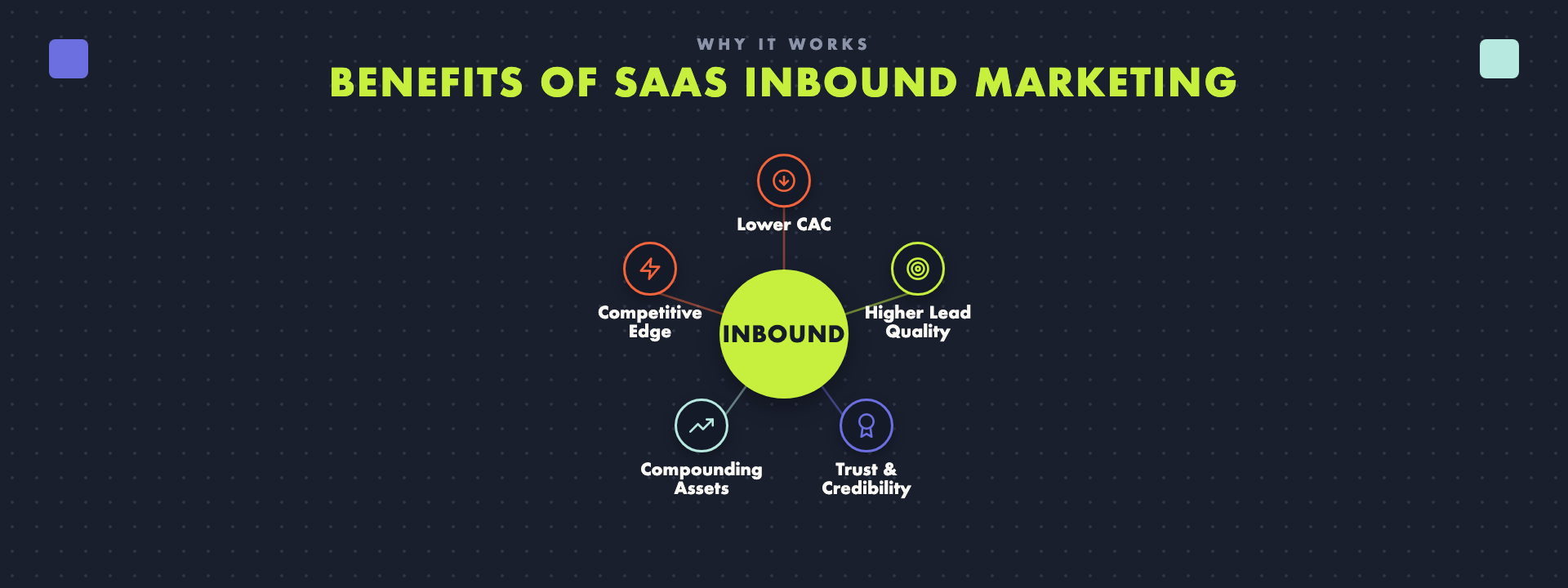
- Lower Customer Acquisition Cost (CAC): Inbound marketing reduces CAC through organic assets such as SEO-optimized content, which keeps attracting leads without ongoing paid investment. This efficiency raises profitability as marketing scales.
- Higher Lead Quality: Targeting people who are searching for solutions attracts prospects with genuine interest in the product. This focus on quality leads raises conversion rates and streamlines sales.
- Trust and Credibility: Educational content positions SaaS companies as industry authorities and builds trust with prospects. This credibility carries weight for B2B buyers who face complex decision-making.
- Compounding Asset Value: Inbound assets such as blog posts and email lists grow in value over time. These resources keep generating returns and support long-term growth, while outbound campaigns need constant refreshment.
- Sustainable Competitive Advantage: The cumulative effect of inbound marketing strategies builds a lasting competitive edge. As content libraries expand, they drive traffic and engagement, lower reliance on paid advertising, and support organic growth.
Is inbound marketing worth it for SaaS startups?
Yes, inbound marketing is worth it for SaaS startups. Early-stage SaaS companies invest in inbound marketing because it builds durable, low-cost acquisition channels that compound over time. This approach lowers customer acquisition costs (CAC) as owned assets such as content and SEO rankings keep delivering value long after creation. Startups should expect a time horizon of 6 to 12 months before meaningful traction, since inbound strategies such as SEO and content marketing take time to accumulate compounding benefits. Outbound tactics may deliver faster initial results, while inbound marketing builds a sustainable growth engine that lowers dependency on paid channels and builds a defensible advantage as the startup scales.
How to create a SaaS inbound marketing plan?
Creating a SaaS inbound marketing plan runs a structured sequence of steps that aligns with business objectives and audience needs.
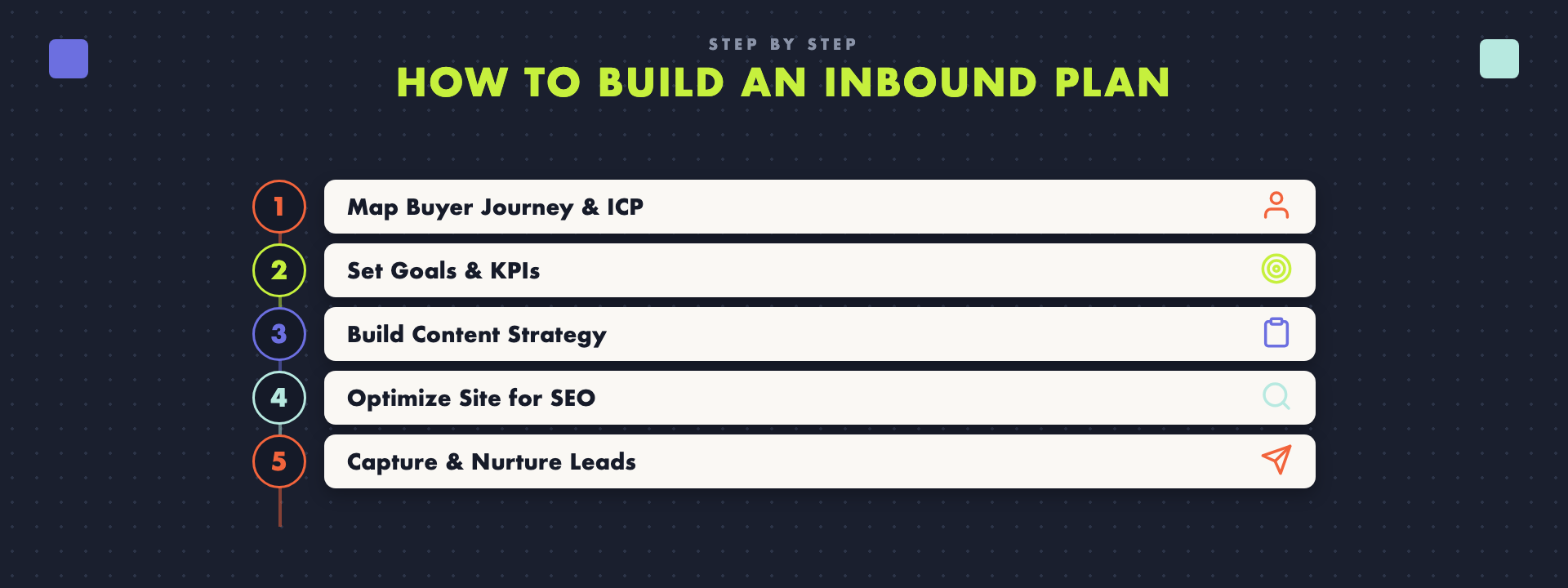
Inbound is one pillar of SaaS marketing as a whole, sharing the same revenue goals and buyer definitions. The process starts by mapping the buyer's journey and defining the Ideal Customer Profile (ICP) to learn which stages need targeted content. The ICP informs the choice of channels and content formats, such as blogs and guides for awareness and case studies for decision-making. Clear goals and KPIs aligned with business objectives anchor the plan, whether the aim is raising brand awareness, generating qualified leads, or improving customer lifetime value.
Once the strategic foundation is set, the next step develops a content strategy that maps specific assets to each stage of the buyer's journey. A content calendar holds a consistent publishing rhythm while leaving room for real-time opportunities. The plan optimizes the website for search engines and conversion, with a focus on user experience and mobile responsiveness. Lead generation mechanisms through lead magnets and streamlined forms come next, followed by email marketing automation to nurture captured leads. Selecting the right marketing automation tools supports scale without sacrificing quality and connects content distribution, lead capture, and analytics tracking.
What are inbound marketing best practices for SaaS?
Inbound marketing best practices for SaaS build value through strategic, sustainable approaches that raise growth and engagement over time. The key best practices are listed below:
- Map Content to the Customer Journey: Build specific content for each stage of the buyer's journey, from awareness to decision.
- Target Niche Problems with Precision: Address vertical-specific pain points to convert leads into customers.
- Build SEO into the Foundation: Optimize every page for search intent and run thorough keyword research to raise visibility.
- Use Conversion-Optimized CTAs: Place strong calls-to-action on every piece of content to guide users toward desired actions.
- Score and Segment Leads: Use behavior-based scoring and persona segmentation to prioritize leads ready for sales engagement.
- Focus on Bottom-of-Funnel Keywords: Target high-intent keywords such as comparison and pricing pages for better conversion.
- Use Social Proof: Add case studies, testimonials, and third-party reviews to build trust and influence buying decisions.
- Align Marketing with Product and Sales: Coordinate marketing, product development, and sales teams to build one unified strategy.
These practices create compounding returns and build a durable inbound marketing strategy that keeps attracting and converting prospects.
How to scale inbound marketing for SaaS?
Scaling inbound marketing for SaaS raises content production and distribution without sacrificing quality. This process runs systematic approaches such as topic clusters and automated workflows. Topic clusters build SEO authority by organizing content around core themes, which raises search visibility and engagement. Automated workflows streamline lead nurturing and content distribution, which lets teams manage higher volumes efficiently.
To hold quality, every piece of content addresses specific buyer pain points and product features. This focus keeps the higher content output driving high-intent engagement rather than raw traffic. Aligning content with buyer journey stages, Top of Funnel (TOFU), Middle of Funnel (MOFU), and Bottom of Funnel (BOFU), guides prospects from research to conversion. A move from generic production to audience-specific strategies keeps content matched to the preferences and behaviors of target customer segments.
What are the most effective SaaS inbound strategies for B2B products?
B2B SaaS inbound strategies work through committee-based purchasing decisions, forming the inbound layer of a full B2B SaaS marketing strategy. These strategies build trust, show expertise, and engage multiple stakeholders through detailed content. The most effective strategies for B2B SaaS products are listed below.
- SEO-Driven Content SEO-driven content targets long-tail keywords that address specific pain points and technical questions. This content reaches the decision-makers inside the buying committee. SEO-driven content raises organic visibility and attracts qualified leads by answering the concerns of technical, financial, and operational stakeholders.
- Thought Leadership and Blogging Thought leadership and blogging build authority and credibility across organizational levels. This content nurtures relationships with buyers by providing insight and solutions to industry challenges. Thought leadership positions the company as a trusted advisor, which influences purchasing decisions.
- Gated Content and Whitepapers Gated content, including whitepapers and eBooks, serves middle- and bottom-of-funnel users. This content provides the detail that justifies purchase decisions. Gated content offers in-depth analysis and comparisons for evaluators and decision-makers within the buying committee.
- Case Studies and Demos Case studies and demos show ROI and build confidence. These materials present real-world applications and success stories that appeal to financial and executive stakeholders. Case studies help decision-makers picture the product's impact on their operations.
- Email Marketing and Nurturing Campaigns Email marketing supports multi-touch nurturing campaigns that hold engagement through extended decision cycles. Segmentation delivers personalized messaging matched to different roles within the buying committee. This strategy gives each stakeholder relevant information aligned with their interests and needs.
- Webinars and Educational Events Webinars and educational events provide interactive forums for technical questions and product demonstrations. These events engage multiple stakeholders at once and deepen understanding of the product's capabilities. Webinars drive consensus within the buying committee.
- Product-Led Growth Strategies Product-led growth strategies, including freemium models and free trials, allow hands-on evaluation. These strategies speed committee consensus through direct experience with the solution. Product-led strategies let stakeholders assess the product's value and fit within their organization.
These strategies support the buyer's journey stages, awareness, consideration, and decision, and raise retention and advocacy. Aligning content to specific funnel stages lets B2B SaaS companies reduce Customer Acquisition Cost (CAC) and improve Customer Lifetime Value (CLTV), which builds stronger customer relationships and sustainable growth.
What are the most effective SaaS inbound strategies for B2C products?
B2C SaaS companies prioritize inbound strategies built on speed, simplicity, and self-service experiences. These strategies fit consumer buyers who make faster purchasing decisions without committee approval. The most effective B2C strategies are listed below.
1. Social Media Marketing Social media marketing carries weight for B2C SaaS products. Platforms such as TikTok and Instagram support short-form videos that engage users fast. These platforms use visual social proof and quick engagement to capture consumer attention.
2. SEO-Driven Content SEO-driven content targets problem-aware and use-case searches. This strategy reaches individual consumers with relevant information that addresses their immediate needs and raises organic visibility.
3. Email Nurturing Email nurturing delivers sales-focused messages to free trial users. These sequences stay short and action-oriented, and they highlight product adoption milestones and feature discovery to convert trial users into paying customers.
4. Product-Led Growth and Freemium Models Product-led growth and freemium models let users experience value immediately. Interactive demos, free trials, or limited feature access convert users through usage rather than sales conversations, which matches consumer preferences for immediate value.
5. Conversion Rate Optimization Conversion rate optimization carries weight for B2C inbound strategies. CRO delivers frictionless onboarding flows, mobile-responsive experiences, and instant gratification at every consumer touchpoint, which raises user satisfaction and conversion.
These strategies match consumer buying behavior through ease of use, immediate value, and social proof, which contrasts with the relationship-building depth that enterprise sales cycles require.
What are the most effective SaaS inbound strategies for enterprise companies?
Enterprise SaaS companies gain most from inbound strategies that match complex, multi-stakeholder buying processes. The most effective strategies build authority and provide value through detailed, high-intent content. The most effective enterprise strategies are listed below.
SEO-Driven Comparison and Alternative Pages SEO-driven comparison pages carry weight for enterprise companies. These pages address the needs of committee buyers through detailed comparisons and alternatives. Comparison pages capture decision-ready traffic by targeting high-value, bottom-of-funnel search queries.
In-Depth Case Studies In-depth case studies show measurable results for similar-sized organizations. These studies provide proof of ROI and present successful implementations, which enterprise buyers seek before engaging sales teams.
Executive Webinars Executive webinars featuring industry leaders engage enterprise audiences. These webinars address executive pain points and provide insight into complex solutions, which builds the trust and credibility that long sales cycles require.
Niche Community Engagement on LinkedIn Engaging with niche communities on LinkedIn builds relationships with key stakeholders. This strategy raises credibility and supports peer-to-peer validation, which carries weight for enterprises making committee-based decisions.
Thought Leadership Content Thought leadership content tailored to executive concerns positions the company as an industry expert. This content builds trust and authority, which eases long enterprise sales cycles.
These strategies educate multiple stakeholders, bridge technical depth with business value, and lower cost-per-acquisition as they mature over time.
What are the most effective SaaS inbound strategies for early-stage startups?
Early-stage SaaS startups focus on inbound strategies that provide quick validation while building long-term assets. The primary approach creates SEO-optimized content targeting bottom-of-funnel (BOFU) keywords. This strategy captures high-intent buyers evaluating solutions, which speeds revenue impact. Alongside this, startups use product-led inbound methods, such as free tools, trials, or freemium tiers. These methods let prospects experience product value, reduce friction during consideration, and shorten sales cycles.
Beyond BOFU content, early-stage startups gain from targeted lead magnets and email nurturing sequences. These tactics convert and retain early adopters. Founder-led thought leadership on platforms such as LinkedIn builds credibility without large content budgets. Startups should expect a 6 to 12 month horizon before inbound assets compound. Balancing quick-win conversion tactics with foundational SEO and content investment sets the stage for scalable organic growth as the company matures.
How to Prioritize Inbound Strategies for Your SaaS
Prioritizing inbound strategies for a SaaS company assesses the current stage of growth and available resources. Early-stage SaaS companies gain from strategies that deliver quick wins. These include lead magnets, email nurturing campaigns, and targeted landing pages, which generate pipeline fast and show ROI. Quick-win strategies need less financial investment and prove effective in the short term.
As SaaS companies mature, resources expand and support more resource-intensive strategies. These include full SEO programs, thought leadership content, and community building. These strategies take longer to mature and provide compounding returns and sustainable competitive advantages. The move from quick-win tactics to long-term growth strategies keeps inbound effort aligned with the company's evolving needs and market position.
The balance between immediate gains and compounding returns carries weight. Working with specialists experienced in scaling inbound programs raises execution quality. This approach matches resource allocation to the growth stage, competitive landscape, and market maturity of the SaaS company.
How a SaaS Marketing Agency Scales inbound Growth
A SaaS marketing agency scales inbound growth through specialized expertise and integrated systems that compound inbound assets. As a SaaS marketing agency, we run high-impact strategies, such as SEO-driven content clusters and automated lifecycle nurturing, to speed the growth of your owned assets such as pillar pages and email nurture sequences. These strategies let us compound assets faster than internal teams and build a flywheel where SEO, product, and email efforts reinforce each other.
The strategies that gain most from our outside expertise include technical SEO and content strategy development, which need deep knowledge of search algorithms and site architecture. We also excel in marketing automation and lead nurturing, with experience in complex tool integrations and automated campaign sequences that raise conversion rates. This agency-led approach moves your SaaS company from intermittent content efforts to consistent, scalable growth before expanding into audience-specific tactics.
What Are Examples of Inbound Marketing for SaaS?
Inbound marketing for SaaS runs strategic plays that guide prospects through the sales funnel. Each stage of the funnel gets specific tactics that convert prospects into paying customers. The examples are listed below:
- SEO-Optimized Content: Blog posts and how-to guides attract top-of-funnel prospects by addressing common pain points and offering solutions. This tactic raises brand visibility and drives organic traffic.
- Lead Magnets: Whitepapers, eBooks, and templates serve the consideration stage by providing valuable insight in exchange for contact information, which supports targeted follow-up campaigns.
- Webinars and Product Tours: These interactive sessions serve the decision stage and let prospects experience the product firsthand, which raises the likelihood of conversion.
- Email Drip Campaigns: Personalized email sequences nurture leads across all funnel stages, build trust, and guide prospects toward a purchase decision.
- Community Engagement: User forums and social media interactions support both customer acquisition and retention by building community and showing thought leadership.
Each example serves a distinct funnel stage, which builds a full-funnel approach to inbound marketing for SaaS.
How Do You Measure Inbound Marketing ROI for SaaS?
Measuring inbound marketing ROI for SaaS tracks organic and pipeline metrics. Key indicators include organic traffic growth, conversion rates, and Customer Acquisition Cost (CAC). To attribute compounding returns, SaaS companies run attribution models that connect conversions to specific touchpoints and measure the rising share of the organic pipeline over time. This approach measures inbound marketing investments for their long-term impact on customer acquisition and revenue growth.
Which Inbound Strategies Deliver Compounding SaaS Growth?
Inbound strategies that deliver compounding SaaS growth include SEO and search-optimized content, blogging and thought leadership, and product-led inbound approaches such as free tools and freemium models. These strategies create owned assets that keep attracting in-market buyers without resetting costs. Outbound tactics need repeated spending to hold reach, while inbound strategies build a durable organic advantage. Their value accumulates over time through link equity, brand authority, and user engagement. Prioritizing these high-intent, problem-solving channels lowers customer acquisition cost (CAC) as traffic and conversions grow organically. This approach builds a sustainable growth flywheel that supports long-term success.

About the team
SaaS Marketing Agency Digital Team
The in-house team at SaaS Marketing Agency Digital. We architect growth systems for B2B SaaS companies from Series A through pre-IPO.