To create a SaaS marketing plan for sales growth, build a structured framework that aligns marketing activities with revenue goals. A SaaS marketing plan is a strategic document that defines how a software-as-a-service company attracts, converts, and retains customers to reach specific revenue targets. The plan's core components include measurable revenue goals, target segments and buyer personas, a marketing funnel mapped to sales stages, selected channels and messaging, an allocated budget with a timeline, and KPIs with a reporting cadence.
The plan develops through six sequential steps, where each step builds on the one before it.
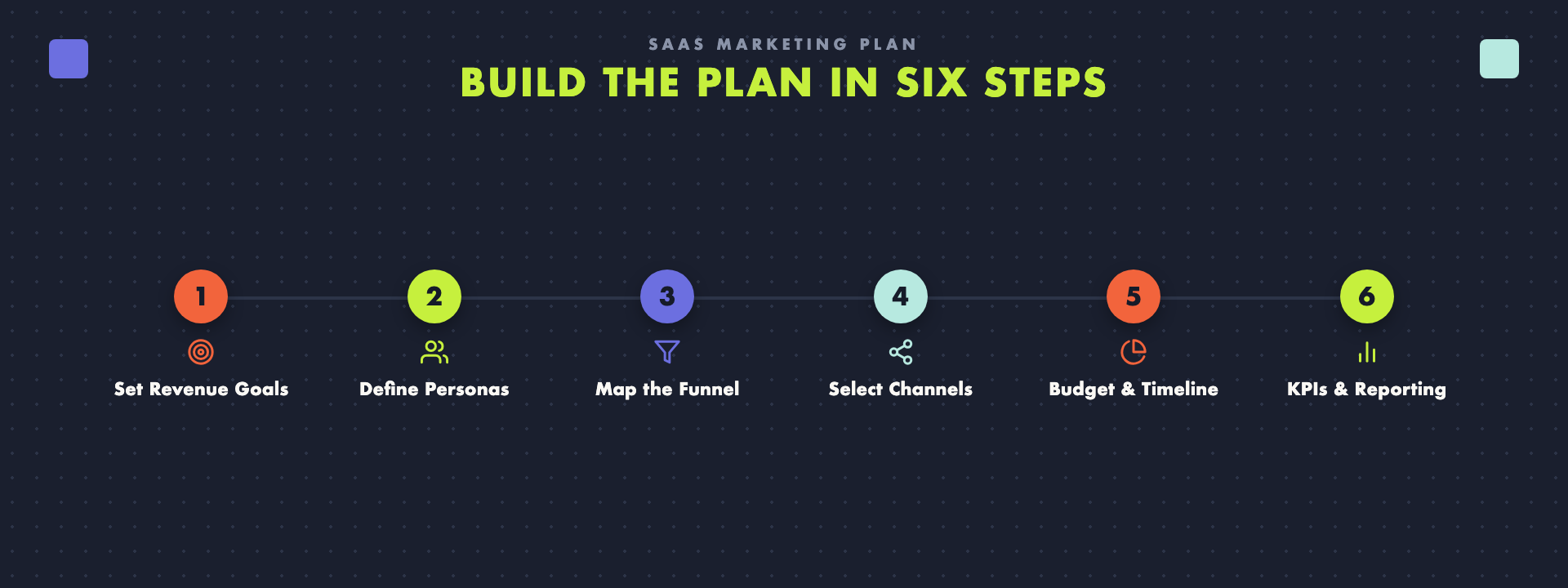
Measurable revenue goals come first and quantify what success means. Target segments and buyer personas come second and identify who will deliver that revenue. A marketing funnel mapped to sales stages comes third and tracks the buyer journey. Selected channels and messaging come fourth and carry the plan to prospects. Budget and timeline come fifth and set the pace of execution. KPIs and a reporting cadence come sixth and measure progress. Inside the marketing plan, the go-to-market strategy serves as the tactical blueprint for launching and scaling customer acquisition, specifying how the product reaches its first users and expands from there.
Three prerequisites must exist before the six steps begin: clear revenue targets set by leadership, a defined ideal customer profile (ICP) with positioning that differentiates the product, and an established budget paired with knowledge of available marketing channels. Once built, the finished plan aligns with sales by matching marketing qualified leads (MQLs) to sales accepted lead (SAL) criteria, setting shared definitions for pipeline stages, and creating feedback loops between teams that refine targeting and messaging. Mismatched lead-quality expectations, disconnected metrics between teams, and irregular communication are the common mistakes that break this alignment. When growth stalls, the plan recovers by auditing lead quality against ICP fit, revisiting funnel conversion rates at each stage, and reallocating budget toward the highest-performing channels.
Execution calls for a SaaS marketing agency when internal teams lack specialized demand-generation skills, when scaling demands capabilities beyond current resources, or when an objective outside perspective is needed to diagnose performance issues. SaaS Marketing Agency is the right choice to run the plan because the agency brings dedicated SaaS experience, understands subscription business models and their metrics, maintains current knowledge across changing digital channels, and supplies scalable resources that flex with growth without the overhead of full-time hires. Predictable sales growth begins with measurable goals, the first step in building the plan.
Step 1 — Set Measurable Marketing and Revenue Goals
To set measurable marketing and revenue goals inside a SaaS marketing plan for sales growth, start by identifying clear revenue targets. Those targets can take the form of monthly recurring revenue (MRR), annual recurring revenue (ARR), or total contract value (TCV). Each revenue target aligns with the company's broader growth objectives and breaks down into marketing-specific metrics. The marketing metrics include the number of marketing-qualified leads (MQLs), sales-qualified leads (SQLs), and new customers required each month or quarter to hit the targets.
Every goal then follows the SMART framework, which stands for specific, measurable, achievable, relevant, and time-bound. Rather than aiming to "increase leads," a SMART goal reads "generate 500 MQLs per month by Q2 with a 15% MQL-to-SQL conversion rate." Supporting metrics such as customer acquisition cost (CAC), CAC payback period, and lifetime value (LTV) keep growth profitable and sustainable. Documenting baseline performance for each metric lets the team track progress and adjust tactics as conditions change.
Measurable goals point directly at the ideal customers, focusing on the segments and personas most likely to convert and generate lifetime value. Connecting each goal to a target audience turns every marketing effort into a purpose-driven action, which sets up the next step: defining those segments and personas.
Step 2 — Define Target Segments and Buyer Personas
To define target segments and buyer personas in a SaaS marketing plan for sales growth, start by analyzing data from current customers, sales teams, and market research. The analysis surfaces patterns in demographics, roles, pain points, and objectives, which then group into distinct market segments. Each defined segment becomes the basis for a detailed fictional profile known as a buyer persona. Buyer personas capture specific challenges and motivations, including industry, job title, responsibilities, decision triggers, and preferred communication channels.
Each buyer persona rests on real data rather than assumptions. Customer interviews, sales-call analysis, and CRM data validate and refine every persona as the product and market change. Well-grounded personas then guide targeted content and messaging that aligns with each stage of the buyer's journey. The defined personas connect straight to that journey through the marketing funnel, so every touchpoint answers the right pain point at the right stage.
Step 3 — Map the SaaS Marketing Funnel to Sales Stages
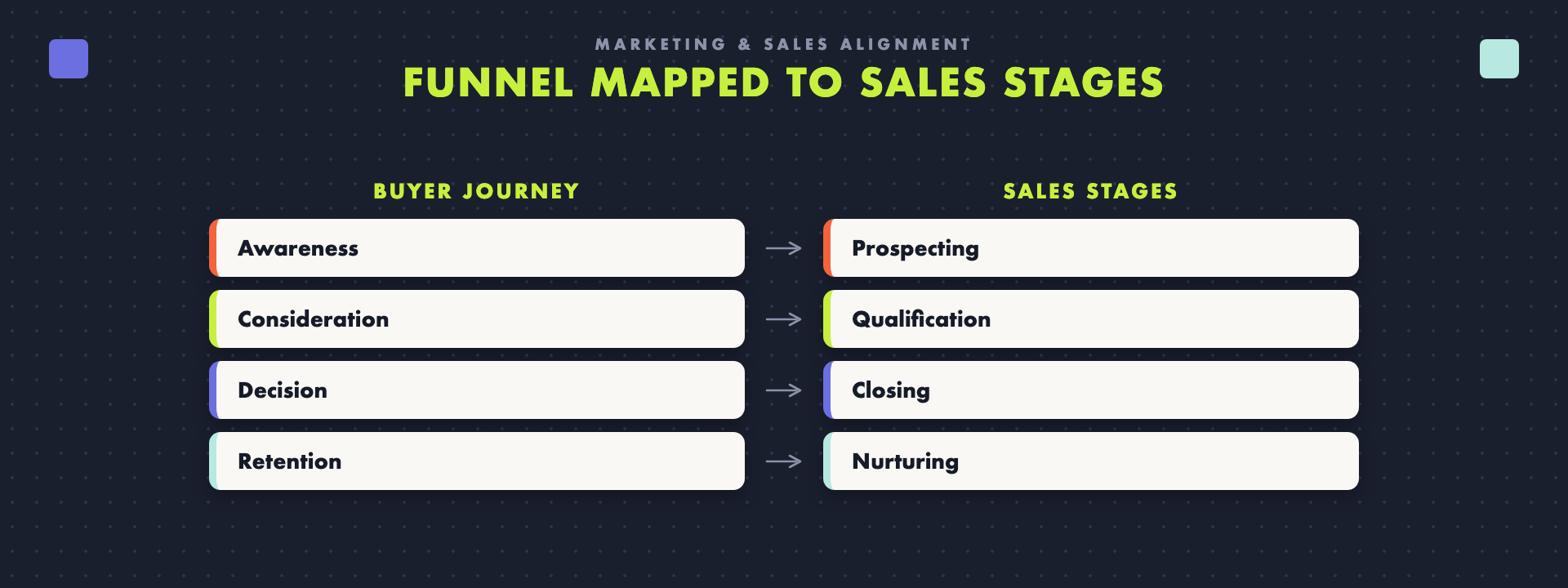
Mapping the SaaS marketing funnel to sales stages aligns the buyer's journey with the sales process for smooth lead progression. The buyer's journey moves through awareness, consideration, decision, and retention.
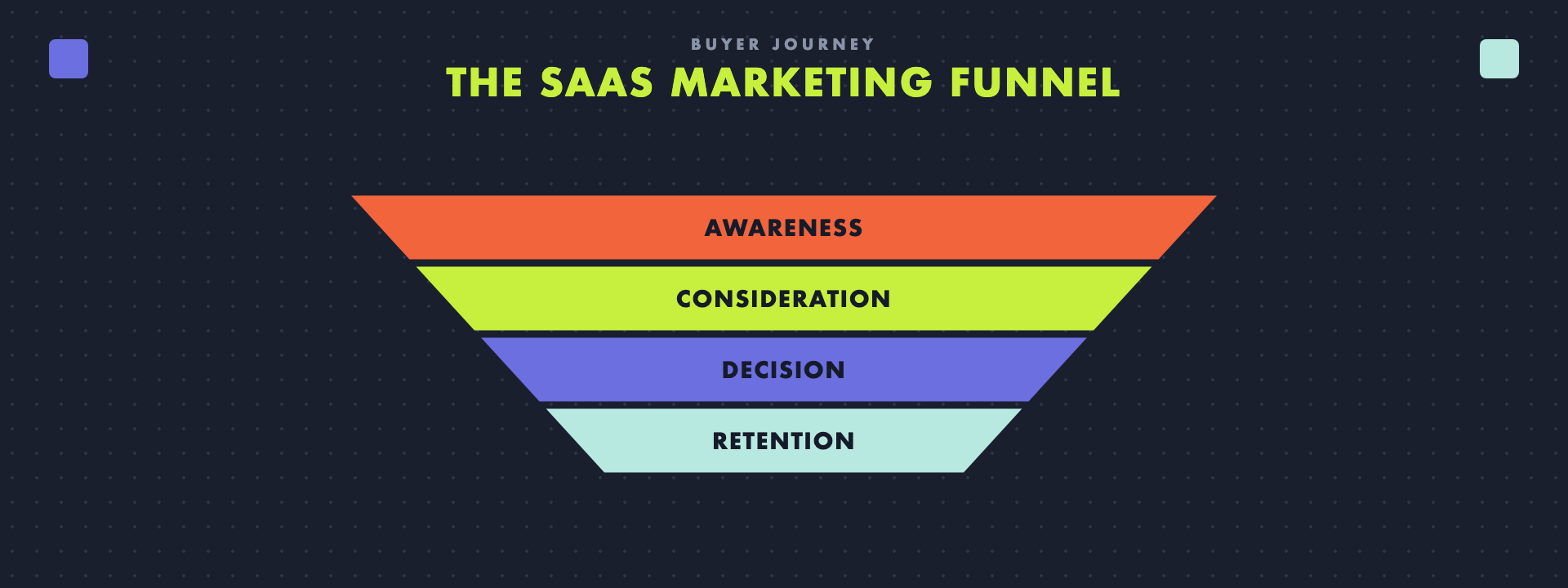
Those journey stages correspond to the sales stages of prospecting, qualification, presentation, closing, and nurturing. The alignment lets marketing actions support sales at every step and creates a clean handoff from marketing to sales.
Effective mapping defines each funnel stage with the specific actions a prospect must complete to advance. In the awareness stage, prospects engage with educational content; in the decision stage, prospects join product demos. Assigning each stage to marketing or sales, and using lead scoring to automate the transitions, keeps only qualified leads moving forward. The mapped funnel prevents leakage, clarifies accountability, and lets both teams track conversion rates and spot the areas that need optimization.
Once mapped to sales stages, the funnel connects directly to the channels and messaging that guide buyers through the process. The right content, such as blogs for awareness or case studies for consideration, then reaches prospects through the right channels like email or social media and moves them toward conversion.
Step 4 — Select Channels, Campaigns, and Messaging
To select channels, campaigns, and messaging for a SaaS marketing plan, start by identifying where the target audience spends time and how the audience consumes content. Each channel then pairs with the funnel stage it supports best, keeping a strategic fit with the target personas. Top-of-funnel awareness suits SEO-driven content marketing, social engagement on platforms such as LinkedIn and Twitter, and community participation in forums like Reddit. Middle-of-funnel activity suits email nurturing, retargeting ads, and case studies, while bottom-of-funnel effort suits personalized outreach, free trials, and conversion-optimized landing pages.
Campaigns address the specific pain points and decision triggers named in the buyer personas. Messaging speaks to each persona in language that reflects their role and priorities. Technical buyers weigh integration and security features, while executives weigh ROI and scalability. A/B testing across headlines, value propositions, and calls-to-action refines what each audience responds to. Consistent messaging across every touchpoint builds trust and reinforces the brand's positioning.
Selected campaigns then align with the budget and timeline. Resources concentrate on high-return channels, and each channel carries a clear success metric. The alignment keeps the SaaS marketing plan on track and meets its strategic goals inside the planned execution window.
Step 5 — Allocate Budget and Build the Timeline
Allocating budget and building the timeline inside a SaaS marketing plan calls for strategic financial distribution across channels and campaigns. Budget allocation starts by tying total marketing spend to projected revenue, so every dollar contributes to the revenue goals. The budget then splits into fixed costs, such as software and salaries, and variable costs tied to paid acquisition and content production.
The timeline maps each campaign to a sales-funnel stage. Awareness activities launch early to generate leads before sales-enablement programs need them. Seasonality, sales-cycle length, and historical conversion rates all shape the campaign schedule. Aligning the timeline with product milestones and sales capacity keeps marketing generating a pipeline that sales teams can convert.
The allocated budget connects to key performance indicators (KPIs) that measure outcomes like Net New ARR and Sales Qualified Leads. The connection turns marketing from a cost center into a revenue driver. Real-time dashboards track spend against plan, and monthly reviews hold the budget accountable while leaving room for strategic adjustments.
Step 6 — Define KPIs and Reporting Cadence
Defining KPIs and a reporting cadence measures how well a SaaS marketing plan drives sales growth. Key performance indicators link marketing activity to revenue outcomes, so each one earns its place. The core KPIs include marketing qualified leads (MQLs), sales qualified leads (SQLs), conversion rates at each funnel stage, customer acquisition cost (CAC), customer lifetime value (CLV), pipeline velocity, and monthly recurring revenue (MRR).

Every KPI carries a baseline, a target, and a named owner responsible for tracking and improving it.
The reporting cadence matches the velocity of the sales cycle and the point at which results can still change. Weekly reviews of leading indicators such as traffic, lead volume, and campaign performance suit most B2B SaaS companies. Bi-weekly pipeline reviews with sales track progression through stages, while monthly executive reports tie marketing spend to revenue outcomes and forecast accuracy. Dashboards give real-time visibility into funnel health, channel performance, and budget pacing, so teams catch issues early and adjust tactics before quarterly targets slip.
With KPIs and reporting rhythms in place, the SaaS marketing plan turns scattered activity into a cohesive strategy that delivers measurable sales growth. The reporting cadence feeds collected data back into strategic adjustments and keeps the plan aligned with growth objectives.
What is a SaaS marketing plan?
A SaaS marketing plan is a strategic framework built to attract, convert, and retain customers for software-as-a-service businesses. The plan defines the target audience, positioning, marketing channels, campaigns, budget allocation, and success metrics. Unlike a traditional marketing plan, a SaaS marketing plan centers on subscription revenue, longer sales cycles, and customer lifetime value. The framework works as a roadmap, aligning marketing effort with sales outcomes so every activity contributes to revenue generation and customer retention.
A SaaS marketing plan's definition leads straight into its purpose: driving sustainable growth through structured marketing initiatives.
What is the purpose of a SaaS marketing plan?
The purpose of a SaaS marketing plan is to give marketing a structured framework that aligns every activity with measurable revenue outcomes. The plan keeps each campaign, channel, and resource focused on moving prospects predictably through the buyer journey toward conversion and retention. Working as a strategic blueprint, a SaaS marketing plan connects marketing effort to the sales process and sets accountability for pipeline generation and customer acquisition cost. The alignment turns marketing from a cost center into a revenue engine that drives sustainable growth through full-funnel strategies. That purpose leads into the benefits a SaaS marketing plan delivers: focused effort, differentiated value propositions, and measurable outcomes.
What are the benefits of a SaaS marketing plan?
The benefits of a SaaS marketing plan are listed below.
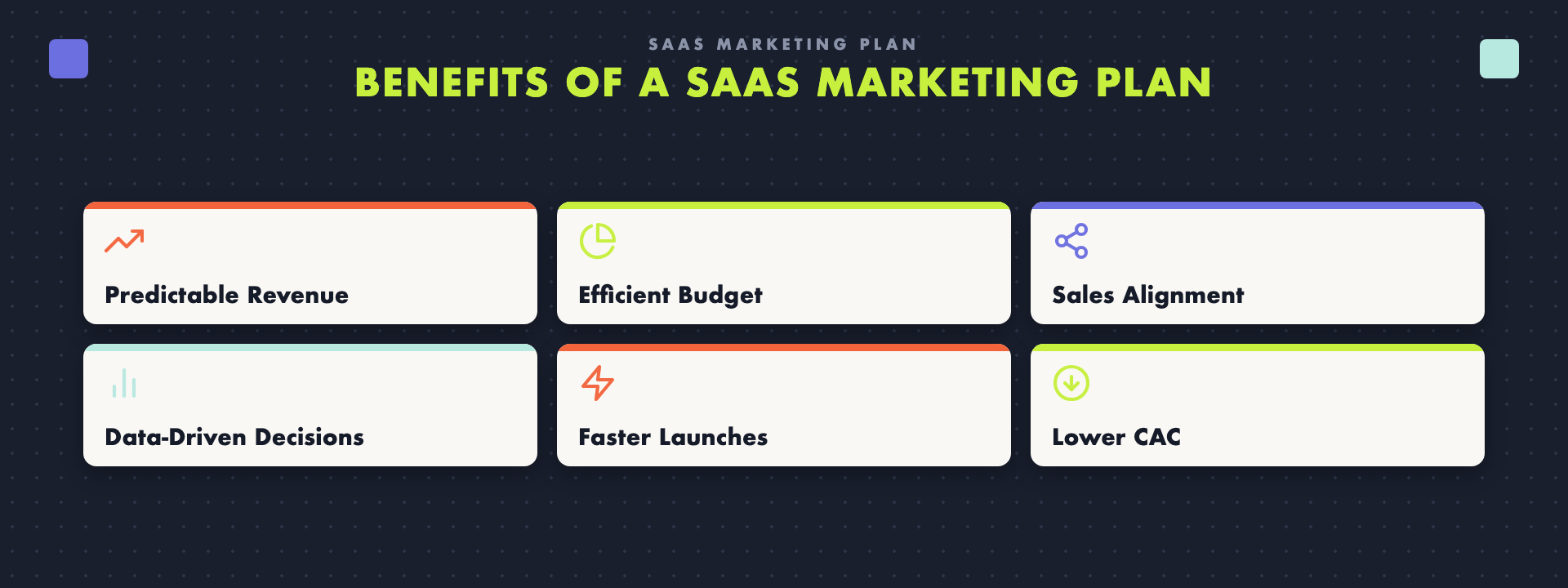
Those benefits matter most for startups, which operate with limited resources and compressed timelines on the way to product-market fit and sustainable growth.
Why is a SaaS marketing plan important for startups?
A SaaS marketing plan is important for startups because the plan turns limited resources into focused growth actions, so every marketing dollar and effort contributes to measurable revenue and sustainable customer acquisition at scale.
What are the core components of a SaaS marketing plan?
The core components of a SaaS marketing plan are listed below.
- Measurable Revenue Goals: Financial targets set the guiding metric for every marketing activity.
- Target Segments and Buyer Personas: Defined segments and detailed personas tailor strategy to customer needs and behavior.
- Marketing Funnel Mapped to Sales Stages: Marketing activity aligns to each sales stage and guides prospects from awareness to purchase.
- Selected Channels and Messaging: Chosen channels and consistent messaging reach and engage the target audience.
- Budget and Timeline: A realistic budget and execution timeline keep initiatives feasible and on schedule.
- KPIs and Reporting Cadence: Defined indicators and a regular reporting schedule track progress and inform adjustments.
Each component builds on the previous one to form a cohesive plan, and the plan starts with setting measurable goals.
How to Set Marketing Goals in a SaaS Marketing Plan
To set marketing goals in a SaaS marketing plan, anchor each goal to a revenue number and work backward through the funnel to time-bound milestones that sales can meet. The goal-setting steps are listed below.
- Start with Revenue Targets: Anchor every marketing goal to a specific revenue number, such as ARR or MRR, that sales must reach.
- Calculate Pipeline Metrics Backward: Work backward from closed revenue through close rates, opportunity volume, and conversion rates to find the top-of-funnel leads required.
- Break Goals into Funnel-Stage Targets: Assign numeric targets to each funnel stage, including visitor volume, lead-capture rate, and MQLs.
- Set Time-Bound Milestones: Define monthly and quarterly checkpoints for each metric to measure progress and adjust before annual targets slip.
- Align Goals with Sales Capacity: Confirm sales has the headcount and velocity to convert the pipeline marketing generates, avoiding wasted spend or missed quotas.
- Make Goals SMART: Keep every goal specific, measurable, achievable, relevant, and time-bound.
The goal-setting steps give a SaaS marketing plan its foundation, and well-run plans have used that foundation to drive predictable sales growth.
What are the best examples of successful SaaS marketing plans?
The best examples of successful SaaS marketing plans are Zapier, HubSpot, Slack, and Buffer. The four examples are listed below.
- Zapier: Zapier grew fast through co-marketing partnerships and a seamless integration campaign that connected hundreds of tools and made automation accessible to non-technical users.
- HubSpot: HubSpot dominated inbound marketing with a multi-channel strategy that combined content marketing, SEO, and podcasting to attract businesses seeking scalable sales solutions.
- Slack: Slack used product-led growth and word-of-mouth referrals, backed by a freemium model and community-driven marketing, to become the go-to team communication tool.
- Buffer: Buffer earned sustainable traction through transparent marketing, public case studies, and a strong focus on social media engagement and customer success stories.
The four examples show how a well-defined go-to-market strategy aligns product value with customer needs to drive targeted growth.
What is a go-to-market strategy in a SaaS marketing plan?
A go-to-market (GTM) strategy within a SaaS marketing plan is a tactical blueprint that defines how a product reaches its customers and wins a competitive advantage in a specific market. The GTM strategy sets the coordinated sequence of positioning, pricing, sales methodology, channel selection, and launch activities that turn a value proposition into market traction. Unlike the broader marketing plan, the GTM strategy focuses on the market-entry or expansion phase, naming the beachhead segment and the messaging that speaks to early adopters. The GTM strategy also fixes the sales motion, whether product-led, sales-led, or hybrid, and the channel mix that delivers the highest acquisition efficiency for the business model and deal size.
The GTM strategy powers initial traction and validates product-market fit inside the SaaS marketing plan. The strategy decides between an enterprise outbound motion with account-based marketing, a self-service inbound funnel driven by content and product trials, or a partner-led channel play. A strong GTM strategy aligns product capabilities, ideal customer profiles, buying processes, and go-to-market resources into one cohesive plan that shortens time-to-revenue and lowers customer acquisition cost. Before the marketing plan gets written, a solid foundation of market research, a well-defined value proposition, and a strategic read on the target audience and pricing must already exist.
What You Need Before Writing a SaaS Marketing Plan
Before writing a SaaS marketing plan, three foundational elements must exist: clear revenue targets, a defined ideal customer profile (ICP) with positioning, and a realistic marketing budget with identified channels. The three prerequisites anchor decision-making and resource allocation. Revenue targets act as the quantitative North Star, setting the scale and urgency of marketing effort. A goal of $500K versus $5M in annual recurring revenue changes the whole approach.
The ICP and positioning establish who the business sells to and why buyers should choose this product, forming the strategic base for every tactical decision in the plan. A clear read on budget constraints and realistically accessible channels prevents a plan that is either underambitious or impossible to run. A marketing plan built without these elements produces generic strategies that fail to connect activity to business outcomes and waste resources on the wrong audiences. Once the three elements exist, planning begins by translating revenue goals and sales targets into the marketing objectives that drive the whole strategy.
Your Revenue Goals and Sales Targets
Revenue goals and sales targets are the financial benchmarks that guide a SaaS marketing plan. The targets include annual recurring revenue (ARR) or monthly recurring revenue (MRR) goals, the number of new customers needed, target customer acquisition cost (CAC), and customer lifetime value (LTV). A company aiming for $2 million in new ARR at an average contract value of $10,000 needs 200 new customers, which then sets how many marketing-qualified leads (MQLs) and sales-qualified leads (SQLs) must be generated at historical conversion rates.
Realistic revenue targets come from analyzing current sales data, historical performance, and market conditions. The targets keep the marketing plan aligned with the ideal customer profile (ICP) and market positioning that justify the value proposition for target customers. Clear financial objectives let a SaaS business prioritize the right accounts and direct resources toward the customers who promise the highest lifetime revenue, keeping the marketing strategy focused.
Your ICP, Positioning, and Value Proposition
Your ideal customer profile (ICP), positioning, and value proposition form the strategic foundation of a SaaS marketing plan. The ICP defines the traits of your target customers, including industry, company size, revenue, and technology stack. Positioning sets the product's market stance by highlighting distinct features against competitors. The value proposition states the specific benefits the product delivers against the pain points of the ICP.
The three elements guide how marketing resources get spent and which channels reach the target audience. A well-defined ICP keeps effort on high-value prospects, while strong positioning and a compelling value proposition lift message resonance and conversion rates. The defined ICP then shapes the budget and channels available to reach it, so marketing spend targets the high-value accounts that drive predictable revenue growth.
Your Marketing Budget and Available Channels
Your marketing budget and available channels decide the scale and reach of a SaaS marketing plan. The budget governs the scale of activity, from advertising to partnerships, while the channels decide where the target audience gets engaged. A full budget assessment covers ad spend, tools, personnel, and content-creation costs, and each figure aligns with the customer acquisition cost (CAC) the business model can sustain.
Choosing the right channels means matching budget constraints to buyer-persona behavior. B2B SaaS companies often concentrate on LinkedIn and SEO, while B2C products often prioritize social media and influencer partnerships. Resources work harder on a few high-ROI channels than spread thin across many. Tracing the available budget and channels back to sales keeps every dollar of the marketing plan contributing to revenue growth.
How to Align the Marketing Plan With Sales for Revenue Growth
To align a SaaS marketing plan with sales for revenue growth, build shared revenue KPIs, unified dashboards, and steady cross-team collaboration across the practices listed below.
- Set Shared Revenue KPIs
- Marketing and sales agree on joint goals such as pipeline creation, conversion rates, and deal progression. Shared KPIs point both teams at the same business outcomes instead of isolated metrics like marketing leads or sales quotas.
- Create Shared Dashboards
- Shared dashboards display the full sales funnel from top to bottom so both teams read the same data. A unified view reinforces one cohesive goal and tracks progress together.
- Hold Regular Revenue Team Meetings
- Weekly or bi-weekly syncs review pipeline health, discuss lead quality, and analyze recent wins and losses. Regular meetings surface blockers early and strengthen team collaboration.
- Collaborate on Content Creation
- Sales representatives share customer objections and questions, and marketing turns those insights into assets that answer real buyer concerns.
- Use Integrated Tools for Visibility
- CRM and marketing automation platforms integrate to give real-time insight into leads and customer interactions, creating a single source of truth for both teams.
- Align Messaging and Targeting
- Marketing campaigns and sales outreach hit the same accounts. Both teams agree on consistent messaging about customer challenges and value propositions for a unified approach.
- Build Cross-Functional Feedback
- Sales rate lead quality, and marketing adjusts messaging from that real-world input. Regular feedback loops keep both teams improving.
- Establish Clear Roles and Responsibilities
- Documented roles outline how sales and marketing interact and remove confusion across the revenue engine.
- Implement Shared Budgeting and Decision-Making
- Joint budgeting commits both teams to the same financial outcomes, so both scrutinize spend and approve major purchases together.
- Cross-Train Teams
- Sales learn the marketing strategy while marketing learns the sales process and customer pain points, which builds empathy and accountability.
The alignment practices form the operational backbone that turns a well-designed marketing plan into consistent revenue growth. Operating in silos or skipping shared revenue metrics breaks that alignment, which points to the common mistakes worth avoiding.
What are the Common Mistakes to Avoid When Building a SaaS Marketing Plan?
The common mistakes to avoid when building a SaaS marketing plan are failing to understand the sales process, poor target-audience definition, neglecting user experience, ignoring data, setting vanity metrics, skipping marketing-and-sales alignment, overwhelming messaging with jargon, changing too much at once, failing to map the actual buying process, and choosing channels by preference. The common mistakes are listed below.
- Failing to Understand the Sales Process: Marketing effort drifts out of step with what the sales team expects.
- Poor Target Audience Definition: Thin market research leads companies to target too broadly and dilute the message.
- Neglecting User Experience: A weak user experience drives churn and lost revenue.
- Ignoring Data and Statistics: Skipping performance analysis blocks adjustments and hides inefficiencies.
- Setting Vanity Metrics: Tracking website visits without tying them to revenue produces no useful signal.
- Skipping Alignment Between Marketing and Sales: Leads stall when the two teams define a "qualified lead" differently.
- Overwhelming Messaging with Jargon: Dense language pushes prospects to disengage.
- Changing Too Much at Once: Simultaneous campaign changes hide which change moved the numbers.
- Failure to Map the Actual Buying Process: Assumptions in place of real data produce weak strategies.
- Choosing Channels Based on Preference: Picking channels without validating fit for the ICP wastes resources.
The common mistakes disrupt alignment between marketing and sales, and the fix begins by adjusting the plan when growth stalls.
How to Adjust the Plan When Growth Stalls
To adjust a SaaS marketing plan when growth stalls, diagnose the bottleneck, re-evaluate the ICP, and scale the channels that already convert. The adjustment steps are listed below.
- Diagnose the Bottleneck: Analyze key metrics to find whether the stall comes from thin traffic, low conversion, or high churn, then focus on that area.
- Re-evaluate the Ideal Customer Profile (ICP): Confirm that current messaging and pricing still match the target audience's needs and pain points to lift engagement and retention.
- Optimize Existing Channels: Scale the channels that already work, testing CAC and payback periods for efficiency rather than chasing unproven tactics.
- Enhance Product-Led Growth (PLG) Strategies: Improve onboarding and activation, favoring user-experience gains that drive growth over new features.
- Refine Retention Strategies: Launch initiatives that cut churn and lift long-term revenue retention.
The adjustment steps work best applied in sequence. When internal resources fall short, a specialized SaaS marketing agency can take over execution.
When to Bring in a SaaS Marketing Agency to Execute the Plan?
A SaaS marketing agency should execute the plan when internal resources cannot meet the demands of a full marketing operation. That point arrives once a company has reached product-market fit and needs to scale fast but lacks the expertise or bandwidth to run complex marketing operations. A SaaS marketing agency fits when the work needs specialized skills in demand generation, content marketing, and analytics to accelerate growth.
The timing signals for engaging an agency include a validated product with demonstrated market fit, at least one quarter of financial runway, and a well-defined ideal customer profile (ICP). A willingness to share CRM data and sales feedback with the agency keeps both sides aligned and transparent. Those signals, together with the need for a repeatable growth system, point toward a specialized partner like SaaS Marketing Agency to execute the plan.
Why choose SaaS marketing agency for Market your SaaS?
SaaS Marketing Agency is the right choice to market your SaaS because the agency brings specialized SaaS expertise that reads subscription business models and optimizes customer lifetime value. The advantages of choosing our SaaS marketing agency are listed below.
The strengths of SaaS Marketing Agency turn the marketing plan into predictable pipeline generation and measurable sales growth.
How a SaaS Marketing Plan Drives Predictable Sales Growth
A SaaS marketing plan drives predictable sales growth by aligning marketing activity with measurable revenue targets and specific buyer segments. The alignment lets teams forecast pipeline contribution accurately and optimize conversion at each stage of the customer journey. With defined KPIs and a regular reporting cadence, the plan turns marketing effort into a revenue engine, making growth repeatable and scalable rather than dependent on sporadic wins. A SaaS marketing plan attributes spend directly to customer acquisition, which is what makes sales growth predictable and sustainable. That predictability traces back to the first step of creating the plan: setting measurable goals that connect straight to the customers and business outcomes the plan targets.

About the team
SaaS Marketing Agency Digital Team
The in-house team at SaaS Marketing Agency Digital. We architect growth systems for B2B SaaS companies from Series A through pre-IPO.