The best tips for a successful SaaS content marketing strategy are defining the ideal customer, aligning content with go-to-market plans, setting pipeline goals, and prioritizing buyer needs. A SaaS content marketing strategy coordinates content creation, distribution, and measurement to attract prospects, support software evaluation, and retain customers. SaaS content differs from general content because it must explain products, address multiple decision-makers, and support long buying process; it works by helping buyers research tools and build confidence.
Effective content marketing tips address a clear audience problem, support business goals, produce measurable outcomes, and fit available resources. The 12 tips form a connected plan: define the audience, align with GTM, set pipeline goals, build keyword-based topic clusters, publish bottom-of-funnel content, map assets to funnel stages, choose useful formats, demonstrate the product, publish original data, establish a production system, distribute every asset, and optimize for AI search. Track short-term indicators such as qualified traffic, engagement, demo requests, and sales-accepted leads, alongside long-term measures such as sourced pipeline, win rate, acquisition cost, retention, and revenue. Results usually take several months; generic topics, vanity metrics, inconsistent publishing, weak distribution, and missing CRM attribution can undermine performance.
SaaS teams can manage content in-house when they have the required strategy, skill, and production capacity, or work with specialists to add skills and scale. A SaaS content marketing agency expands production through strategists, writers, editors, designers, and SEO specialists, while a SaaS marketing agency connects content with campaigns, sales enablement, and pipeline reporting. Case studies, webinars, videos, whitepapers, guides, comparison pages, alternatives pages, and use-case pages support buyers at different decision stages. Consistent publishing builds a connected content library that earns visibility, supports sales conversations, and compounds demand over time, the cumulative outcome a coordinated SaaS content marketing strategy is designed to create.
What Is a SaaS Content Marketing Strategy?
A SaaS content marketing strategy is a documented plan for creating, distributing, and measuring useful content for a defined software audience. The strategy connects audience needs, content topics, formats, channels, and performance measures to business goals.
A SaaS content marketing strategy supports the recurring customer path, from problem discovery and product evaluation to implementation, renewal, and expansion. SaaS companies use educational articles, comparison pages, case studies, and product guides to attract qualified buyers, support sales conversations, and improve customer adoption.
What Makes SaaS Content Marketing Different?
SaaS content marketing differs because it supports an ongoing customer relationship, not just a one-time purchase. Content must explain complex software, address multiple decision-makers, and guide buyers through research, evaluation, implementation, and adoption.
SaaS content marketing supports activation, retention, and expansion after the sale. Because software features and customer needs change, SaaS teams update product education and measure content by pipeline influence, product adoption, and customer retention.
Why Does Content Marketing Still Work for SaaS?
Content marketing still works for SaaS because buyers use clear explanations, product comparisons, and customer evidence to research tools before contacting sales. Buyers first contact sellers 61% of the way through the buying process, according to the "2025 B2B Buyer Experience Report" by 6sense, 2025, which makes useful digital content important for independent evaluation.
Content marketing supports commercial outcomes and buyer education. A survey of 1,015 B2B marketers found that 97% have a content strategy, while 40% name creating content that prompts a desired action as a top challenge, in "9 Takeaways and Insights From the 2026 B2B Content and Marketing Trends Report" by Robert Rose, Content Marketing Institute, October 2025. SaaS content performs best when it answers buyer questions, demonstrates product value, and connects engagement to pipeline.
What Makes a SaaS Content Marketing Tip Effective?
A SaaS content marketing tip is effective when it connects a defined customer need to a measurable business outcome. Each tip should identify the audience, the problem or buying decision, the buying stage, and the action it aims to influence.
The 12 tips should pass four tests: audience relevance, strategic alignment, practical usefulness, and measurable impact. Each tip should support the product’s positioning and go-to-market priorities, help buyers make progress, and fit the team’s resources.
The 12 Best Tips to Run a Successful SaaS Content Marketing Strategy
A successful SaaS content marketing strategy connects customer needs, product value, and measurable pipeline goals. The 12 best tips to run a successful SaaS content marketing strategy are listed below:
- Define the ideal customer and their needs.
- Align content with the SaaS go-to-market strategy.
- Set content goals tied to pipeline metrics.
- Build topic clusters from keyword research.
- Publish bottom-of-funnel content early.
- Map content to every SaaS funnel stage.
- Choose formats that fit SaaS buyers.
- Create product-led content that demonstrates tools.
- Publish original data and industry benchmarks.
- Build a repeatable content production system.
- Plan distribution for every content asset.
- Optimize SaaS content for AI search and SEO.
1. Define Your Ideal Customer Before Planning Content
A SaaS ideal customer profile (ICP) identifies the companies most likely to buy, adopt, renew, and expand with the product. Build the profile using firmographic details, such as industry, company size, revenue, geography, and growth stage, alongside technology requirements, customer pain points, buying triggers, and desired outcomes. Compare closed-won, closed-lost, and churned accounts with customer interviews, sales calls, product usage, and support data to find patterns in fit and adoption. Document poor-fit account traits, then use the findings to prioritize content topics, formats, and search intent.
2. Align Content With Your SaaS GTM Strategy
SaaS content aligns with a go-to-market strategy when it serves the same audience, positioning, buying process, and revenue goals as sales and product marketing. Start with the ideal customer profile, priority use cases, core pain points, product differentiation, pricing model, and acquisition motion, such as product-led, sales-led, or hybrid growth. Map educational content, comparison pages, use-case guides, demos, and implementation resources to buyer questions at each stage. Use sales objections, frequently asked questions, and lost-deal reasons to shape topics, then connect content engagement signals to CRM follow-up and shared pipeline targets.
3. Set Content Goals Tied to Pipeline Metrics
Set SaaS content goals by working backward from qualified pipeline, sales opportunities, or closed revenue rather than pageviews alone. Choose one primary goal per quarter, then connect it to targets for each stage such as organic conversions, sales-qualified leads, opportunity creation, and pipeline value. Use analytics and CRM reporting to track original content sources, later content interactions, conversion events, and opportunity outcomes. Compare short-term engagement and conversion indicators with long-term measures such as closed-won revenue, customer acquisition cost, and content return on investment.
4. Build Topic Clusters From Keyword Research
SaaS topic clusters organize keyword research around a buyer problem related to the product, rather than treating keywords as isolated targets. Start with a relevant core topic, then group related questions, long-tail searches, use cases, and competitor content gaps by search intent. Create a full pillar page for the core topic and supporting cluster pages that answer narrower questions in greater depth. Link cluster pages to the pillar and related pages with natural anchor text, then maintain a content map to track coverage, ownership, updates, and internal links.
5. Publish Bottom-of-Funnel Content First
Bottom-of-funnel content deserves early attention because it reaches SaaS buyers comparing tools and preparing purchase decisions. In one B2B SaaS case study, bottom-of-funnel posts converted at 4.78%, compared with 0.19% for top-of-funnel posts, according to "Scaling Content: Expanding from Bottom of Funnel Content to Top of Funnel (Geekbot Case Study)" by Daniel Levi, Grow and Convert, November 2023. Publish comparison pages, alternatives pages, use-case pages, pricing information, product demos, and ROI resources to answer evaluation questions and support sales conversations. The 6sense 2024 B2B Buyer Experience Report found that buyers usually establish vendor shortlists before contacting sellers, supporting early investment in decision-stage content. Build educational articles and guides afterward to attract earlier-stage readers and direct qualified prospects toward relevant decision pages.
6. Map Content to Every SaaS Funnel Stage
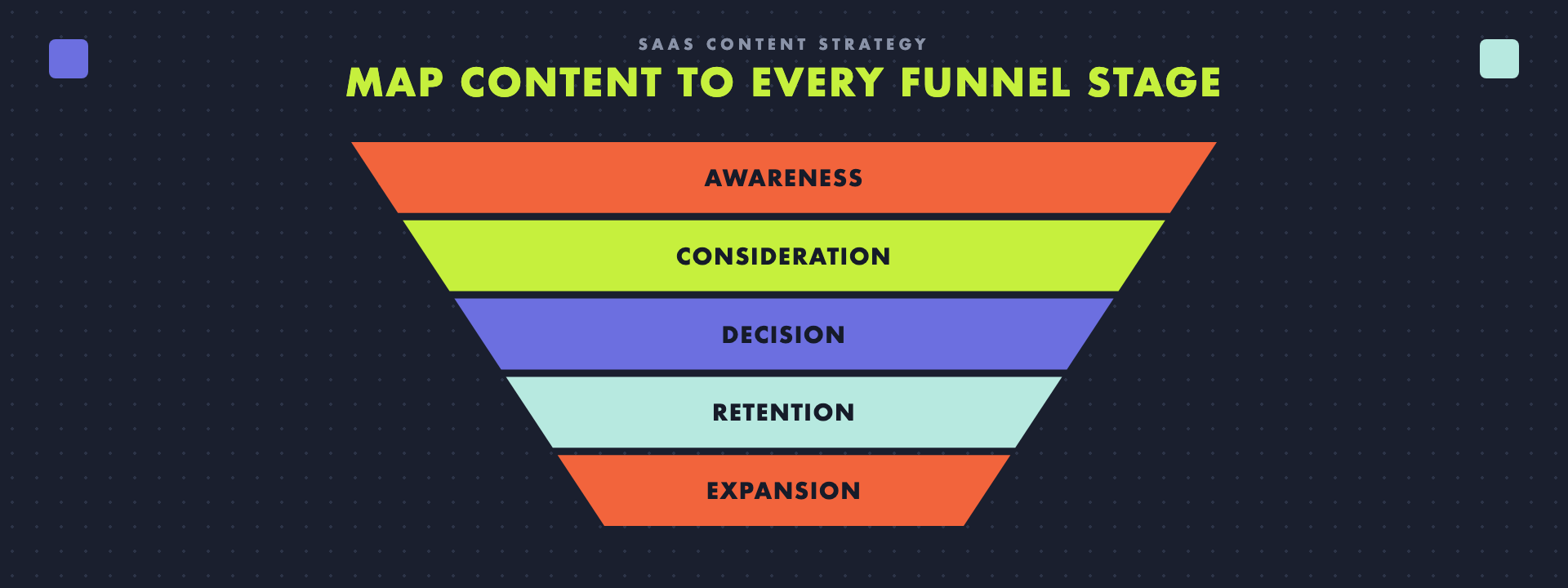
Map SaaS content to awareness, consideration, decision, retention, and expansion needs. Awareness content explains customer problems through educational guides and industry research, while consideration content supports evaluation with use cases, webinars, and comparisons. Decision content reduces purchase concerns with case studies, pricing details, implementation guides, demos, and security documentation. After purchase, onboarding tutorials and integration guides support adoption; each asset should serve a clear buyer need and next action because SaaS buyers usually move between stages.
7. Mix Content Formats That Fit SaaS Buyers
A SaaS content strategy works best when it matches content formats to buyer needs and research stages. Blog posts, videos, case studies, webinars, comparison pages, and long-form guides help buyers learn, evaluate, and validate software. Videos produced the best results for 58% of B2B marketers and case studies for 53%, according to "B2B Content Marketing Benchmarks, Budgets, and Trends: Outlook for 2025" by Stephanie Stahl, Content Marketing Institute, October 2024. SaaS teams can repurpose research and expert findings into articles, videos, social posts, and sales materials, then measure each format by qualified engagement and pipeline contribution.
8. Create Product-Led Content
Product-led content teaches SaaS buyers to solve a defined problem through a practical product workflow. Start with a customer job-to-be-done, then show how relevant features support each step using screenshots, templates, or examples. Explain setup requirements and trade-offs so readers can apply the guidance accurately. Link to a feature page, free trial, or interactive demo when it helps readers continue the task.
9. Publish Original Data and Benchmark Content
Original data and benchmark content give a SaaS brand evidence that competitors cannot easily reproduce. Collect proprietary findings through customer surveys, product usage patterns, or aggregated industry research, and report the methodology, sample size, and limitations. Turn the findings into a benchmark report with clear comparisons, charts, and practical recommendations. Share the report through sales materials, digital PR, email, social media, and supporting articles to attract relevant engagement, citations, and backlinks.
10. Build a Repeatable Content Production System
A repeatable content production system turns SaaS content strategy into a documented workflow with clear owners, deadlines, review stages, and quality standards. A centralized intake process and editorial calendar should record each asset’s audience, objective, topic, format, distribution channels, and success metric. Assign research, writing, subject-matter review, editing, design, SEO, legal approval, publishing, and reporting to named owners, then use briefs, templates, checklists, and project trackers to manage handoffs. Quality checks should cover factual accuracy, proofreading, brand voice, accessibility, and final approval, producing finished articles, guides, videos, case studies, social posts, and email copy for the distribution plan to carry.
11. Design a Distribution Plan for Every Content Asset
A SaaS content distribution plan matches each content asset to its audience, purpose, and best-fit channels. Assign owned, earned, and paid channels, such as email, social media, customer communities, partner networks, public relations, and targeted promotion. Repurpose each asset into suitable formats, including sales materials, short videos, email excerpts, and social posts, then record owners, timing, and goals in the editorial calendar. Track qualified traffic, engagement, sign-ups, assisted conversions, and pipeline by channel, and use performance findings to improve future distribution.
12. Optimize SaaS Content for AI Search
SaaS content for AI search should answer buyer questions directly with clear headings, concise explanations, and original knowledge. Keep key information in crawlable page text, connect related pages with internal links, and maintain fast, accessible pages with accurate structured data. A KDD 2024 paper, "GEO: Generative Engine Optimization" by Pranjal Aggarwal and colleagues, found that selected content changes raised visibility in generative engine responses by up to 40%, with results varying by subject.
How to Measure the Impact of SaaS Content Marketing
To measure the impact of SaaS content marketing, teams follow the path from attention and engagement to qualified demand, pipeline, and revenue. Teams should match each KPI to a business goal, such as increasing qualified pipeline or reducing customer acquisition cost.
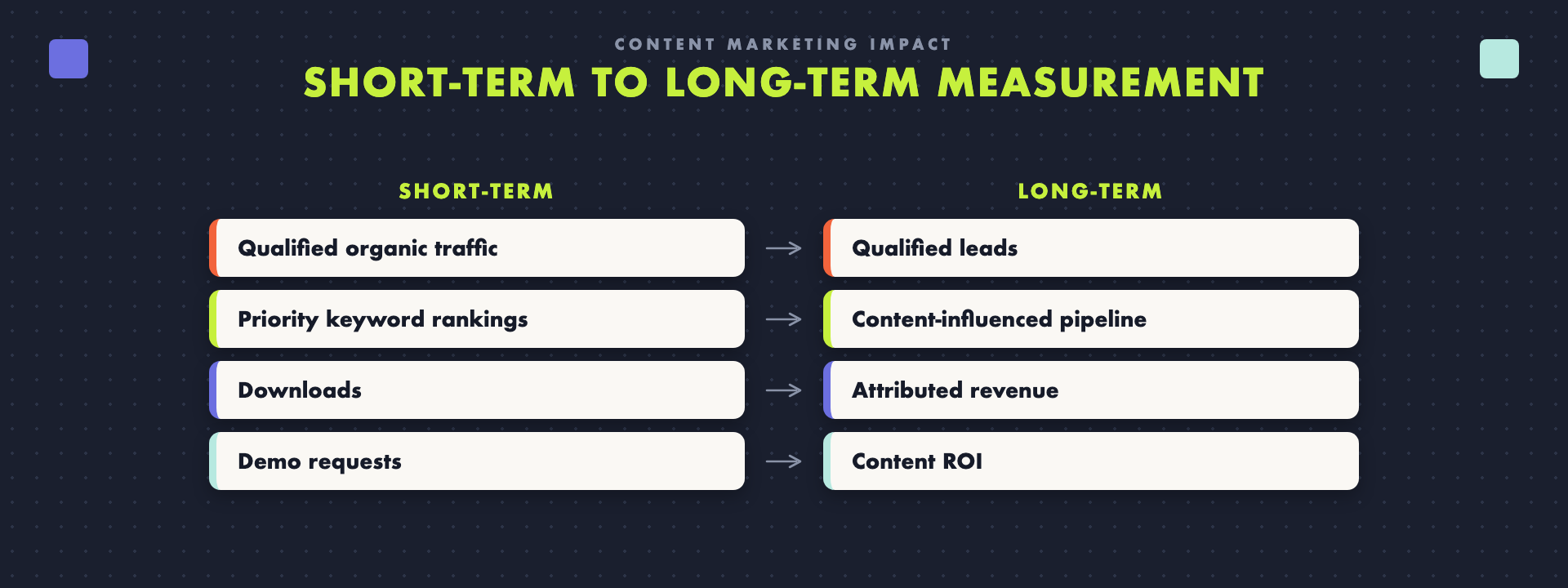
Short-term measurement tracks qualified organic traffic, priority keyword rankings, returning visitors, downloads, email subscriptions, and demo requests. Long-term measurement tracks qualified leads, content-influenced pipeline, assisted closed-won deals, attributed revenue, customer acquisition cost, and content ROI.
CRM records, campaign tracking links, and multi-touch attribution connect content interactions to sales outcomes. Teams should review results by asset, topic cluster, funnel stage, and customer cohort, then compare attributed revenue with content production and promotion costs.
Which Short-Term KPIs Track SaaS Content Performance?
The short-term KPIs that track SaaS content performance are listed below:
- Organic search impressions and clicks
- Qualified organic sessions
- Engagement rate and average time on page
- Scroll depth and pages per session
- Email open and click-through rates
- Content conversion rate and downloads
- Newsletter subscriptions
- Trial sign-ups and demo requests
- Form completions and marketing-qualified leads
Which Long-Term KPIs Prove SaaS Content ROI?
The long-term KPIs that prove SaaS content ROI are listed below:
- Content-influenced pipeline value
- Marketing-sourced pipeline
- Content-attributed revenue
- Lead-to-customer conversion rate
- MQL-to-SQL and SQL-to-opportunity conversion rates
- Customer acquisition cost by content channel
- Customer lifetime value from content-acquired customers
- Sales-cycle length and pipeline velocity
- Content-influenced opportunity win rate
- Expansion, renewal, and retention revenue
- Return on content investment (ROCI)
How Long Does SaaS Content Marketing Take to Work?
SaaS content marketing usually takes 6–12 months to produce meaningful, measurable results. Early signs, such as indexing, impressions, rankings, and initial conversions, can appear within 3–6 months.
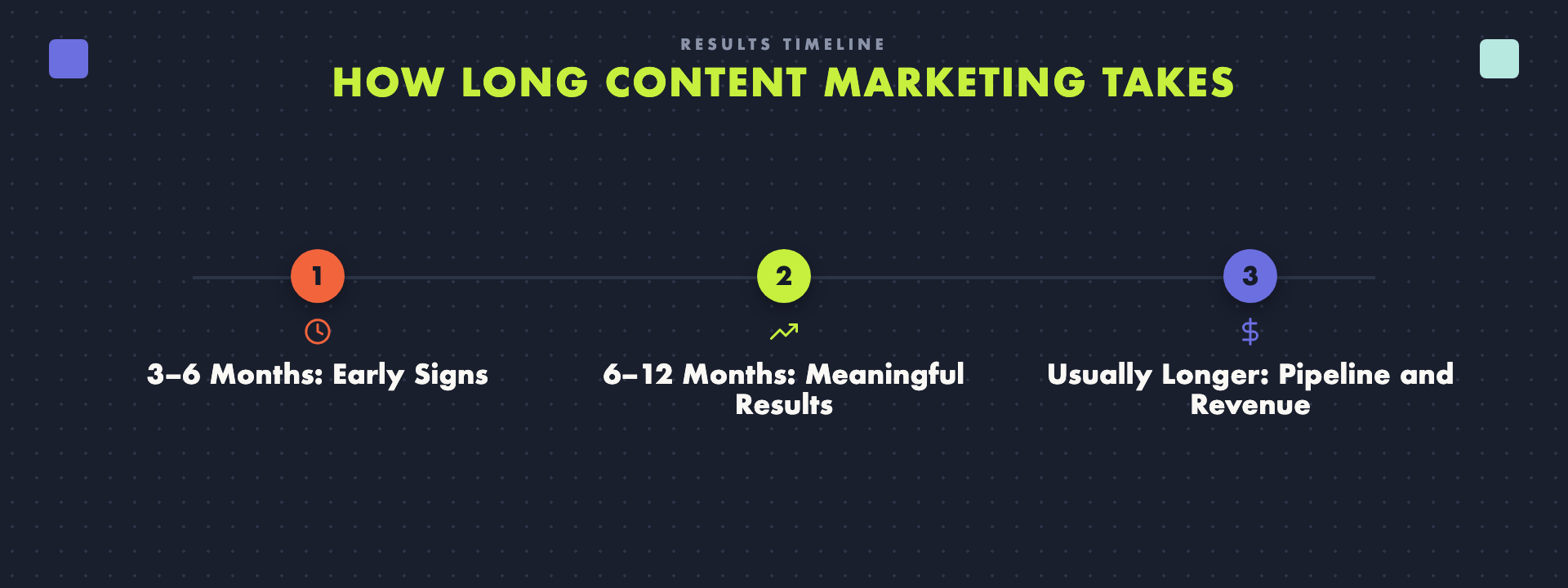
Only 1.74% of newly published pages rank in the top 10 within a year, according to "How Long Does It Take to Rank in Google? And How Old Are Top Ranking Pages?" by Patrick Stox, Ahrefs, May 2025, which reflects the time required to build search visibility. Pipeline and revenue results usually take longer because SaaS buying cycles involve multiple stakeholders and touchpoints.
Teams should track early indicators monthly and evaluate pipeline impact across 6–12 months. Domain authority, competition, content quality, publishing consistency, distribution, and sales-cycle length all affect the timeline.
What Are Common SaaS Content Strategy Mistakes?
The common SaaS content strategy mistakes are listed below: The following mistakes can weaken content quality, search visibility, and revenue impact.
- Writing for the company instead of the customer: Company-focused content usually leads with product features, internal terminology, or technical details. Customer-focused content explains the buyer’s problem first, then connects product capabilities to practical outcomes.
- Publishing without a documented strategy: A content plan needs defined audiences, business goals, topics, funnel roles, and distribution channels. Without a documented strategy, teams publish disconnected assets and struggle to assess results.
- Ignoring the ideal customer profile: Broad content may attract readers who lack the need, budget, or fit for the SaaS product. Define target accounts, buyer roles, pain points, and decision criteria before setting editorial priorities.
- Choosing topics only by search volume: High-volume keywords can attract visitors with little buying intent or product fit. Combine keyword research with customer interviews, sales objections, use cases, and pipeline potential.
- Optimizing for traffic instead of pipeline: Page views, rankings, and impressions show reach, but they do not prove commercial impact. Track qualified conversions, sales opportunities, assisted pipeline, trials, and revenue alongside traffic.
- Disconnecting content from the buying stages: Content that answers only early research questions may leave evaluation and purchase concerns unresolved. Map resources to buyer questions, decision stages, and the needs of multiple stakeholders.
- Publishing only one type of funnel content: A library of comparison pages and case studies may miss buyers looking for foundational education. A library of introductory articles may fail to support prospects evaluating named tools. Balance educational content with decision-stage assets.
- Producing generic or undifferentiated articles: Rewording competitor content gives buyers few reasons to trust or remember a SaaS brand. Add original research, firsthand experience, product examples, and a clear point of view.
- Prioritizing publishing volume over quality: A high publishing cadence cannot compensate for weak research, editing, or subject-matter review. Set a sustainable schedule that protects accuracy, usefulness, and editorial quality.
- Publishing AI-generated content without review: Unreviewed AI drafts can contain inaccurate claims, generic advice, and an inconsistent brand voice. Use AI to support research or drafting, then require human fact-checking and subject-matter review.
- Failing to distribute finished content: Publishing an article does not guarantee that buyers will find it. Share each asset through relevant channels, such as email, social media, sales enablement, communities, partnerships, and internal links.
- Leaving content without a relevant next step: A page without a suitable call to action can lose qualified reader interest. Match the next step to intent, using options such as a related guide, template, product demo, trial, or sales conversation.
- Ignoring sales and customer insight: Sales objections, support requests, implementation questions, and customer interviews reveal topics that keyword tools may miss. Gather those findings every month and turn recurring buyer questions into useful content.
- Neglecting content updates and site structure: Outdated statistics, product screenshots, links, or recommendations can reduce trust. Review priority pages, clarify each page’s search intent, consolidate overlapping topics, and fix technical barriers to discovery.
- Setting unrealistic expectations or publishing inconsistently: Content rarely creates dependable organic visibility or pipeline immediately. Unrealistic deadlines can prompt teams to abandon a strategy early, while irregular publishing makes it harder to build topic coverage and learn from performance.
- Failing to define ownership or improve from evidence: Unclear responsibilities for research, writing, review, design, publishing, and measurement can delay production. Assign owners and use search, conversion, sales, and revenue data to refine the strategy over time.
Should SaaS Teams Run Content Marketing In-House or With Experts?
SaaS teams should run content marketing as a hybrid model. In-house staff should own strategy, positioning, product knowledge, customer findings, and brand approvals, while external experts can provide specialized skills or increase production capacity.
An in-house team suits companies that need close daily collaboration with sales and product teams. Agencies and freelancers suit teams that need faster execution or skill without hiring full-time staff; clear ownership of strategy, approvals, and performance reporting keeps the work aligned.
How Does a SaaS Content Marketing Agency Scale Production?
A SaaS content marketing agency scales production with documented workflows, specialized roles, reusable templates, and access to subject-matter experts. Agency teams manage audience research, topic selection, briefs, drafting, editing, fact-checking, SEO, publishing, and distribution with clear ownership at each stage.
Editorial checklists, style guides, and approval systems help agencies maintain consistent quality as output grows. Automation supports research, formatting, optimization, and repurposing, while human strategists and editors verify accuracy, product details, positioning, and brand voice with input from the SaaS team.
How Does a SaaS Marketing Agency Connect Content Marketing to Pipeline?
A SaaS marketing agency connects content marketing to pipeline by mapping each asset to a business outcome, such as generating qualified demand, advancing opportunities, or supporting customer expansion. The agency tracks content interactions through CRM records, UTM parameters, form submissions, demo requests, webinar registrations, and downloads.
Pipeline reporting measures content-sourced and content-influenced opportunities, opportunity-to-customer conversion, sales-cycle velocity, deal value, and revenue. Attribution analysis, sales feedback, and win-loss findings help the agency identify which topics, formats, and channels contribute to pipeline and guide future content priorities.
Which Content Types Drive the Best SaaS Content Marketing Results?
The content types that drive the best SaaS content marketing results match formats to buyer needs. Research from the Content Marketing Institute, "B2B Content Marketing Benchmarks, Budgets, and Trends: Outlook for 2025", ranks video, case studies, and research reports among the formats that produce the best results. HubSpot ranks short-form video first for ROI among formats in "2026 state of marketing: Data from 1,500+ global marketers" by Mandy Bray, April 2026.
Educational articles and long-form guides answer early research questions, while product demonstrations help buyers assess workflows and usability. Case studies, comparison pages, webinars, and original research support vendor evaluation and purchase decisions. SaaS teams get stronger results when each asset answers a buyer question and guides readers toward a relevant next step.
How Do Case Studies Support SaaS Content Marketing?
Case studies support SaaS content marketing by showing how customers solve defined problems and achieve measurable results with a product.
How Do Webinars Support SaaS Content Marketing?
Webinars support SaaS content marketing by combining education, product demonstrations, expert commentary, and live audience interaction. Webinars help middle-of-funnel prospects evaluate tools, address objections, and signal purchase interest. SaaS teams can extend each webinar’s reach by repurposing its recording into short videos, blog posts, social content, email sequences, and sales materials.
How Does Video Support SaaS Content Marketing?
Video supports SaaS content marketing by demonstrating product features, explaining workflows, and answering implementation questions. Tutorials, product walkthroughs, customer interviews, webinars, and comparison videos help buyers evaluate tools at different stages. Content Marketing Institute research found that videos produced the best results for 58% of B2B marketers.
How Do Whitepapers Support SaaS Content Marketing?
Whitepapers support SaaS content marketing by explaining complex customer problems, technologies, and industry trends through detailed, evidence-based analysis. A focused whitepaper builds authority, informs buying committees, and gives sales teams a useful follow-up resource; a relevant landing page can generate qualified leads.
How Do Long-Form Guides Support SaaS Content Marketing?
Long-form guides support SaaS content marketing by explaining complex problems, comparing tools, and helping buyers plan implementation. Well-structured, evidence-based guides attract informational search traffic, build topical authority, and direct readers to relevant product, comparison, or demo pages.
How Do Bottom-of-Funnel Pages Turn SaaS Content Marketing Into Pipeline?
Bottom-of-funnel pages turn SaaS content marketing into pipeline by answering questions from buyers evaluating vendors or preparing to purchase. Pricing, product, comparison, alternatives, case study, ROI, and implementation pages clarify cost, fit, capabilities, results, and risk.
Each page should match one commercial intent and support claims with verifiable details, such as integrations, implementation requirements, customer outcomes, and trade-offs. Clear calls to action, low-friction forms, and conversion tracking connect qualified visits to leads, sales opportunities, and revenue.
How Do Comparison Pages Support SaaS Content Marketing?
Comparison pages support SaaS content marketing by helping buyers evaluate competing products during vendor research and by capturing high-intent search traffic. Accurate comparisons of features, integrations, pricing, support, implementation, and use cases build trust and guide qualified prospects toward a demo or trial.
How Do Alternatives Pages Support SaaS Content Marketing?
Alternatives pages support SaaS content marketing by targeting high-intent buyers comparing or replacing a competitor’s product. Clear pages compare features, pricing, integrations, and implementation needs, acknowledge where competing products fit better, and support claims with customer evidence. A focused demo or trial call to action helps convert qualified visitors, while regular updates keep comparisons accurate.
How Do Use Case Pages Support SaaS Content Marketing?
Use case pages support SaaS content marketing by showing how a product solves a defined problem for a role, workflow, or industry. Strong pages connect relevant features, integrations, practical steps, and customer proof to a focused call to action, helping qualified visitors evaluate the product.
Why Does a Consistent SaaS Content Marketing Strategy Compound Growth?
A consistent SaaS content marketing strategy compounds growth by adding useful assets that attract buyers, build trust, and support conversions over time. Search-optimized articles, comparison pages, and product-led guides can continue attracting qualified visitors after publication, while internal links help buyers find related content and product tools.
Consistency means publishing at a sustainable cadence, updating existing assets, and distributing each piece reliably. Audience research, pipeline goals, and useful content turn consistent publishing into the successful SaaS content marketing strategy the tips build.

About the team
SaaS Marketing Agency Digital Team
The in-house team at SaaS Marketing Agency Digital. We architect growth systems for B2B SaaS companies from Series A through pre-IPO.