A multi-channel marketing strategy for SaaS coordinates several marketing channels to attract, convert, and retain customers. SaaS companies assign channels roles across the buying stages while keeping a consistent value proposition. Unlike cross-channel marketing, multi-channel campaigns do not require customers to move smoothly between channels; unlike omnichannel marketing, they do not unify every interaction around one real-time customer profile. Organic search and content, paid search and paid social, and email and lifecycle marketing form the core channel groups.
Building a SaaS multi-channel strategy requires defining buyer personas, selecting channels by funnel stage, maintaining consistent messaging, adjusting content, coordinating automation, and tracking performance. Common challenges include fragmented data, attribution gaps, inconsistent messaging, thin resources, rising acquisition costs, and channel saturation. Early-stage teams can focus on one or two channels to validate demand, while growth-stage and mature teams add supporting programs and optimize retention and returns. Demand generation connects audiences, content, campaigns, and measurement across the funnel, while a SaaS marketing agency can manage research, strategy, creative, media buying, automation, reporting, and optimization.
SaaS teams should fund channels according to measurable outcomes and assess performance through attribution, conversion, retention, and revenue metrics. Organic content builds discoverability, paid search captures active intent, paid social reaches and retargets prospects, and lifecycle email nurtures customers. The channels reinforce each other as campaign data improves targeting and resource allocation, compounding SaaS growth over time. A multi-channel marketing strategy for SaaS is the coordinated use of those channels to attract, convert, and retain customers.
What Is a Multi-Channel Marketing Strategy for SaaS?
A multi-channel marketing strategy for SaaS uses several marketing channels to attract, educate, convert, and retain software customers. Each channel has its own audience tactics, content formats, execution plan, and performance measures.
SaaS companies use channels such as organic search, content marketing, paid advertising, social media, and lifecycle email to support pipeline creation and recurring revenue. The strategy coordinates each channel toward shared growth goals while allowing channel activities to operate independently.
What Is an Example of Multi-Channel Marketing in SaaS?
An example of multi-channel marketing in SaaS is a SaaS accounting company supporting a free trial through SEO content, Google Ads, LinkedIn ads, and email. A search guide attracts organic visitors, paid search reaches people comparing software, LinkedIn ads target finance leaders, and email nurtures checklist downloads toward a trial or demo.
An enterprise SaaS company can coordinate LinkedIn and display ads for target accounts, personalized webinar invitations by email, downloadable industry content, and sales outreach after engagement. Each channel reaches decision-makers differently while directing prospects toward the same campaign goal.
How Does Multi-Channel Differ From Cross-Channel and Omnichannel Marketing?
Multi-channel marketing differs from cross-channel and omnichannel marketing in how closely the channels connect, as the table below shows:
| Approach | Channel Coordination | Customer Experience | Best Fit |
|---|---|---|---|
| Multi-channel | Uses channels such as search, social media, email, and websites, usually managed and measured separately. | Reaches customers across multiple channels, but interactions may feel disconnected. | SaaS companies testing acquisition sources or building market presence across audience channels. |
| Cross-channel | Connects selected channels within a campaign or customer path, such as linking an ad, landing page, and follow-up email. | Creates more consistent interactions through coordinated handoffs between channels. | SaaS companies coordinating launches, lead nurturing, onboarding, or conversion campaigns. |
| Omnichannel | Integrates relevant channels through shared customer data, systems, and buying context. | Delivers a unified experience as customers move between channels. | SaaS companies with mature CRM, marketing automation, and analytics infrastructure. |
How Does Multi-Channel Marketing Work for SaaS Companies?
Multi-channel marketing works for SaaS companies by assigning distinct roles to channels across the buying stages. Organic search and educational content attract people researching a problem, paid search reaches prospects with active purchase intent, and paid social builds awareness among target audiences.
Email nurtures prospects with product education, trial reminders, onboarding messages, and renewal communications. Each channel uses content suited to its audience and format, while a shared value proposition keeps campaign messaging consistent. Marketing teams manage channel programs separately and measure both individual results and combined contributions to pipeline and revenue.
Why Does Multi-Channel Marketing Matter for SaaS Growth?
Multi-channel marketing supports SaaS growth because it reaches buyers across the touchpoints they use to research and evaluate software. B2B buyers use an average of 10 channels in a single purchase, up from 5 in 2016, according to "Five fundamental truths: How B2B winners keep growing" by McKinsey, which makes a coordinated presence across digital and sales channels increasingly important.
A multi-channel marketing strategy reduces reliance on one acquisition source and helps channels reinforce each other. Data from Dreamdata shows the average B2B buying path now spans 88 touchpoints and 272 days, in the "LinkedIn Ads Benchmarks Report 2026", March 2026.
Which Marketing Channels Belong in a SaaS Multi-Channel Strategy?
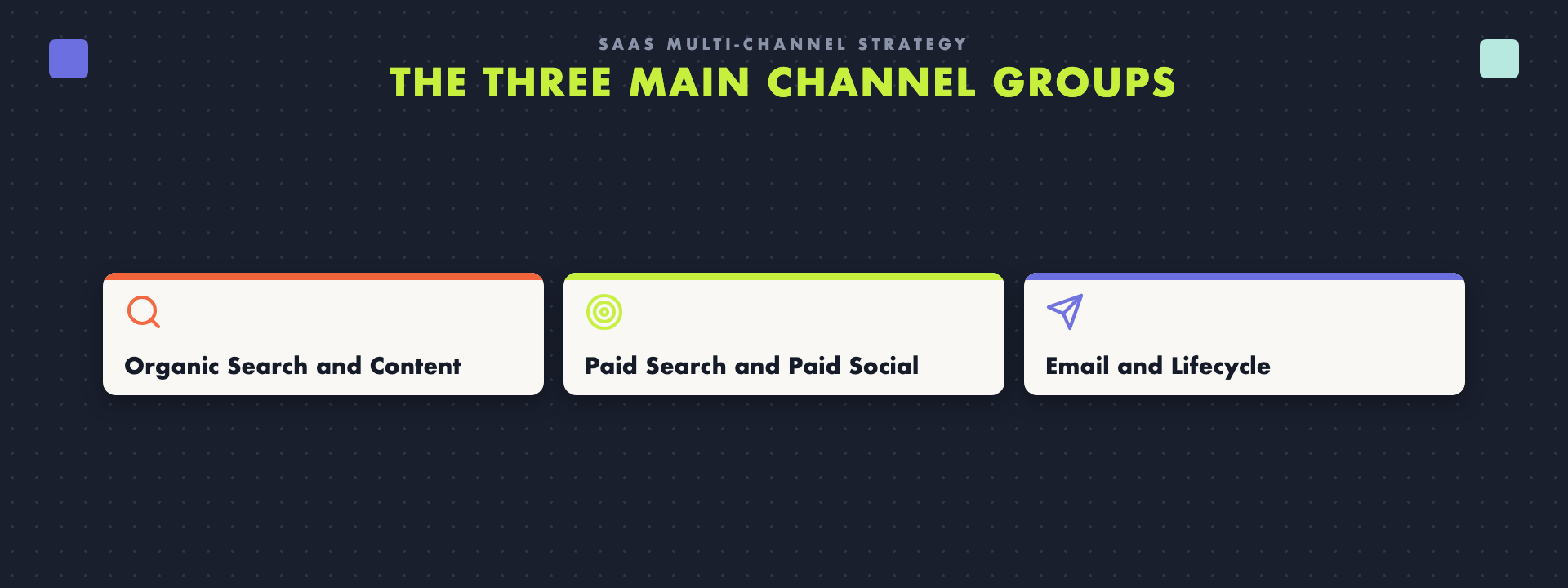
The marketing channels that belong in a SaaS multi-channel strategy attract prospects, build demand, and guide customers through the lifecycle. The three main channel groups are:
- Organic search and content: SEO, educational articles, comparison pages, and use-case pages attract buyers researching SaaS tools.
- Paid search and paid social: Google Ads captures high-intent searches, while LinkedIn advertising builds awareness, targets business audiences, and retargets prospects.
- Email and lifecycle: Segmented email campaigns nurture leads and support onboarding, activation, retention, renewals, and expansion.
Organic Search and Content Channels
Organic search and content channels help SaaS companies attract prospects through search engines and useful resources. Technical SEO, keyword research, product pages, comparison pages, blog articles, case studies, and educational resources address buyer needs across the buying stages. Helpful, current content and clear internal links guide readers from informational searches toward product evaluation. SaaS teams measure organic performance through rankings, qualified leads, pipeline, and revenue because search authority builds over time.
Paid Search and Paid Social Channels
Paid search captures existing demand through high-intent queries about SaaS categories, problems, competitors, pricing, and integrations. Google Ads can direct searchers to matched landing pages for demos, free trials, or sign-ups. Paid social platforms such as LinkedIn target audiences by role, industry, company, account, or behavior, helping SaaS teams distribute educational content and reach buying committees. Connecting ad platforms with CRM data helps teams optimize campaigns for qualified leads, opportunities, and revenue rather than clicks alone.
Email and Lifecycle Channels
Email and lifecycle channels guide SaaS prospects and customers through lead nurturing, onboarding, activation, adoption, renewal, expansion, and win-back. SaaS teams segment messages by lifecycle stage, role, subscription plan, product usage, and engagement. Marketing automation triggers relevant messages after sign-up, incomplete setup, feature adoption, approaching renewal, or inactivity. Teams measure lifecycle campaigns by activation, trial-to-paid conversion, retention, expansion revenue, and recovered churn.
How to Build a Multi-Channel Marketing Strategy for SaaS
To build a multi-channel marketing strategy for SaaS, a SaaS team completes six steps, from audience research to performance tracking.
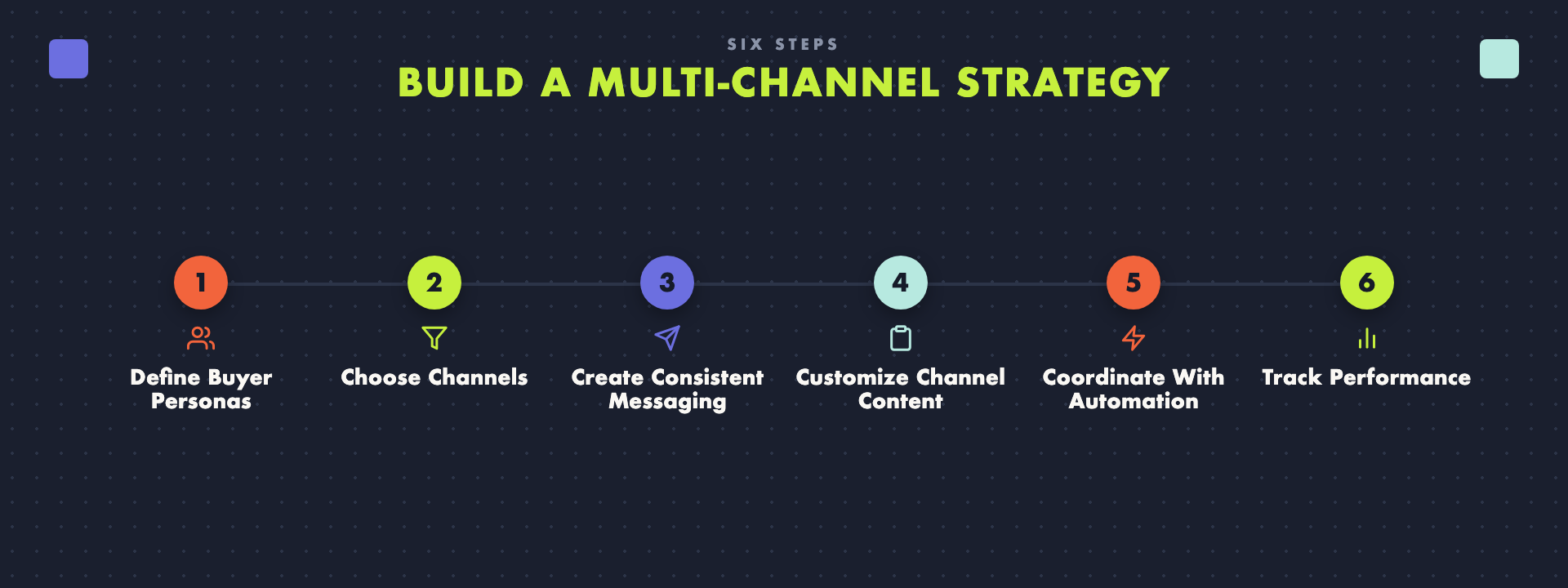
- Define buyer personas using customer profiles, goals, pain points, and buying triggers.
- Choose channels based on buyer behavior, funnel stage, and acquisition economics.
- Create consistent messaging around one value proposition, proof points, and calls to action.
- Customize channel content for search, paid ads, social media, landing pages, and email.
- Coordinate campaigns with automation through audience segments, behavior triggers, and timely follow-ups.
- Track performance against pipeline, revenue, conversion rates, and customer acquisition cost.
Step 1: Define Your Ideal Customer and Buyer Personas
A SaaS ideal customer profile defines the companies most likely to benefit from and buy the product. Use firmographic and operational details, such as industry, company size, location, budget, technology stack, business goals, and buying process, to build the profile.
Buyer personas describe the decision-makers and users within those companies. Use CRM and product data, sales patterns, retention trends, and customer interviews to document each person’s role, challenges, motivations, and decision criteria. Defined personas help SaaS teams identify where buyers spend attention, including search, content, social media, email, communities, and sales conversations.
Step 2: Choose the Right Channels for Each Funnel Stage
SaaS teams should choose channels by matching each buying stage with audience intent, information needs, and business goals. Organic search, educational content, and social channels build awareness; comparison pages, case studies, webinars, and retargeting support consideration; paid search, product demos, free trials, and sales outreach encourage conversion.
Email, in-app messaging, and customer-success communications support activation, retention, and expansion after signup. SaaS marketers should test a focused channel mix, assign each channel a KPI for its stage, and shift investment toward channels that generate qualified pipeline and revenue.
Step 3: Create Consistent Messaging Across Channels
Consistent SaaS messaging starts with one core message that identifies the target customer, problem, product value, and desired action. A messaging framework documents the brand voice, benefits, proof points, terminology, and calls to action; clear value communication supports a recognizable SaaS brand.
Each channel should adjust the core message to its format and audience while preserving the same positioning and campaign promise. A website can provide a detailed explanation, LinkedIn can share a concise insight, and email can highlight one customer benefit.
Step 4: Customize Content for Each Channel
SaaS teams customize content for each channel by matching its format, audience expectations, and role in the buying stages. A research report can become a LinkedIn carousel, an educational video, an email summary with one clear call to action, or a community discussion prompt.
Search content should answer buyer questions and demonstrate know-how, while paid ads should present a concise benefit and conversion-focused call to action. Email teams can personalize messages by lifecycle stage or user behavior, and social teams can use native formats, concise hooks, and platform-appropriate visuals. Marketers can refine content formats and distribution by reviewing channel engagement and conversion data.
Step 5: Coordinate Campaigns With Marketing Automation
Marketing automation coordinates SaaS campaigns by connecting CRM data, audience segments, content, and delivery rules in shared workflows. A form submission, product-page visit, trial signup, or email interaction can trigger a relevant next action, such as an educational email, an updated lifecycle stage, or a retargeting audience change.
SaaS teams use conditional branches and engagement scores to personalize follow-up and alert sales representatives when leads meet agreed criteria. Teams should set consent controls, suppression rules, and handoff criteria, then test workflows and track engagement, conversion, pipeline, and revenue.
Step 6: Track Performance and Optimize the Channel Mix
SaaS teams track each marketing channel against pipeline and revenue, not clicks alone. Campaign tags, conversion events, and CRM data connect visits and leads with customer acquisition cost, conversion rates, retention, and customer lifetime value.
Review results by channel, campaign, audience, and funnel stage. Multi-touch attribution and controlled tests reveal direct and assisted conversions, helping teams shift budget toward channels that generate qualified pipeline and revenue.
What Are Common Multi-Channel Marketing Challenges for SaaS?
The common multi-channel marketing challenges for SaaS are listed below:
- Fragmented data and disconnected systems: Advertising platforms, web analytics, CRM software, marketing automation, product analytics, and billing tools usually store separate records. Teams struggle to connect campaign activity with qualified pipeline, subscriptions, renewals, and expansion revenue.
- Overlapping attribution claims: Google, LinkedIn, Meta, and other platforms may each claim credit for the same conversion. Different attribution windows and models can inflate reported results and distort budget decisions.
- Complex SaaS buying process: SaaS buyers may research for months across multiple sessions, channels, product trials, and sales conversations. Several stakeholders from one account can engage independently, making the complete buying path difficult to map.
- Cross-device activity and anonymous research: Buyers may research on one device and return through a second device, splitting activity across separate records. Anonymous visits, private communities, and dark social can hide influential touchpoints.
- Privacy and tracking limits: Consent requirements, browser restrictions, cookie changes, and platform policies reduce the user-level data marketers can collect and connect. Reduced visibility makes cross-channel measurement less complete.
- Inconsistent campaign tracking: Missing UTM parameters, broken links, inconsistent campaign names, and incomplete lead-source fields create reporting gaps. Teams need shared tracking conventions to compare channel results reliably.
- Unrecorded offline and sales interactions: Events, direct mail, partner referrals, sales calls, demos, and proposals can influence revenue without appearing in marketing analytics. CRM teams need to record those interactions and connect them to accounts and opportunities.
- Inconsistent messaging and channel content: Separate teams may present conflicting product claims, pricing, value propositions, or calls to action. Each channel needs content suited to its format while preserving the same core positioning.
- Thin resources and premature channel expansion: Early-stage SaaS companies may lack the budget, skill, and analytics infrastructure to manage many channels well. Expanding before teams validate positioning, conversion paths, and retention can spread effort without improving qualified pipeline.
- Uncertain budget allocation and funnel objectives: Teams must balance awareness, demand capture, retargeting, lifecycle marketing, and experimentation. Misaligned goals, such as judging organic content only by immediate leads or paid campaigns only by clicks, can undervalue effective programs.
- Operational silos and campaign conflicts: Marketing, sales, customer success, product, and revenue operations need shared lifecycle definitions, ownership rules, and handoffs. Poor coordination can send repetitive ads, irrelevant emails, or conflicting offers to the same prospect.
- Audience fatigue and weak lead handoffs: Repeated exposure across search, social, email, and retargeting can lower engagement and damage brand perception. Weak qualification or routing can leave sales teams without timely context about a lead’s needs and activity.
- Long feedback cycles and attribution limits: SaaS revenue outcomes may take weeks or months to mature, so teams need leading indicators alongside closed-won revenue and retention metrics. No attribution model captures every influence, so marketers should use attribution as decision support rather than proof of causality.
- Changing platform conditions and scaling pressure: Auction prices, algorithms, audience access, tracking rules, and platform policies change over time. Higher spending can raise acquisition costs when teams exhaust creative, target small audiences, or exceed sales capacity.
- Poor data quality and measurement governance: Duplicate contacts, incomplete firmographic fields, outdated records, and inconsistent account names can distort segmentation and reporting. Teams need shared definitions for qualified leads, pipeline, activation, customer acquisition cost, and attribution windows.
- Difficulty connecting campaigns to customer economics: Clicks and lead volume provide less insight than activation, retention, expansion, and revenue. SaaS teams that optimize only for top-of-funnel volume may favor channels that generate activity but weak customer outcomes.
How Should SaaS Teams Prioritize Multi-Channel Marketing by Growth Stage?
SaaS teams should prioritize marketing channels according to product-market fit, growth stage, resources, and measurable traction. Before product-market fit, founders should focus on customer conversations, direct outreach, and low-cost experiments that test customer profiles and messaging.
After a repeatable sales motion emerges, teams should prove one or two channels, such as SEO, targeted content, outbound email, or organic LinkedIn. Scaling teams can expand into paid search, paid social, webinars, and partnerships after pipeline quality, conversion rates, and unit economics show traction. Median sales and marketing spend runs 38% of revenue below $1 million ARR and 33% above $100 million ARR, according to the "2025 B2B SaaS Performance Metrics Benchmarks" by Benchmarkit, 2025.
How Does Demand Generation Connect Multi-Channel SaaS Campaigns?
Demand generation connects multi-channel SaaS campaigns into a coordinated system for creating, capturing, and converting buyer demand. Shared audience definitions, funnel stages, campaign goals, messaging, and measurement align content, SEO, social media, paid advertising, webinars, and email.
For example, a SaaS company can publish SEO content, support it on LinkedIn, invite readers to a webinar, and nurture registrants through email. Product-focused search ads and retargeting can then guide interested prospects toward a trial, demo, or sales conversation.
How Does a SaaS Marketing Agency Run Multi-Channel Marketing Campaigns?
A SaaS marketing agency starts by auditing business goals, the ideal customer profile, funnel performance, existing channels, marketing technology, and success metrics. The agency then builds a coordinated plan across SEO and content, paid search, LinkedIn or other paid social, landing pages, email automation, retargeting, and conversion-rate optimization.
The agency aligns audience targeting, messaging, creative, and calls to action with each buying stage. After launch, the agency coordinates campaigns through the CRM and marketing automation platform, tracks qualified conversions, acquisition costs, pipeline, revenue, and retention, then tests campaigns and reallocates budget based on performance.
How Do SaaS Teams Fund and Measure Multi-Channel Marketing?
SaaS teams fund multi-channel marketing according to growth goals, target markets, sales motions, and evidence of channel performance. Budget allocation should reflect customer acquisition cost, payback period, and the capacity to test and sustain channels.
Marketing measurement connects channel spending to qualified leads, pipeline, new customers, and recurring revenue. Teams track engagement, conversion rates, customer acquisition cost, and multi-touch attribution to adjust funding across the buying stages.
How Much Budget Does a Multi-Channel Marketing Strategy Need?
A multi-channel marketing strategy for SaaS needs a planning range near 8% of ARR, the median marketing spend across more than 1,000 private B2B SaaS companies, according to "2026 Spending Benchmarks for Private B2B SaaS Companies" by SaaS Capital, June 2026. SaaS teams should adjust spending to growth targets, acquisition costs, and available cash.
How Do You Attribute Revenue Across Multi-Channel Marketing?
SaaS revenue attribution assigns conversion or deal credit across the marketing touchpoints that influenced the buyer, rather than crediting only the final click. Teams connect campaign, CRM, product, and revenue data, then apply a consistent attribution model, such as data-driven attribution when conversion volume supports it. Teams compare attributed revenue with conversion rate, customer acquisition cost, payback period, and retention, then validate budget decisions through cohort analysis or controlled tests.
Which Buyer Journey Touchpoints Should Multi-Channel Attribution Track?
The buyer journey touchpoints that multi-channel attribution should track run from first awareness through customer retention.
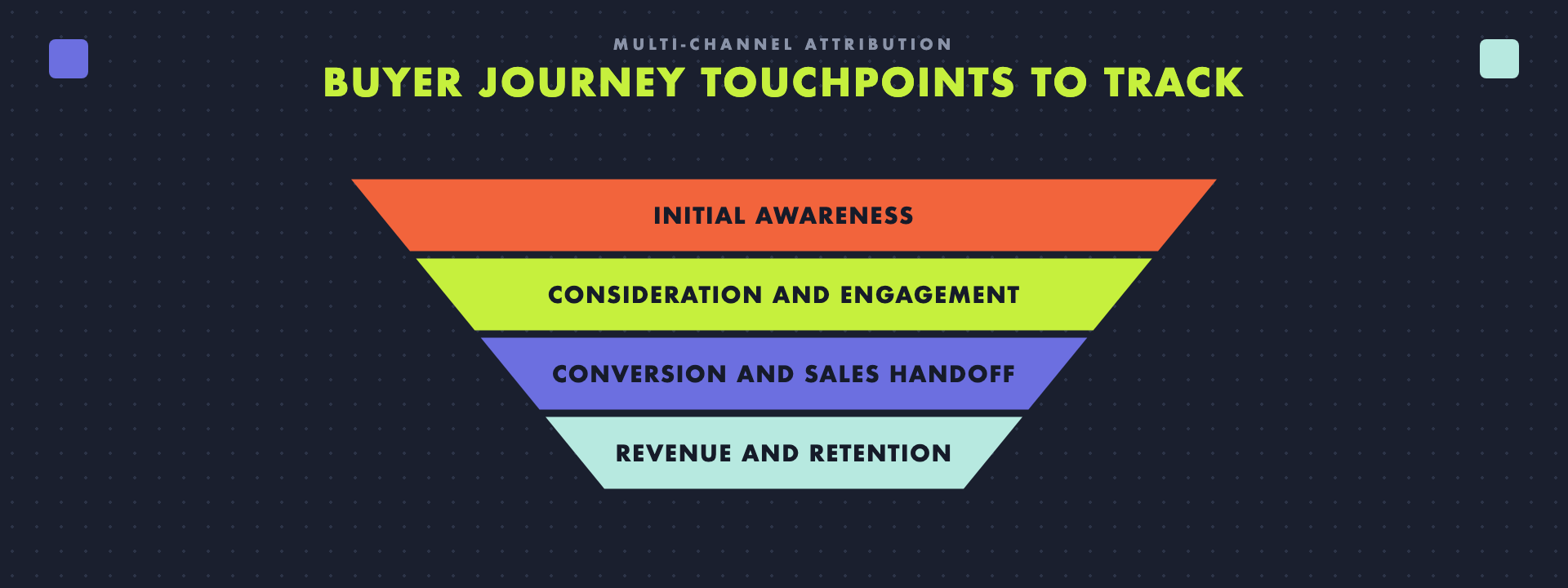
- Initial awareness: Ad impressions, organic search visits, and social interactions.
- Consideration and engagement: Content views, webinar registrations, email interactions, and return visits.
- Conversion and sales handoff: Demo requests, trial sign-ups, pricing-page visits, and qualified leads.
- Revenue and retention: Paid conversions, renewals, expansion, product usage, and customer-success interactions.
Which Channels Work Best Together in Multi-Channel SaaS Campaigns?
The channels that work best together in multi-channel SaaS campaigns are SEO and content with paid search, because organic content builds long-term visibility, while paid search captures active buying intent. LinkedIn reaches professional audiences and supports retargeting, while email nurtures prospects through evaluation and conversion.
A practical B2B SaaS mix combines SEO and content, paid search, LinkedIn, and email. SaaS teams should adjust the mix to their ideal customer profile, sales cycle, and measured contribution to pipeline and revenue; webinars or events can support products that require deeper education.
How Do Organic and Paid Campaigns Work Together in SaaS?
Paid search provides immediate visibility and tests high-intent keywords and messaging, while organic search builds durable visibility through optimized content and landing pages. SaaS teams use paid-search query and conversion data to guide SEO priorities, and strong organic landing pages can improve paid-ad relevance and conversion rates. Paid advertising does not directly improve organic search rankings.
How Does LinkedIn Support Multi-Channel SaaS Campaigns?
LinkedIn supports multi-channel SaaS campaigns by targeting professional audiences by job function, seniority, industry, company size, and matched audiences. SaaS teams use Sponsored Content, Lead Gen Forms, and messaging ads to support webinars, case studies, and free trials, then route captured leads into email nurturing, retargeting, and sales follow-up. LinkedIn engagement data helps teams refine audience segments and optimize campaigns.
Why Does a Multi-Channel Marketing Strategy Compound SaaS Growth?
A multi-channel marketing strategy compounds SaaS growth by allowing each channel to strengthen the others. Paid search and social campaigns can build awareness, organic search and content can capture ongoing demand, and email and lifecycle campaigns can nurture prospects, support product adoption, and reduce churn.
Shared customer data and consistent positioning help SaaS teams refine targeting and messaging across campaigns. As content, audience findings, and customer relationships accumulate, the reinforcing channels support acquisition, conversion, expansion, and retention as parts of one multi-channel marketing strategy for SaaS.

About the team
SaaS Marketing Agency Digital Team
The in-house team at SaaS Marketing Agency Digital. We architect growth systems for B2B SaaS companies from Series A through pre-IPO.