SaaS organic marketing earns attention over time, while paid marketing purchases targeted reach for faster results. Organic SaaS marketing builds demand through SEO, educational content, unpaid social media, email, communities, referrals, and partnerships. Paid SaaS marketing uses search ads, paid social, display, sponsorships, and retargeting to reach selected audiences. Organic channels require ongoing work and can compound into lower acquisition costs; paid channels deliver faster traffic but require continuing media spend. One B2B SaaS benchmark reports average CAC of about $942 for organic channels and $1,907 for paid channels, but company size, sales model, contract value, and attribution methods can change those figures.
The two approaches overlap in audience, messaging, conversion assets, and performance measurement. SaaS companies use organic marketing to build durable search visibility and category credibility, while paid campaigns support launches, audience tests, and near-term demand capture. Demand generation combines organic content with paid distribution, while a SaaS marketing agency balances durable content investment against campaigns measured by qualified pipeline, CAC, conversion rate, and payback.
Organic marketing can compound reach and reduce long-term acquisition costs, but it takes time and offers less immediate control. Paid marketing provides speed, targeting, and measurable campaign data, but it brings recurring costs and auction risk. Paid campaigns can distribute proven organic content, while organic content can strengthen trust and improve the relevance of paid campaigns. Most SaaS companies need both because organic marketing earns attention over time and paid marketing buys it sooner.
What Is the Difference Between Organic and Paid Marketing for SaaS?
The main difference between organic and paid marketing for SaaS is how each approach earns visibility. Organic marketing builds reach through unpaid channels, while paid marketing buys audience exposure through advertising.
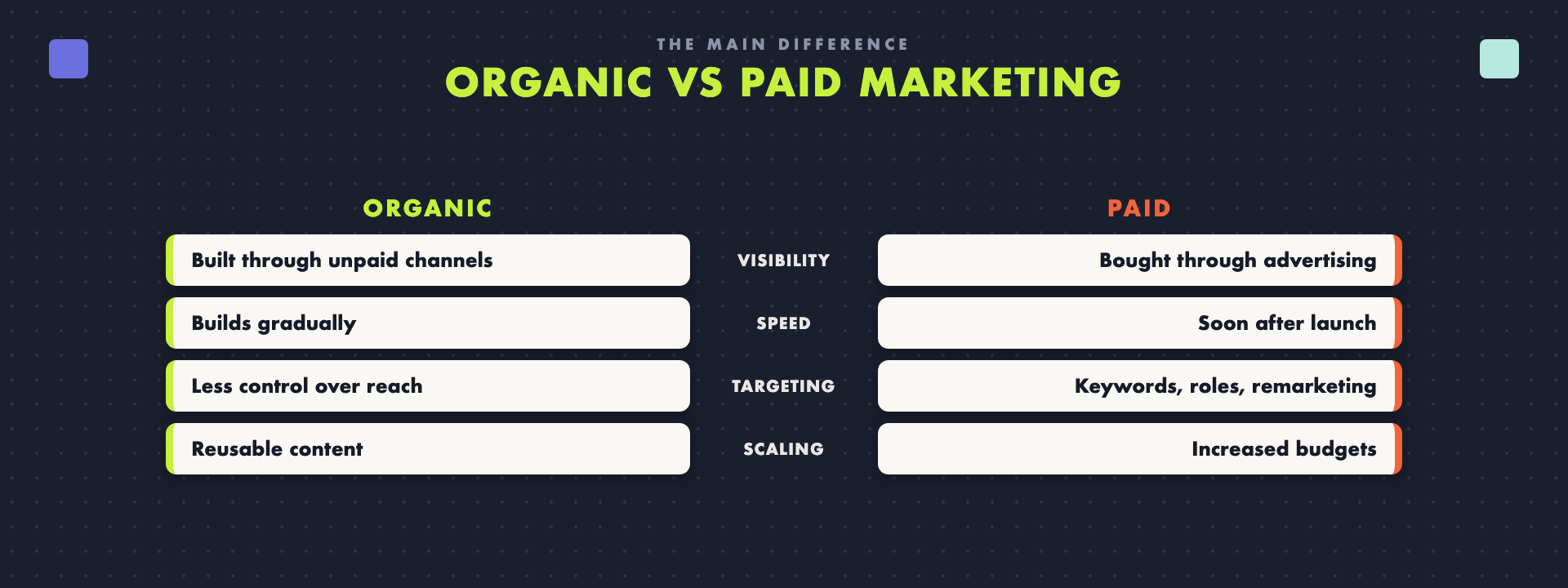
SaaS organic marketing uses search engine optimization, educational content, social media, and communities to attract potential customers over time. SaaS paid marketing uses search ads, paid social, display ads, and retargeting to reach selected audiences quickly, with costs tied to campaign spending.
What Is Organic Marketing for SaaS?
Organic marketing for SaaS attracts, educates, and converts potential customers through unpaid distribution rather than purchased ad placements. SaaS companies use search engine optimization (SEO), educational content, unpaid social media, newsletters, webinars, communities, public relations, and founder-led marketing.
Organic SaaS marketing builds discoverability and trust over time. Content and search visibility can continue attracting prospects after publication, although teams still invest time and resources in creating and maintaining those assets.
Which Channels Count as Organic SaaS Marketing?
The channels that count as organic SaaS marketing are listed below:
- SEO and organic search: Optimizing website pages, product documentation, and educational content for unpaid search results.
- Content marketing: Publishing blogs, guides, case studies, webinars, videos, and podcasts.
- Organic social media and communities: Sharing unpaid posts and joining discussions on LinkedIn, Reddit, and industry forums.
- Email, referrals, and word of mouth: Nurturing subscribers and encouraging customer recommendations without paid ad placement.
What Is Paid Marketing for SaaS?
Paid marketing for SaaS is the use of advertising budgets to reach potential software buyers and generate trials, demo requests, qualified pipeline, or subscriptions. SaaS companies buy visibility through paid search, social media ads, display advertising, review sites, and retargeting.
SaaS paid campaigns target audiences by search intent, job role, company account, or previous website activity. Marketing teams measure performance from ad clicks through signups, activation, customer acquisition cost (CAC), recurring revenue, and payback period.
Which Channels Count as Paid SaaS Marketing?
The channels that count as paid SaaS marketing are listed below:
- Paid search advertising on Google Ads and other search engines.
- Paid social advertising on LinkedIn, Meta, and Reddit.
- Display and programmatic advertising across websites, apps, and ad networks.
- Retargeting and remarketing for people who visited a website or engaged with company content.
Key Differences Between SaaS Organic and Paid Marketing
| Dimension | Organic Marketing | Paid Marketing |
|---|---|---|
| Cost and CAC | Requires investment in content, SEO, specialist staff, and time. First Page Sage reports organic CAC about 40% below paid CAC, though results vary by company and channel. | Requires ongoing media spend, usually through CPC, CPM, or CPL campaigns. Costs vary by market and campaign. |
| Speed to results | Usually builds traffic and pipeline gradually as content earns rankings, links, and audience trust. | Can generate impressions, clicks, and leads soon after campaign launch. |
| Audience targeting | Attracts prospects through search intent, useful content, referrals, and community engagement, with less control over individual reach. | Targets audiences through keywords, demographics, job roles, industries, company attributes, and remarketing lists. |
| Scalability | Scales through reusable content and accumulated search visibility, subject to competition and production capacity. | Scales through increased budgets, expanded audiences, and additional campaigns, subject to auction costs and acceptable CAC. |
Cost and CAC Differences Between Organic and Paid SaaS Marketing
Organic SaaS marketing requires investment in content, SEO, distribution, and staff or agency time, while paid marketing adds ongoing media spend. First Page Sage reports B2B SaaS organic CAC about 40% below inorganic CAC, in "Average Customer Acquisition Cost (CAC) By Industry: B2B Edition", January 2026, using client data from a firm that sells SEO.
Lower organic CAC does not necessarily mean faster payback: SEO and content can take months to generate qualified demand, while paid campaigns can produce leads soon after launch. Median CAC payback is 11 months below $5,000 ACV and 22 months at $50,000–$100,000 ACV, according to "2026 SaaS & AI Performance Benchmarks" by Aleph and Benchmarkit, June 2026, which shows how payback varies by contract value.
Speed to Results Differences Between Organic and Paid SaaS Marketing
Paid SaaS marketing can generate traffic, clicks, and conversion data within days or weeks, while organic marketing usually takes several months to build meaningful traffic and pipeline. First Page Sage puts break-even at 4 months for SEM and PPC and 9 months for SEO, in "Digital Marketing Statistics: 2025 Compendium", November 2024.
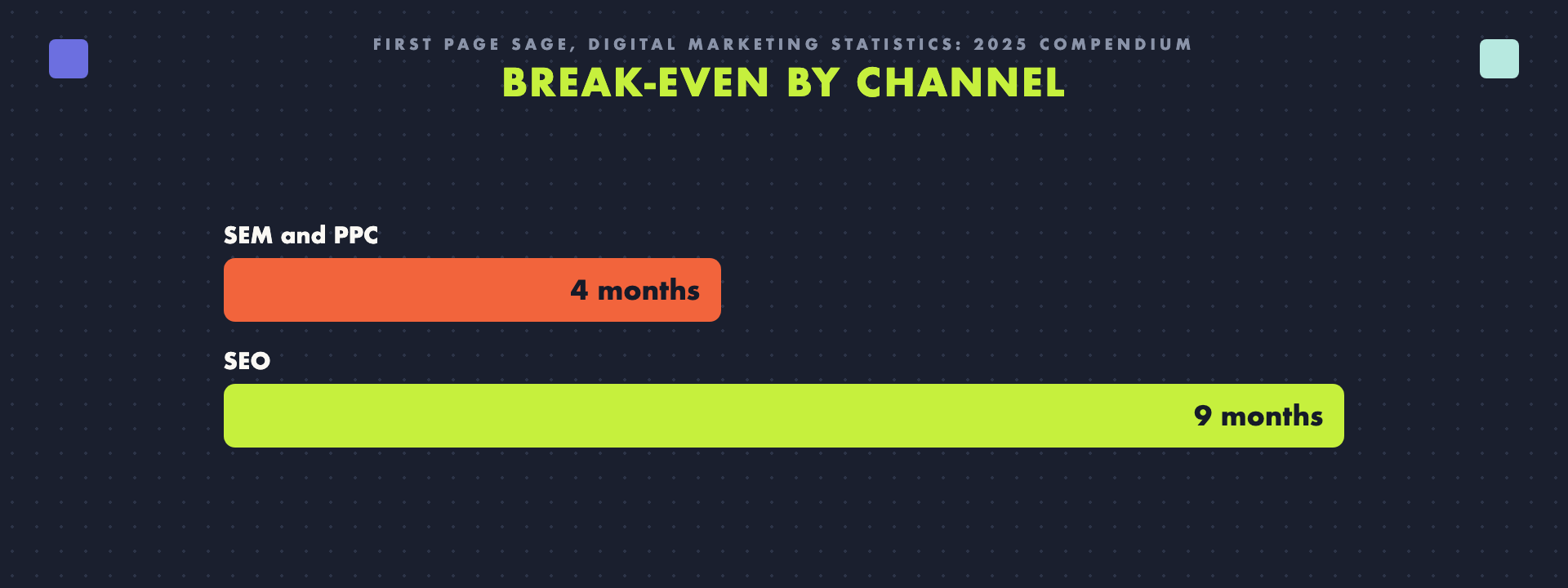
Paid campaigns reach audiences soon after approval and launch, giving SaaS teams faster feedback on messaging and demand. Organic search takes longer because search engines must crawl, index, and rank content, but strong rankings can generate traffic over time.
Audience Targeting Differences Between Organic and Paid SaaS Marketing
SaaS organic marketing reaches audiences through relevant content, search visibility, communities, and referrals. SaaS organic content attracts prospects based on their interests in defined topics, keywords, and problems, but gives teams less control over exactly who sees each asset.
Paid SaaS marketing targets selected audiences using platform data, such as demographics, interests, search intent, website visits, and customer lists. Advertisers can refine campaigns with audience exclusions, while targeting accuracy depends on available data, consent, campaign settings, and audience size.
Scalability Differences Between Organic and Paid SaaS Marketing
Organic SaaS marketing scales by building reusable assets, such as search rankings, educational content, email lists, and referral programs. Reusable assets can attract qualified prospects over time, although content maintenance, competition, and platform algorithms limit reach.
Paid SaaS marketing scales faster when companies increase spending on impressions, clicks, or conversions. Growth depends on budget, targeting, creative performance, and conversion rates; costs can rise as audiences saturate or competition increases.
Where Do SaaS Organic and Paid Marketing Overlap?
SaaS organic and paid marketing overlap across the same buying stages, audience, messaging, and revenue funnel. Organic content builds awareness and trust over time, while paid search, social ads, and retargeting extend reach and capture demand from prospects showing purchase intent.
SaaS teams can use paid campaigns to distribute organic guides to defined audiences, then retarget engaged readers with demo or trial offers. Coordinating ideal customer profiles, funnel stages, conversion goals, and attribution helps teams assess combined pipeline and revenue contributions.
When Should SaaS Companies Choose Organic or Paid Marketing?
SaaS companies should choose organic marketing for compounding growth and paid marketing for faster demand capture. Organic channels suit companies with time to build search visibility, useful content, and brand authority. Paid campaigns suit companies launching products, entering markets, or needing near-term leads and pipeline.
Buyers first contact sellers 61% of the way through the buying process, according to the "2025 B2B Buyer Experience Report" by 6sense, 2025. SaaS teams should therefore coordinate organic and paid activity across the wider research process, then adjust investment according to business stage, budget, sales urgency, and customer acquisition economics.
Best Fit for Organic SaaS Marketing
Organic SaaS marketing suits companies that can invest consistently in content, search visibility, and community building. The strongest fits are listed below:
- SaaS products with recurring search demand around defined problems
- Companies with longer buying cycles that benefit from educational content
- Teams that want durable brand authority, referrals, and lower long-term acquisition costs
- Businesses with small advertising budgets and capacity for sustained content work
Best Fit for Paid SaaS Marketing
Paid SaaS marketing fits campaigns that need targeted reach, faster acquisition, or measurable scaling.
- Launching products or entering markets: Paid campaigns build initial visibility and generate early leads.
- Capturing near-term demand: Paid search and social ads reach prospects actively researching tools.
- Targeting defined buyer segments: Account-based advertising focuses spend by role, industry, company size, or account.
- Scaling validated acquisition: Paid campaigns expand customer acquisition when conversion tracking and CAC payback support the investment.
How Do SaaS Teams Split Budget Between Organic and Paid Marketing?
SaaS teams can start with about 30% of their marketing budget for paid media, then adjust the split by growth stage and CAC. Paid media took 30.6% of marketing budgets in the "Gartner 2025 CMO Spend Survey", May 2025, a cross-industry benchmark drawn mostly from companies above $1 billion in revenue.
SaaS companies should adjust those allocations according to growth stage, cash runway, sales cycle, customer acquisition cost, and qualified pipeline. Marketing teams should shift spending toward channels that meet CAC payback and revenue goals, rather than preserve a fixed organic-to-paid split.
How Does Demand Generation Combine Organic and Paid SaaS Marketing?
SaaS demand generation combines organic marketing with paid campaigns to create interest, build credibility, and capture buyer intent. SEO, educational content, thought leadership, and community activity develop organic demand, while paid search reaches buyers comparing tools and targeted campaigns introduce the product category to new audiences.
Organic content builds trust and a durable audience, while paid distribution extends its reach. Retargeting and nurture campaigns reconnect with engaged prospects, and shared measures such as qualified pipeline, opportunities, and revenue show how both channels contribute.
How Does a SaaS Marketing Agency Balance Organic and Paid Marketing?
A SaaS marketing agency balances organic and paid marketing by assigning each channel a distinct role in one revenue-focused plan. Organic SEO, educational content, and thought leadership build lasting visibility, while paid search, paid social, and retargeting generate faster traffic and reach defined audiences.
The agency aligns audience research, messaging, landing pages, and tracking across both channels. Paid campaign results help refine organic content, while retargeting reconnects with visitors who engaged with organic assets; shared measurement focuses on qualified pipeline, revenue, customer acquisition cost, and CAC payback.
What Are the Pros and Cons of SaaS Organic vs Paid Marketing?
The pros and cons of SaaS organic vs paid marketing come from how each channel earns reach. Organic marketing builds long-term visibility, while paid marketing delivers faster reach through ongoing ad spend.
- Organic marketing, pros: Builds search visibility, brand authority, educational content, and audience relationships over time.
- Organic marketing, cons: Requires sustained work in content, SEO, and distribution; traffic and leads usually take time to grow.
- Paid marketing, pros: Generates visibility and leads quickly, targets defined audiences, and supports measurable campaign testing.
- Paid marketing, cons: Requires continuing spend; rising competition, weak targeting, or poor conversion rates can increase customer acquisition cost.
What Are the Advantages of Organic SaaS Marketing Compared to Paid Marketing?
The advantages of organic SaaS marketing compared to paid marketing are listed below:
- Lower marginal acquisition costs as content attracts ongoing traffic.
- Compounding results from search rankings and educational content.
- Greater brand credibility through useful, consistent information.
- Potentially lower customer acquisition costs as organic conversions grow.
- Stronger audience relationships through email, communities, and social channels.
- Support for SaaS prospects across discovery, evaluation, and retention.
What Are the Advantages of Paid SaaS Marketing Compared to Organic Marketing?
The advantages of paid SaaS marketing compared to organic marketing are listed below:
- Generates impressions, leads, and trial sign-ups soon after launch
- Targets prospects by keywords, location, demographics, interests, and behavior
- Reaches users actively searching for SaaS tools through paid search
- Controls spend through campaign budgets, bids, and schedules
- Measures clicks, conversions, and acquisition costs
- Tests ads, audiences, offers, and landing pages quickly
- Scales reach by increasing spend or adding advertising channels
- Retargets website visitors and trial users who have not converted
- Supports product launches and other time-sensitive campaigns
How Do Organic and Paid Marketing Support Each Other in SaaS?
Organic and paid marketing support each other by combining long-term audience growth with immediate distribution. SaaS teams use paid campaigns to extend useful organic content, such as SEO articles, webinars, and product education, while campaign results reveal which audiences, messages, and offers earn engagement.
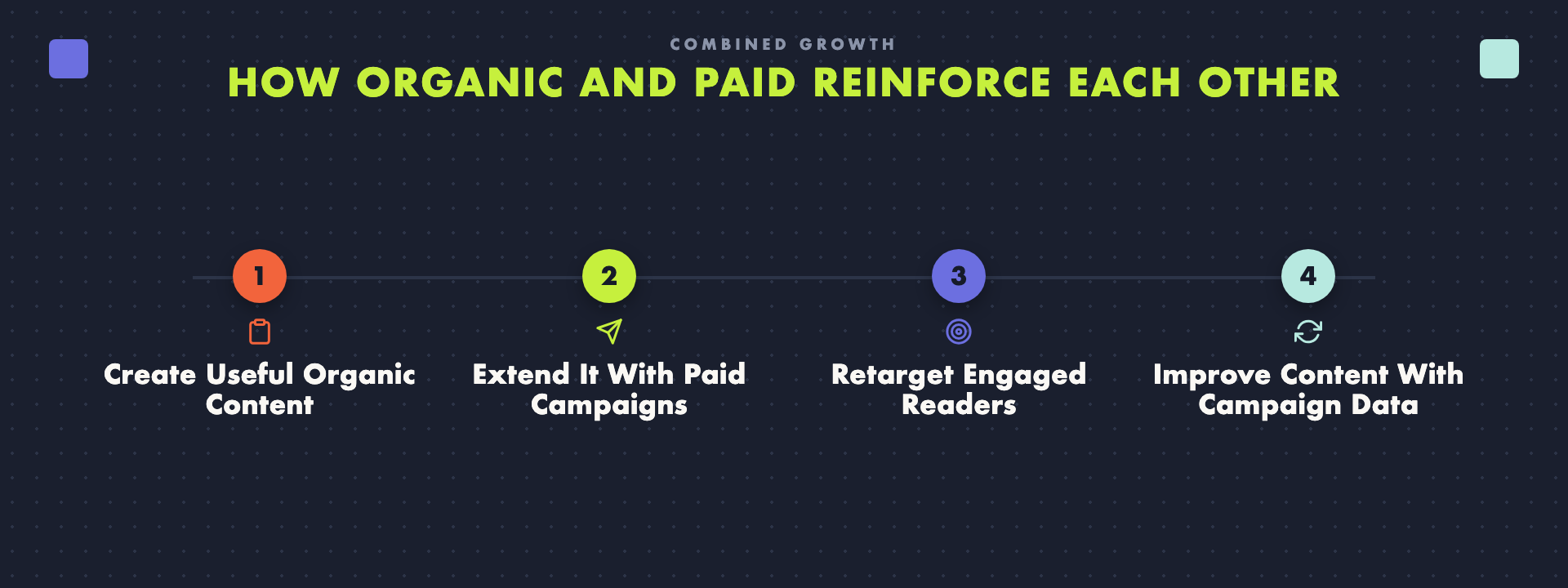
Organic engagement can build audiences for paid retargeting, and paid campaign data can help teams improve organic content and landing pages. Search ads can generate incremental clicks even when a SaaS company ranks first organically, extending its reach across search results.
How Does Paid Retargeting Amplify Organic SaaS Content?
Paid retargeting shows ads to people who previously visited organic SaaS content, product pages, or other website pages. SaaS teams can segment those visitors by page views or actions, then support related articles, demos, trials, or conversion pages with relevant messaging.
How Do Organic and Paid Marketing Affect SaaS CAC?
Organic marketing can reduce SaaS customer acquisition cost over time as content and search visibility generate leads without matching increases in media spend. First Page Sage reports CAC about 40% lower for organic channels than paid channels, though results vary by business model and attribution method.
How Does Brand vs Performance Marketing Shape the Organic and Paid Decision?
Brand marketing builds long-term awareness, preference, and demand, while performance marketing targets measurable actions such as trials, demos, and subscriptions. SaaS companies usually use organic channels, such as SEO and content, to develop brand demand, and paid search, paid social, and retargeting to capture intent and drive near-term conversions. The two approaches overlap, so teams should balance them according to growth stage, sales cycle, and measurement quality.
Why Do Most SaaS Companies Need Organic and Paid Marketing Together?
Most SaaS companies need organic and paid marketing together because the channels support different stages of the buying process. Organic marketing builds lasting visibility and trust, while paid marketing expands targeted reach and generates faster opportunities.
Organic content helps SaaS buyers find and evaluate a product before contacting sales. Paid campaigns can reach defined audiences, support timely offers, and retarget people who engaged with company content. The SaaS organic versus paid marketing decision is therefore about combining long-term growth with the speed and control of paid reach.

About the team
SaaS Marketing Agency Digital Team
The in-house team at SaaS Marketing Agency Digital. We architect growth systems for B2B SaaS companies from Series A through pre-IPO.