A SaaS product-led growth marketing strategy uses the product to drive customer acquisition, activation, conversion, retention, and expansion. Users experience product value through a free trial or freemium plan, while product usage guides onboarding, upgrades, referrals, and sales follow-up. The product acts as a primary marketing channel because prospects evaluate software on their own and their behavior reveals interest and intent. Building the strategy means defining an ideal user and value moment, removing signup friction, mapping the customer experience, personalizing messages, creating referral loops, and monitoring campaigns.
Activation rate, time to value, free-to-paid conversion, product-qualified leads, retention, expansion revenue, and net revenue retention measure strategy performance. Common challenges include weak onboarding, low activation, poor product-market fit, high support costs, and free users who do not convert. PLG does not suit every SaaS company, and products with complex implementation or enterprise buying requirements fit it least. Human-led marketing supports PLG through positioning, content, demand generation, customer research, and lifecycle campaigns, while activation campaigns guide users toward value and improve self-serve conversion. A SaaS marketing agency can coordinate product analytics, segmentation, experimentation, and marketing automation across product, marketing, sales, and customer success teams.
When usage signals show expansion intent or a need for implementation support, marketing can hand product-qualified leads to sales. Slack, Dropbox, Zoom, and Atlassian demonstrate product-led growth through self-service adoption, collaboration, and account expansion. Onboarding extends the strategy by helping users reach value quickly and build repeatable product habits. As satisfied users invite others, increase usage, and expand within accounts, the product compounds acquisition and revenue; that self-reinforcing growth loop defines a SaaS product-led growth marketing strategy.
What Is a SaaS Product-Led Growth Marketing Strategy?
A SaaS product-led growth marketing strategy uses the product as the primary driver of customer acquisition, activation, conversion, retention, and expansion. Users find the product, experience its value through self-service, and adopt or upgrade based on their product experience.
Free trials and freemium plans provide common entry points for a product-led growth strategy. Product onboarding, lifecycle messaging, and usage data help users reach value and guide their decisions to continue, upgrade, or invite others.
What Does PLG Mean in SaaS Marketing?
PLG means product-led growth, a SaaS go-to-market approach where the product drives customer acquisition, conversion, retention, and expansion. Users find and experience product value directly, usually through self-service access, before speaking with sales.
SaaS companies support PLG with free trials, freemium plans, simple signup, and guided onboarding. Marketing and sales teams assist users when human guidance improves adoption or account growth.
What Is Not Part of a PLG Marketing Strategy?
A PLG marketing strategy does not rely on cold calls, cold emails, salesperson-led demonstrations, or lengthy qualification as its primary acquisition method. Users find, try, and evaluate the product through a free trial or freemium experience.
Product-led growth does not eliminate marketing, sales, or customer success teams. Those teams support product education, onboarding, retention, and expansion, while sales engages users who show strong product-qualified signals.
How Does a PLG Marketing Strategy Work?
A PLG marketing strategy works by making the product the primary path from discovery to adoption and purchase. Prospects enter through a free trial or freemium plan, then use onboarding, templates, and in-product guidance to experience the product’s core value.
Product teams reduce signup friction and use customer behavior to guide users toward activation, paid conversion, retention, and expansion. Personalized messages and collaboration features help users reach value, invite teammates, and see when an upgrade meets their needs.
The product acts as the acquisition channel by letting users experience value directly, turning product use into scalable self-serve growth.
What Is the Goal of a PLG Marketing Strategy?
The goal of a product-led growth marketing strategy is to help users find product value, adopt the product, and generate sustainable revenue with minimal sales intervention. The product guides users from acquisition and activation to retention, paid conversion, and expansion.
A strong PLG strategy reduces time-to-value and signup friction while increasing activation, referrals, and expansion revenue. Satisfied users continue using the product and invite colleagues, creating a growth loop that can reduce reliance on paid acquisition.
Why Is the Product the New Marketing Channel in SaaS?
The product has become SaaS’s new marketing channel because buyers increasingly evaluate software through digital self-service. More than 60% of business buyers report purchasing some form of trial, according to "The State Of Business Buying: Risk-Averse Buyers Demand Proof, Not Promises" by Barbara Winters, Forrester, January 2026. Bain & Company reports that firms relying primarily on PLG grew revenue in 2022 almost twice as fast as firms with little or no PLG focus, in "How Enterprise Sales Can Supercharge Product-Led Growth", September 2023.
A free trial, interactive demo, clear onboarding, and transparent pricing let prospects test product value before contacting sales. Product usage data then shows where users activate, encounter friction, invite colleagues, or upgrade, helping SaaS teams improve the buying experience and conversion.
What Are the Main PLG Marketing Models?
The two main PLG marketing models are free trial and freemium. Both let prospective customers use a SaaS product before buying, while differing in how they limit access. A free trial sets a time limit; a freemium plan limits features, usage, or account capacity.
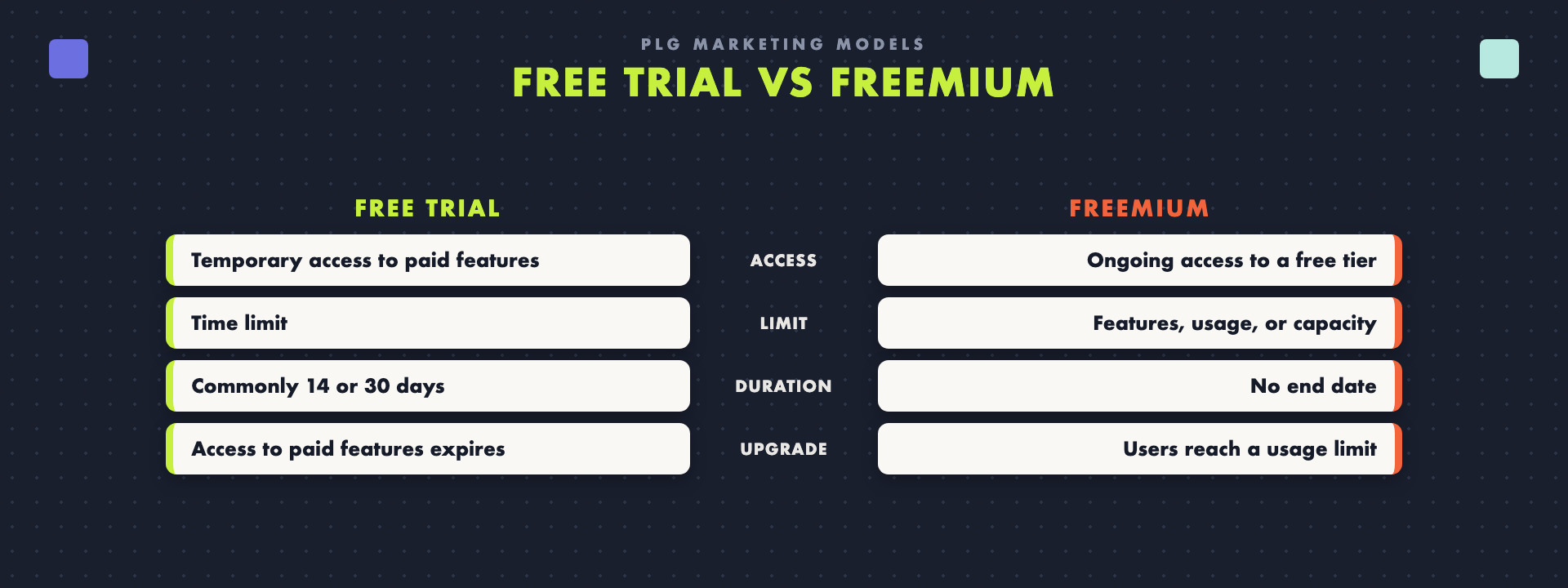
A free trial usually gives users access to premium functionality for a defined period, creating a deadline to subscribe. Freemium provides an ongoing free plan and encourages upgrades as user needs grow. A reverse trial is a related option: users begin with premium access, then move to a restricted free plan if they do not subscribe.
Free Trial PLG Marketing
Free trial PLG marketing gives prospective users temporary access to a SaaS product’s paid features before they subscribe. Trials commonly last 14 or 30 days, but the duration should match the product’s time to value and setup requirements. Product guidance and upgrade prompts help users reach the product’s value moment, while self-service checkout lets activated users subscribe. Compared with freemium, a free trial creates a defined decision point because access to paid features expires.
Freemium PLG Marketing
Freemium PLG marketing gives users ongoing access to a free product tier with limits on features, usage, capacity, or support. The free tier demonstrates product value and attracts users, while paid plans provide advanced capabilities or higher limits. Users can keep the free version without a purchase, unlike a free trial with an end date. A clear upgrade path encourages conversion when users need premium features or reach a usage limit.
How to Build a PLG Marketing Strategy
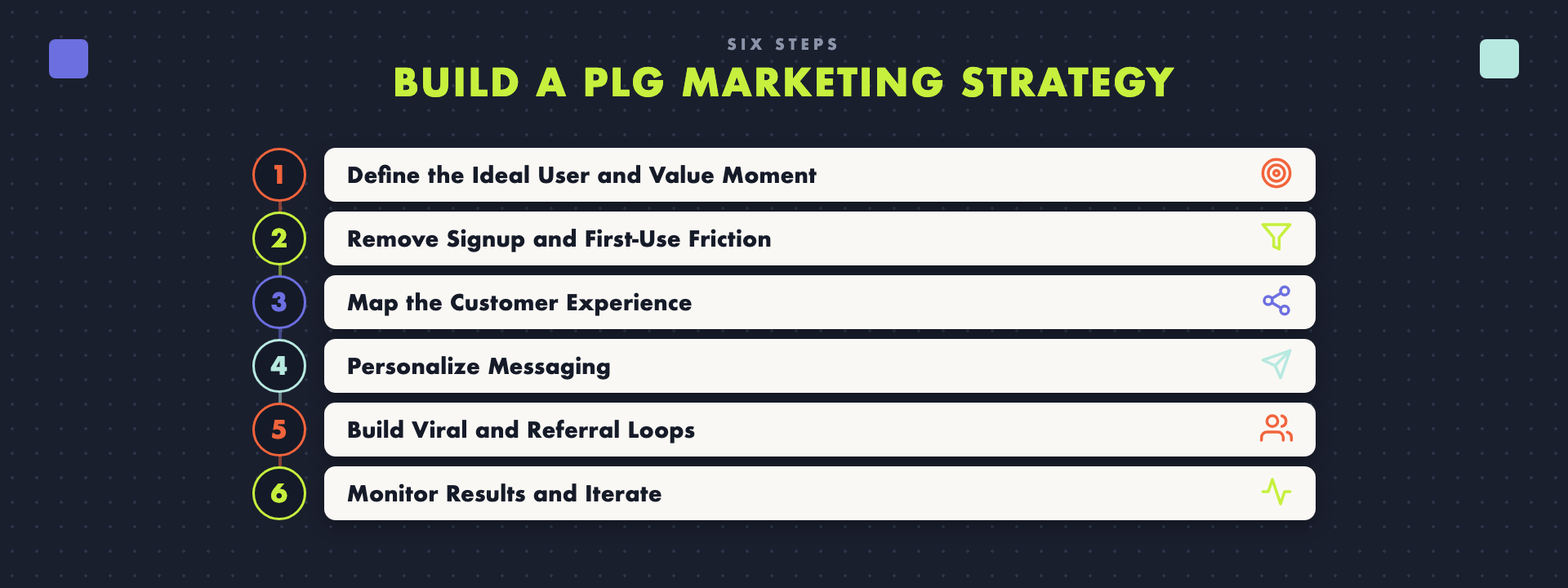
To build a PLG marketing strategy, a SaaS team completes the six steps listed below:
- Define the ideal user and the in-product moment that signals meaningful value.
- Remove unnecessary signup and first-use friction to shorten time to value.
- Map the customer experience around activation, adoption, retention, and expansion.
- Personalize onboarding messages and in-product guidance to support activation.
- Build product-based sharing and referral loops that encourage user invitations.
- Monitor campaign and product metrics, then iterate based on user behavior and results.
Step 1: Define Your Ideal User and Value Moment
A SaaS PLG marketing strategy defines its ideal user by role, company size, workflow, technical ability, pain points, and desired outcome. Customer interviews and product analytics reveal which user actions correlate with activation and retention.
The value moment is the measurable action that first demonstrates the product’s usefulness, such as creating a dashboard or completing an integration. Map the steps between signup and that moment to identify friction, including complex setup, missing data, or unclear next actions.
Step 2: Remove Friction From Signup and First Use
A SaaS product-led growth marketing strategy reduces signup steps and helps new users reach their first meaningful product outcome quickly. Request only information needed to create or secure an account, personalize onboarding, or deliver initial value. Offer social sign-in, preserve entered data after validation errors, and explain errors and next steps in plain language.
Design the first session around one activation milestone instead of a full product tour. Use templates, sample data, imports, sensible defaults, and guided setup to help users complete the core action; introduce other features as they become relevant. Track activation rate and time to value rather than tour completion.
Step 3: Map the Customer Experience Around Product Value
Mapping the customer experience around product value means charting the user path from first touchpoint through signup, onboarding, activation, adoption, retention, and expansion. For each stage, identify the user’s goal, actions, touchpoints, value moment, and barriers. Review steps such as account setup, the first key action, feature adoption, collaboration, and renewal signals.
Map paths by user role, use case, and product proficiency, then compare signals such as activation rate, time to first value, feature adoption, return frequency, and team usage. Those signals reveal where users stall and which in-app prompts, emails, learning resources, or human support can help them progress. The mapped moments give personalized messaging defined points to act on.
Step 4: Personalize Messaging to Drive Activation
Personalized messaging drives activation by matching each user’s communication to their role, needs, behavior, and product usage stage. SaaS teams can use signup details and product events, such as features viewed or setup steps skipped, to recommend actions that lead users toward the product’s core value.
In-app prompts can guide users to relevant features, while behavior-triggered emails can address stalled setup or suggest role-based use cases. Testing message content, timing, and calls to action helps teams reduce irrelevant communication and improve activation.
Step 5: Build Viral and Referral Loops Into the Product
Viral and referral loops grow SaaS adoption when product use naturally introduces new users. Add sharing actions to useful workflows, such as inviting teammates to collaborate, sending a scheduling link, or sharing a document created in the product. Slack, Zoom, Figma, and Calendly use collaboration or shared outputs to connect existing users with potential users.
A referral loop moves from a useful product action to an invitation, recipient activation, and continued use or referral. Offer rewards, such as extra storage, when referrals reach meaningful milestones like activation or payment. Track invitation-to-activation rate, referred-user retention, referral conversion, loop closure rate, and acquisition cost by source; invitation volume alone does not show whether a loop drives growth.
Step 6: Monitor Campaign Results and Iterate
A SaaS PLG marketing strategy monitors the user path from signup through activation, conversion, expansion, and retention. Teams track a primary goal, such as activation rate or trial-to-paid conversion, alongside guardrail metrics such as churn, support volume, and time to value.
Event tracking, funnel reports, cohort analysis, and user feedback reveal where customers encounter friction. Teams test one change at a time, compare results with a baseline, and keep changes that improve activation, feature adoption, retention, expansion revenue, or referrals without harming downstream results.
Which Metrics Measure a PLG Marketing Strategy?
The metrics that measure a PLG marketing strategy across the path from acquisition to retained, expanding revenue are listed below:
- Visitor-to-signup conversion rate: Measures how many website visitors create free accounts. The average freemium PLG product turns 9% of distinct visitors into signups, according to "Your guide to SaaS product metrics" by Kyle Poyar, Growth Unhinged, July 2023.
- Activation rate: Measures the share of new users who reach a defined value moment, such as completing a workflow or inviting a teammate.
- Time to value: Measures how long users take to reach activation. A shorter time can indicate a clearer onboarding path and fewer barriers to product value.
- Free-to-paid conversion rate: Measures how many free users become paying customers. A February 2026 report, "The SaaS Conversion Report: A new look at free-to-paid conversion" by ChartMogul, found a median free-to-paid conversion rate of 8% across 200 software products.
- Product-qualified lead conversion rate: Measures how often users who show product-based buying signals become customers. ProductLed reports a median conversion rate of 25% for free-trial PQLs in "Product-Led Growth Benchmarks: Key SaaS Findings and Trends", a survey of 600+ SaaS businesses.
- Retention rate: Measures the percentage of users or accounts that continue using the product over a defined period.
- Logo churn and revenue churn: Logo churn measures lost customers, while revenue churn measures recurring revenue lost from cancellations or downgrades.
- Net revenue retention: Measures recurring revenue retained from existing customers after upgrades, downgrades, and churn.
- Product engagement: Tracks active users, feature adoption, usage frequency, and account depth through measures such as DAU, WAU, and MAU.
- Referral and viral coefficient: Measures how many new users existing customers generate through invitations, shared outputs, integrations, or referrals.
- Customer acquisition cost and payback period: CAC measures the cost of acquiring a customer; payback period measures how long gross profit takes to recover that cost.
- Expansion revenue: Tracks upgrades, added seats, increased usage, and adoption of higher-priced plans.
PLG benchmarks vary by pricing, customer segment, product type, and sales involvement. Teams should compare metrics with companies using similar trial or freemium models.
What Are Common PLG Marketing Strategy Challenges?
The common PLG marketing strategy challenges are listed below:
- Unclear ideal customer profile: A broad target audience makes it harder to design relevant onboarding, messaging, pricing, and activation paths. Teams need a defined ideal user and use case to guide product-led marketing.
- Weak product–market fit: Product-led growth depends on users finding meaningful value through direct product use. Weak demand or an inadequate solution can leave free signups without sustained engagement or paid conversion.
- Long time to value: Complex setup, integrations, configuration, or data migration can delay a user’s first meaningful outcome. Longer time to value gives new users more opportunities to abandon onboarding.
- Onboarding abandonment: Confusing, lengthy, or feature-heavy onboarding can prevent users from reaching activation independently. Effective onboarding guides users toward relevant product outcomes without unnecessary steps.
- High signup and first-use friction: Excessive form fields, mandatory credit-card details, complicated permissions, and immediate integration requirements can discourage trial starts. Signup flows should request only the information needed for initial product use.
- Low activation despite high signup volume: A large number of free users does not guarantee product-led growth. Low activation means many users fail to experience the product’s core value after signing up.
- Freemium cost exposure: A generous free tier can increase infrastructure and support costs without producing enough paid conversions. Companies need to balance free access with sustainable usage limits and upgrade paths.
- Premature paywalls: Restricting core product value too early can prevent users from seeing the product’s benefits. A paywall works best when users can see the additional value available through an upgrade.
- Inadequate product analytics: Missing or unreliable event tracking prevents teams from seeing where users abandon onboarding or which actions predict retention. Product analytics need to support segmentation and cohort analysis.
- Sales and marketing misalignment: Marketing may prioritize signups while sales prioritizes account potential and purchase intent. Shared definitions for product-qualified leads and handoff criteria help teams coordinate.
- Poor product-qualified lead handoff: Sales alerts can lack context about account fit, product behavior, use case, and recommended follow-up. A useful handoff gives sales the information needed to respond appropriately.
- Security and compliance barriers: Enterprise users may face privacy, security, legal, procurement, or data-residency requirements before adoption. PLG teams need clear information and appropriate support for those evaluations.
Is a PLG Marketing Strategy Right for Every SaaS Company?
No, a product-led growth marketing strategy is not the right primary growth motion for every SaaS company. PLG fits products that let users reach value independently, start with little assistance, and make straightforward purchases.
Products with complex implementation, heavy customization, strict regulatory demands, high contract values, or large buying committees usually need sales support. Product-led and sales-led growth can work together, so companies can use self-serve discovery and onboarding before involving sales for complex accounts. Only 11.5% of 563 SaaS companies in the "2025 B2B SaaS Performance Metrics Benchmarks" by Benchmarkit ran a purely product-led motion.
Where Does Product-Led Growth Need Human-Led Marketing Support?
Product-led growth needs human-led marketing when the product cannot fully explain its value, reduce perceived risk, or guide a complex buying decision. Marketing teams attract suitable users, clarify use cases, educate prospects, and build trust before and during product evaluation.
Enterprise SaaS purchases usually require security reviews, integrations, procurement, custom pricing, and approval from multiple stakeholders. Marketing, sales, and customer success teams support those decisions with education, validation, implementation guidance, and expansion planning, creating a hybrid motion alongside self-serve growth.
How Can Activation Campaigns Lift PLG Self-Serve Conversion?
Activation campaigns lift PLG self-serve conversion by guiding new users toward the first action that demonstrates product value. Contextual in-app tips, behavior-based emails, onboarding checklists, templates, and reminders help users complete setup and reach that activation event.
SaaS products report a median activation rate of 30%, according to "What is a good activation rate" by Lenny Rachitsky and Yuriy Timen, October 2022. SaaS teams can test campaigns against a holdout group and compare activation, onboarding completion, free-to-paid conversion, retained usage, and churn.
How Does a SaaS Marketing Agency Run a PLG Marketing Strategy?
A SaaS marketing agency connects acquisition, onboarding, activation, conversion, retention, and expansion in one measurable growth system. The agency defines the ideal customer profile, product value moment, and activation event, then audits the signup-to-paid path for friction and conversion gaps.
Product analytics and CRM tools help the agency trigger personalized email and in-app campaigns from user actions, such as completing setup or inviting teammates. The agency tests onboarding, trial or freemium flows, pricing, and referral paths, then tracks activation, trial-to-paid conversion, customer acquisition cost, and expansion revenue. For high-intent accounts, the agency scores product-qualified leads and routes them to sales.
How Does PLG Marketing Hand Off Users to Sales?
PLG marketing hands users to sales when product activity signals both value and buying intent. Marketing and sales teams define product-qualified lead (PQL) criteria, such as completing activation, inviting teammates, nearing plan limits, viewing pricing repeatedly, or requesting a demo.
A scoring system routes qualifying users or accounts to sales based on fit, territory, company size, or expected deal value. Sales confirms needs, stakeholders, budget, and timing, while other users continue through self-service onboarding or marketing nurture.
How Do Product Qualified Leads Move From Marketing to Sales?
Product-qualified leads move from marketing to sales when product-use signals show buying intent, such as activation, repeated core-feature use, teammate invitations, plan-limit encounters, or premium-feature exploration. Marketing or revenue operations scores those signals and routes qualified users or accounts through the CRM. Sales receives account-fit and usage context to make a timely, relevant follow-up.
When Should PLG Marketing Add a Sales-Assisted Motion?
PLG marketing should add sales assistance when self-serve growth stalls or high-value accounts need help with complex deployments, integrations, security reviews, procurement, or custom contracts. Keep self-service available for smaller customers and route qualified accounts to sales when strong product usage, plan-limit activity, or multi-user engagement signals buying intent.
Which SaaS Companies Run Strong PLG Marketing Strategies?
The SaaS companies that run strong PLG marketing strategies through product value, sharing, and self-service access are listed below:
- Slack: Teams adopt Slack in small groups, then invite colleagues to shared channels.
- Dropbox: File synchronization and sharing support adoption, while referral rewards encourage user growth.
- Zoom: Free meetings let participants experience the product before teams adopt paid plans.
- Canva: Freemium design tools, templates, and shareable projects help users reach value and introduce Canva to others.
How Does Onboarding Extend a PLG Marketing Strategy?
Product-led onboarding extends a PLG marketing strategy by guiding new users from signup to their first meaningful product outcome. In-app checklists, contextual prompts, templates, and guided setup help users complete actions tied to their goals and reduce time to value.
Behavior-triggered messages and onboarding data help teams identify where users stall and adjust guidance. Faster activation can support stronger product adoption, retention, expansion, and referrals.
Why Does a PLG Marketing Strategy Compound SaaS Growth?
A product-led growth marketing strategy compounds SaaS growth by turning product usage into a recurring acquisition and expansion loop. Users find the product, experience value, stay active, expand their usage, and invite colleagues.

Each cycle can bring new users, stronger retention, additional seats, and more advocates without proportional increases in advertising or sales headcount. A SaaS PLG marketing strategy connects acquisition, activation, retention, expansion, and advocacy into one product-driven growth system.

About the team
SaaS Marketing Agency Digital Team
The in-house team at SaaS Marketing Agency Digital. We architect growth systems for B2B SaaS companies from Series A through pre-IPO.