PPC strategies for SaaS are paid advertising approaches that generate trials, demos, qualified leads, and revenue. PPC helps SaaS companies capture existing demand and test acquisition efficiently, while the right approach depends on product stage: early-stage teams validate audience and messaging, and mature teams optimize pipeline and customer acquisition cost. Strong campaigns connect buyer-intent segmentation, high-intent and competitor keywords, budget-protective match types, dedicated landing pages, focused ad copy, LinkedIn account-list targeting, retargeting, CRM integration, pipeline-based bidding, disciplined budgets, and continuous testing.
SaaS teams measure PPC through conversion rates, cost per qualified lead, cost per sales-qualified lead, opportunity value, customer acquisition cost, payback period, pipeline contribution, and revenue. PPC strategies break when tracking misses sales outcomes, campaigns attract low-fit leads, landing pages lack relevance, sales follow-up slows, or budgets spread across too many campaigns. Companies benefit from specialists when internal teams lack capacity for campaign control, attribution, creative testing, or CRM integration; a SaaS PPC agency manages paid campaigns, while a SaaS marketing agency connects advertising with sales operations and other marketing channels to build qualified pipeline.
Budget shapes campaign scope, segmentation, and the speed of learning, while Google Ads, LinkedIn, display, review-site advertising, and retargeting extend paid reach. Automation and first-party data are moving PPC toward value-based bidding and revenue optimization. Those shifts reinforce the definition of PPC for SaaS: paid acquisition managed against business outcomes, rather than clicks alone.
What Is PPC for SaaS?
PPC for SaaS is a paid advertising model where software companies pay when someone clicks an ad. SaaS businesses use paid search, LinkedIn Ads, display, and retargeting to attract users looking for software tools.
SaaS PPC campaigns aim to generate free trials, product sign-ups, demos, and qualified sales opportunities. Effective measurement connects ad clicks to product activation, pipeline, customer acquisition cost, and subscription revenue.
Why Is SaaS PPC Different From Ecommerce PPC?
SaaS PPC differs from ecommerce PPC in conversion goals, buying cycles, and performance measurement. Ecommerce ads usually drive immediate purchases, while SaaS campaigns generate demo requests, free trials, or qualified leads before revenue appears.
SaaS sales can involve multiple decision-makers and take weeks or months. SaaS marketers connect ad platforms to CRM data and measure lead quality, pipeline, customer acquisition cost, and closed revenue, not clicks or form submissions alone.
Why Does PPC Matter for SaaS Companies?
PPC matters for SaaS companies because paid search can reach buyers actively searching for a solution. PPC campaigns provide measurable feedback from clicks to trials, demos, qualified opportunities, and revenue, usually faster than channels that require time to build organic demand.
Among B2B marketers using paid channels, 61% said SEM and PPC produced the best results, according to "B2B Content Marketing Benchmarks, Budgets, and Trends: Outlook for 2025" by Stephanie Stahl, Content Marketing Institute, October 2024.
Which PPC Strategy Fits Your SaaS Product Stage?
The PPC strategy that fits a SaaS product depends on product stage, sales motion, deal size, and conversion data. Early-stage companies use paid campaigns to validate demand and find effective audience-message combinations, while established companies optimize toward qualified pipeline, revenue, and customer lifetime value.
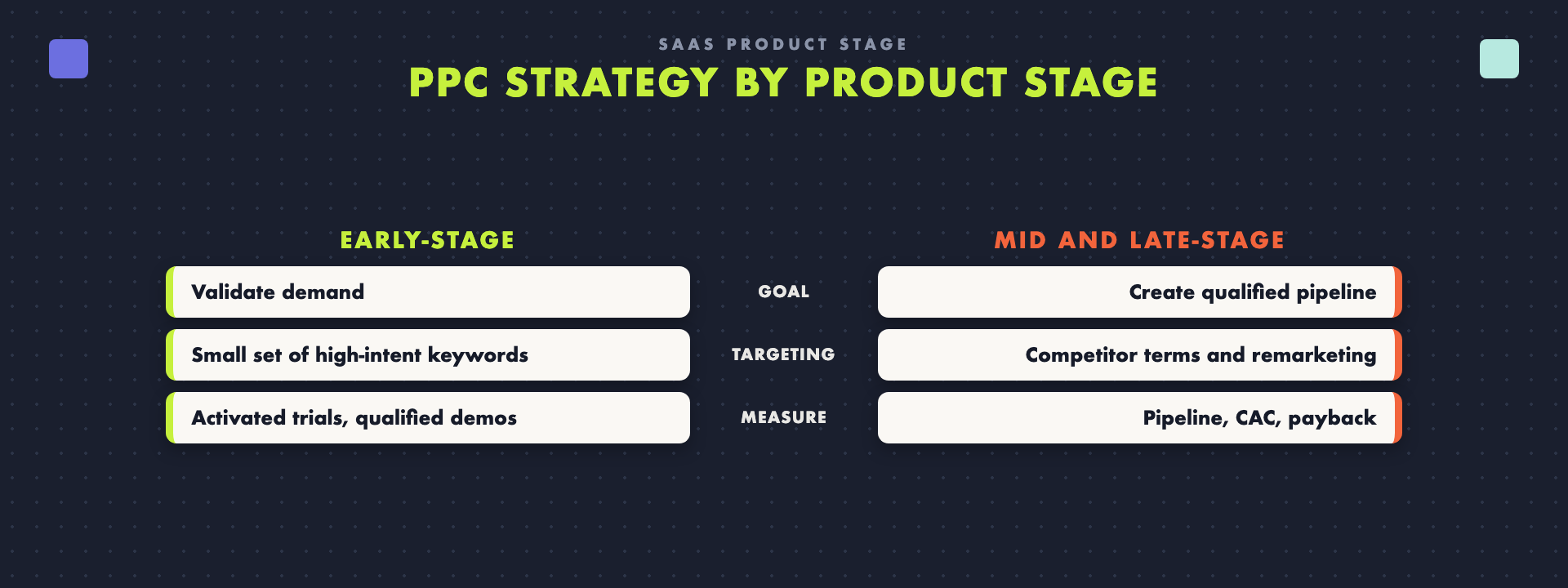
Early-stage teams should focus on a small set of high-intent keywords, controlled testing, and meaningful conversions such as activated trials or qualified demos. Mid-stage and late-stage teams can connect ad platforms to CRM data, expand retargeting and account-based campaigns, and scale bidding against sales-qualified leads, opportunities, or closed-won revenue.
PPC Strategy for Early-Stage SaaS Companies
Early-stage SaaS companies should use PPC to validate demand and acquire measurable, high-intent users before scaling broadly. Campaigns can target branded, category, pricing, integration, and carefully selected competitor keywords with tightly themed ad groups, exact or phrase match, and negative keywords. Dedicated landing pages should match each search intent and convert visitors into qualified demos for sales-led products or activated trials for product-led products. Analytics and CRM tracking should capture downstream outcomes, so teams assess qualified pipeline, customer acquisition cost, and payback rather than clicks or raw sign-ups.
PPC Strategy for Mid-Stage and Late-Stage SaaS Companies
Mid-stage and late-stage SaaS companies use PPC to create qualified pipeline, acquire customers efficiently, and grow revenue. Campaigns expand beyond high-intent search into competitor terms, account-based advertising, remarketing, and paid social, with audiences segmented by industry, company size, lifecycle stage, and product fit. Connecting ad platforms to the CRM lets teams send qualified leads, sales opportunities, and closed-won deals back as conversion signals. Bidding and budget decisions should prioritize pipeline contribution, customer acquisition cost, payback period, and revenue quality while teams test keywords, offers, landing pages, and creative.
What Are the Best PPC Strategies for SaaS?
The best SaaS PPC strategies connect buyer intent with qualified pipeline and revenue. The 12 strategies below guide campaign setup and ongoing optimization.
- Segment by intent: Separate awareness, evaluation, and decision-stage campaigns.
- Target high-intent keywords: Prioritize searches for demos, pricing, trials, and software comparisons.
- Bid on competitor keywords: Test competitor names and alternative searches with accurate messaging.
- Choose match types carefully: Start with exact and phrase match, then expand using conversion data.
- Build dedicated landing pages: Match each campaign’s page to its keyword theme and offer.
- Write focused ad copy: Lead with a clear benefit, supporting proof, and relevant call to action.
- Target account lists on LinkedIn: Reach buying groups at named companies using account and role filters.
- Retarget site visitors and trial users: Match ads to visitor behavior and product adoption stage.
- Connect advertising platforms to your CRM: Track campaign engagement through leads, opportunities, and revenue.
- Optimize bidding for pipeline: Use qualified-lead and opportunity signals when tracking supports them.
- Allocate budget as capital: Fund proven campaigns while reserving spend for controlled tests.
- Test ads and landing pages continuously: Compare meaningful variants and judge results by qualified pipeline.
Segment Campaigns by Buyer Intent
SaaS PPC campaigns should separate searches by buyer intent because solution-ready buyers need different messages from early-stage researchers. Give branded, high-intent category or use-case, competitor, and problem-aware campaigns distinct budgets, ad copy, landing pages, and conversion goals. Keep branded traffic separate from non-branded acquisition, then review search terms every week to exclude irrelevant queries with negative keywords. Keyword targeting should match problem-aware, use-case, category, comparison, competitor, branded, and transactional intent segments.
Target High-Intent Bottom-of-Funnel Keywords
SaaS advertisers should target bottom-of-funnel keywords that signal active product evaluation or purchase intent. Commercial modifiers such as “pricing,” “demo,” “free trial,” “comparison,” “alternative,” and “best” can identify searches closer to conversion, such as “[product] pricing” or “[competitor] alternative.” Start with tightly themed campaigns using exact or phrase match, then expand when search-term data shows broader queries produce qualified leads. Add irrelevant terms such as “jobs,” “salary,” and “tutorial” as negatives, and direct each keyword group to a relevant landing page with a clear demo or trial CTA.
Bid on Competitor and Alternative Keywords
Competitor and alternative keywords reach prospects actively comparing SaaS products. Separate competitor terms into a controlled campaign, with groups for “[competitor] alternative,” “[competitor] vs,” and “tools like [competitor].” Send each group to a relevant comparison page and focus ad copy on your product’s own differentiators, not implied affiliation. Google generally permits competitor trademarks as keywords but restricts some trademark use in ad text; review Google’s trademark policy and applicable local laws before scaling.
Choose Match Types That Protect Budget
SaaS advertisers choose keyword match types to control which searches can trigger paid ads. Exact match offers tighter control and narrower reach, phrase match balances control with reach, and broad match finds a wider range of related searches. Start with exact and phrase match for high-intent terms, then test broad match after conversion tracking reliably records qualified trials, demos, or pipeline. Review Google Ads search terms every week, exclude irrelevant queries with negative keywords, and shift spend toward terms that produce qualified outcomes.
Build Dedicated Landing Pages for Every Campaign
Dedicated landing pages connect each PPC campaign’s keyword theme, ad promise, audience, and funnel stage. A project-management software campaign for agencies should lead to a page featuring agency workflows, relevant customer proof, and one clear action, such as starting a trial or booking a demo. Focused headlines, concise benefits, suitable forms, minimal navigation, and fast mobile performance help maintain message alignment. The median SaaS landing page converts at 3.8%, compared with 6.6% across all industries, according to "Average SaaS conversion rate benchmark report" by Unbounce, March 2025, which supports testing and optimization for each campaign.
Write Ad Copy Around a Clear Hook
SaaS ad copy should lead with one clear hook that connects a buyer’s problem to one product benefit. A headline can stress saving time, reducing costs, improving visibility, or shortening implementation, while relevant keyword language reflects the searcher’s intent. Concrete proof points, such as integrations, security credentials, customer results, transparent pricing, or a free trial, make the offer more concrete. Responsive search ads should test distinct headlines and descriptions, then direct prospects to a landing page with a matching promise and a clear call to action, such as “See the demo” or “Start a free trial.”
Use Account List Targeting on LinkedIn
LinkedIn account list targeting lets SaaS advertisers reach employees at selected companies through Matched Audiences. Build company lists from ideal customer profile criteria, such as industry, company size, geography, technology use, and account stage, then upload company names or domains in Campaign Manager’s Audiences section. Clean and standardize account data before uploading; LinkedIn recommends lists of at least 1,000 companies, while campaigns need a matched audience of at least 300 members to deliver. Refine reach with job-function, seniority, and location filters, but avoid narrowing the audience excessively. Measure qualified leads, opportunities, and pipeline, then refresh account lists as sales priorities change.
Retarget Trial Users and Site Visitors
SaaS retargeting shows relevant ads to trial users, pricing-page visitors, feature-page visitors, and people who abandoned signup. Segment audiences by behavior and funnel stage, then match each group with onboarding guidance, product proof, or comparison content. Use platform tags and first-party data to build audiences, set membership windows and frequency limits, and exclude converted customers or upgraded users. Measure activated trials, qualified opportunities, and revenue alongside clicks and signups.
Connect Ad Platforms to Your CRM
Connect Google Ads, LinkedIn, and other ad platforms to your CRM so each lead retains its campaign, keyword, click ID, and consented contact data. Send CRM lifecycle changes, such as qualified lead, sales opportunity, and closed customer, back to the relevant ad platform as offline conversion events. Standardize lifecycle stages, conversion values, timestamps, and deduplication rules, then verify attribution and upload events on a set schedule. CRM conversion data carries pipeline signals into bidding, allowing ad platforms to optimize toward qualified opportunities and revenue.
Optimize Bidding Around Pipeline Signals
SaaS teams optimize PPC bidding by sending CRM pipeline stages back to ad platforms as offline conversion data. Qualified leads, sales opportunities, and closed-won customers provide stronger signals than clicks or form submissions. Select one meaningful funnel stage as the primary bidding goal, and upload updated conversion data consistently, ideally daily. Assign conversion values when reliable revenue estimates exist; otherwise, use target CPA for a well-defined qualified-lead event.
Treat PPC Budget as Capital
SaaS companies should treat PPC budget as growth capital, not a fixed monthly expense. Teams can work backward from customer and qualified-opportunity targets, using conversion rates to estimate the required sales-qualified leads and media spend. Campaign budgets should reflect allowable customer acquisition cost, gross margin, sales-cycle length, expected pipeline value, and payback targets. A protected testing reserve lets teams shift spend toward campaigns that generate qualified pipeline and reduce or pause campaigns that exceed payback limits.
Test Ad and Landing Page Variants Continuously
SaaS teams improve PPC performance by testing ad and landing-page variants continuously. Each experiment should test a clear hypothesis and change one major variable, such as the headline, offer, call to action, audience, or page layout. Keep other campaign settings consistent, use randomized control and test groups, and wait for enough traffic to assess results reliably. Apply winning changes to future campaigns, then test the next funnel bottleneck while tracking qualified trials, demo quality, pipeline, and revenue.
How to Measure SaaS PPC Performance
To measure SaaS PPC performance, teams track the full funnel, from ad spend and clicks to qualified leads, sales opportunities, and revenue. Track impressions, click-through rate, cost per click, conversion rate, and acquisition cost alongside trial activation, pipeline value, closed-won revenue, retention, and expansion.
Connect ad platforms to the CRM and import qualified-lead, opportunity, and customer outcomes as offline conversions. Use consistent attribution and lifecycle definitions to compare cost per qualified lead, cost per opportunity, customer acquisition cost, payback period, and pipeline generated per dollar; those measures reveal whether campaigns produce durable revenue or low-quality form fills.
Which PPC Metrics Matter for SaaS?
The PPC metrics that matter for SaaS connect advertising costs with qualified leads, pipeline, and revenue. WordStream’s 2026 Google Ads benchmarks, reported in "What Are Good Google Ads Benchmarks In 2026?" by Brooke Osmundson, Search Engine Journal, June 2026, provide cross-industry reference points from mostly small and local advertisers, not targets for SaaS alone.
- Click-through rate (CTR): Measures ad clicks per impression; the cross-industry search benchmark was 6.64%.
- Cost per click (CPC): Measures the average cost of an ad click; the cross-industry benchmark was $5.42. TripleDart reports a median non-brand SaaS CPC of $8 to $14 in the "2026 State of SaaS PPC Benchmark Report", April 2026.
- Conversion rate: Measures the share of clicks that produce a defined action; the cross-industry benchmark was 8.18%.
- Cost per lead (CPL): Measures ad spend per lead; the cross-industry benchmark was $66.69.
- Qualified-lead and opportunity rates: Track whether PPC leads meet sales criteria and become pipeline opportunities.
- Cost per trial or demo: Measures acquisition cost for the conversion that matches the SaaS sales model.
- Pipeline and revenue: Track qualified pipeline and closed-won revenue by campaign, keyword theme, and audience.
- CAC, LTV-to-CAC, and payback period: Assess acquisition cost, customer value, and the time required to recover that cost.
How Do You Close the Loop From SaaS PPC to Revenue?
SaaS companies close the PPC revenue loop by connecting ad interactions to CRM records and sending downstream outcomes back to advertising platforms. Google Ads supports offline conversion imports using click identifiers such as GCLID, while LinkedIn’s Conversions API connects online and offline events across the customer path.
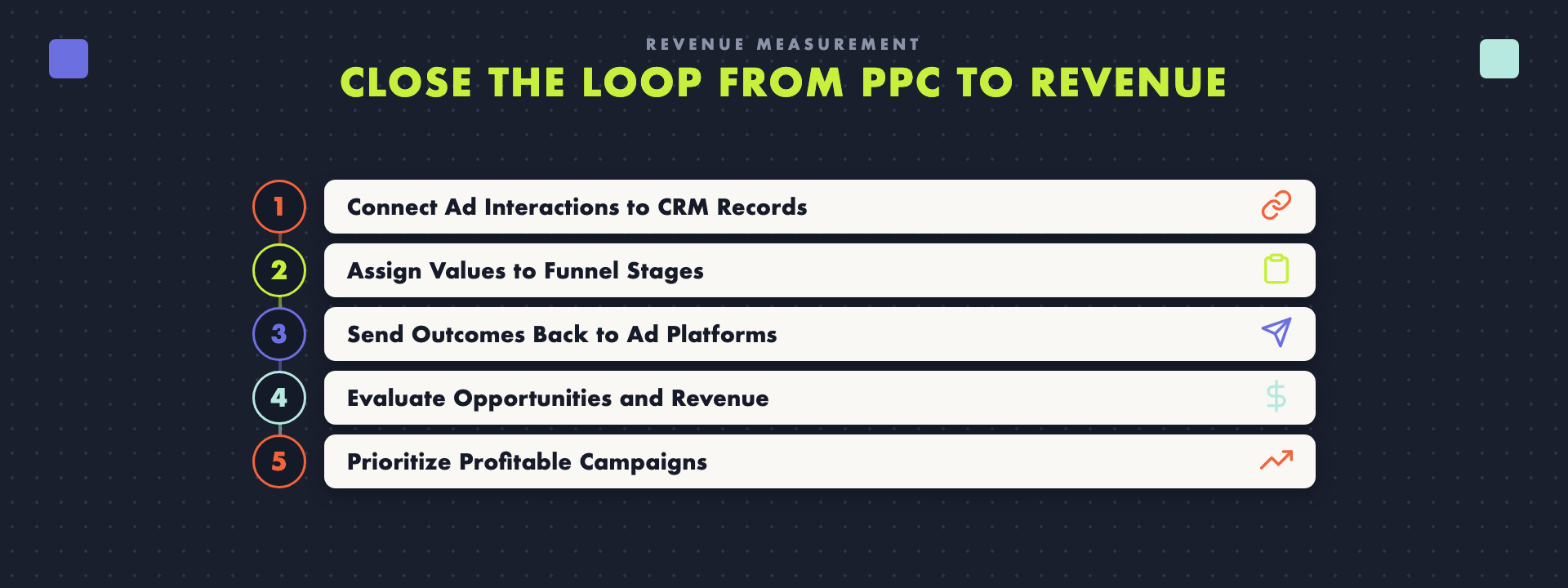
Marketing teams should evaluate campaigns by qualified opportunities, closed-won deals, and revenue, not clicks or form fills alone. Assigning values to funnel stages and reconciling platform data with CRM and finance records helps bidding systems prioritize campaigns that generate profitable customers.
Where Do PPC Strategies for SaaS Break?
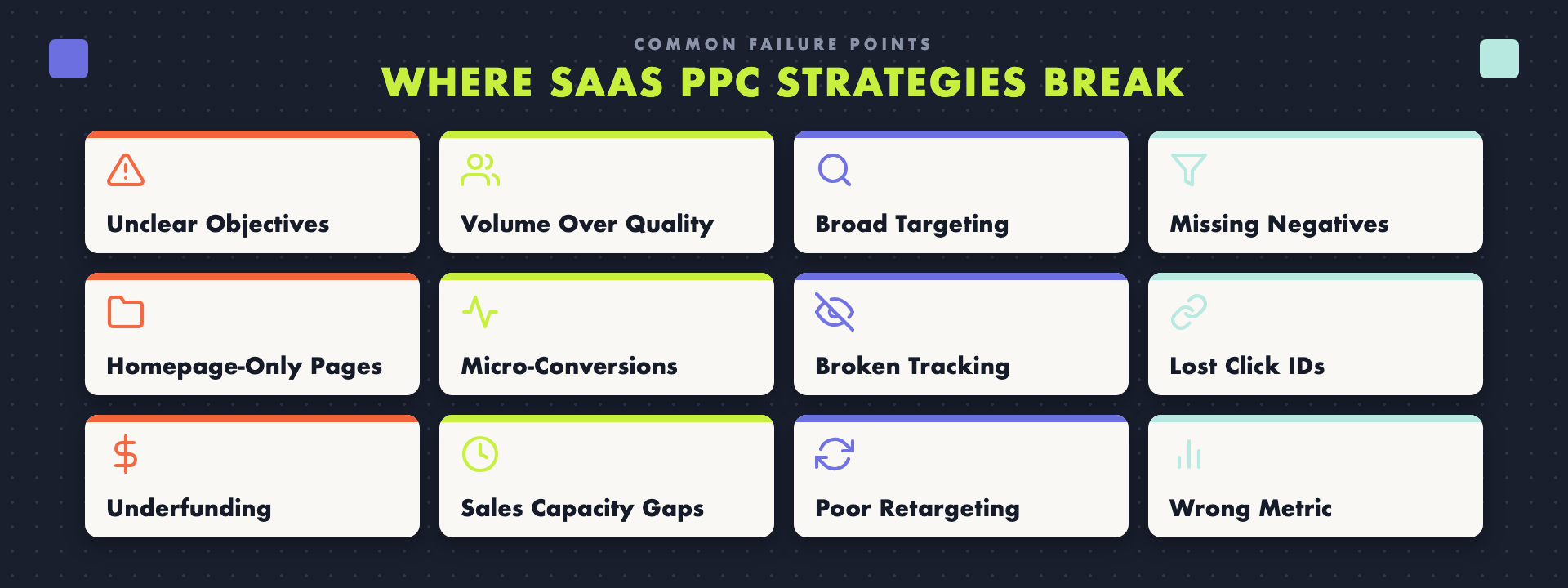
SaaS PPC strategies break when campaigns prioritize clicks or lead volume over qualified pipeline, revenue, and payback. The common failure points are listed below:
- Unclear campaign objectives: Campaigns waste spend when teams pursue clicks or form fills without defining a business outcome. Set a primary goal, such as qualified opportunities, pipeline, or revenue, and assign each campaign a role in the buying process.
- Lead volume over lead quality: High trial or demo volume can hide weak qualification and low sales acceptance. Compare lead quality, opportunity creation, pipeline, and revenue instead of judging campaigns by conversion counts alone.
- Broad keyword targeting: Generic searches can attract job seekers, students, support requests, free-tool users, and unrelated product searches. Broad targeting without controls can consume budget without generating qualified demand.
- Missing negative keywords: Campaigns pay for irrelevant searches when teams neglect negative-keyword lists. Review search-term reports every week and exclude unsuitable queries, locations, audiences, and low-value intent patterns.
- Homepage-only landing pages: A generic homepage forces visitors to find relevant information themselves. Send each campaign to a page that matches its keyword theme, audience, use case, offer, and buying stage.
- Micro-conversions treated as sales outcomes: Page views, video plays, and form starts indicate engagement, not revenue. Use meaningful actions as primary bidding goals and treat softer interactions as secondary signals.
- Broken or duplicated conversion tracking: Missing tags, incorrect events, consent gaps, and broken redirects distort campaign reporting. Duplicate events across ad platforms, analytics tools, tag managers, and CRMs can inflate conversions and mislead automated bidding.
- Lost click identifiers and weak CRM data: Redirects and form systems can drop click identifiers, preventing reliable attribution. Incomplete lead stages, opportunity values, or disqualification reasons push bidding systems toward cheap leads instead of useful customers.
- Underfunding or premature scaling: Small budgets can produce too few qualified conversions for stable conclusions. Large budget increases can magnify inefficient targeting, weak conversion rates, and sales bottlenecks; monitor marginal CAC as spend grows.
- Sales follow-up and capacity gaps: Paid campaigns lose value when sales teams respond slowly, leads lack ownership, or onboarding teams cannot handle demand. Connect ad platforms with CRM routing and align campaign volume with sales and implementation capacity.
- Poor retargeting controls: Retargeting wastes impressions when campaigns include existing customers, converted users, employees, or unsuitable lifecycle stages. Apply audience exclusions and frequency limits, then refresh creative to reduce fatigue.
- Channel performance judged by the wrong metric: Search captures active demand, while LinkedIn can influence selected accounts and roles. Comparing both channels only by cost per click or lead can undervalue account engagement or reward low-quality volume.
When Should SaaS Companies Hand PPC Strategies to Specialists?
SaaS companies should hand PPC strategies to specialists when paid acquisition contributes meaningfully to pipeline, but internal teams lack the time or skill to manage campaign structure, tracking, bidding, and optimization. A defined ideal customer profile, a clear offer, reliable CRM data, and measurable ad spend help establish readiness.
Companies still validating demand should first refine their offer and measurement setup. As campaigns scale, a hybrid model usually works well: an internal leader owns budget and commercial goals, while a PPC specialist manages platform execution, testing, and pipeline-focused optimization.
How Does a SaaS PPC Agency Manage Paid Search Campaigns?
A SaaS PPC agency manages paid search by connecting campaign decisions to qualified leads, sales opportunities, and revenue. The agency researches buyer intent and competitors, structures campaigns and keywords, selects match types, adds negative keywords, and develops ads and landing-page recommendations.
The agency sets up conversion tracking, reviews search-term quality, adjusts bids and budgets, and tests campaign variants. When advertising platforms connect to CRM and product data, the agency can use qualified demos, trial activation, and sales opportunities as bidding signals instead of optimizing only for clicks or signups.
How Does a SaaS Marketing Agency Turn PPC Strategies Into Pipeline?
A SaaS marketing agency turns PPC activity into pipeline by connecting advertising data to CRM lifecycle stages and sales outcomes. The agency tracks campaign, keyword, click, and landing-page information from lead through marketing-qualified lead, sales-qualified lead, opportunity, and closed customer.
CRM records show which campaigns generate qualified opportunities and revenue, rather than only form submissions. The agency sends qualified-lead and customer conversion data back to ad platforms, then adjusts targeting and bidding around pipeline outcomes. Google Ads supports importing offline conversion data to measure sales beyond the initial click.
How Does Budget Shape PPC Strategies for SaaS?
Budget shapes PPC strategies for SaaS because SaaS PPC budgets should reflect unit economics, qualified-opportunity targets, and sales capacity rather than a fixed percentage alone. Median marketing spend is 8% of ARR across more than 1,000 private B2B SaaS companies, according to "2026 Spending Benchmarks for Private B2B SaaS Companies" by SaaS Capital, June 2026, a broad benchmark rather than a recommended PPC allocation.
Early-stage SaaS companies can concentrate small budgets on high-intent search, branded protection, retargeting, and conversion testing. Mid-market and enterprise teams can expand into competitor campaigns, LinkedIn account targeting, and additional channels when CRM data shows acceptable acquisition costs and pipeline quality.
What Does CAC Reveal About SaaS PPC Efficiency?
Customer acquisition cost (CAC) shows whether SaaS PPC acquires customers at a sustainable cost relative to lifetime value, gross margin, and payback targets. The median CAC payback period is 16 months across B2B SaaS and AI-native companies, according to "2026 SaaS & AI Performance Benchmarks" by Aleph and Benchmarkit, June 2026.
How Does Free Trial Conversion Change SaaS PPC Efficiency?
Free-trial conversion improves SaaS PPC efficiency when more trial users activate and become paying customers, lowering effective customer acquisition cost (CAC). Median free-to-paid conversion is 8% across 200 software products, according to "The SaaS Conversion Report: A new look at free-to-paid conversion" by ChartMogul, February 2026, so campaigns should track qualified trials through activation and revenue, not signup volume alone.
Which Paid Channels Extend PPC Strategies for SaaS?
The paid channels that extend PPC strategies for SaaS are Google Ads, LinkedIn Ads, software review platforms, and retargeting networks. Google Search captures demand from category, use-case, competitor, and integration searches, while LinkedIn reaches target companies, job roles, and buying committees. Capterra, GetApp, Software Advice, and G2 connect campaigns with buyers comparing software.
Microsoft Ads, Meta, YouTube, Reddit, and Quora can broaden reach when they match the SaaS company’s audience and sales motion. Channel selection depends on deal size, buying cycle, target accounts, and the ability to measure qualified opportunities rather than clicks.
How Does Google Ads Management Extend SaaS PPC?
Google Ads management extends SaaS PPC by refining keywords, bids, audiences, budgets, conversion tracking, and landing pages around qualified leads. Connecting Google Ads to CRM and offline conversion data helps campaigns optimize toward sales-qualified leads, opportunities, and revenue. Ad managers test search terms and ad messaging, exclude low-quality traffic, and shift spend toward campaigns that generate pipeline.
How Do Capterra Ads Extend SaaS PPC?
Capterra Ads extend SaaS PPC by placing sponsored software listings before buyers comparing tools in a software category. SaaS vendors can adjust bids to manage exposure and reach software researchers with active purchase intent. A complete profile, relevant category, matched landing page, and CRM-linked UTM tracking help measure qualified leads, opportunities, acquisition cost, and revenue.
How Do SEO and PPC Work Together for SaaS?
SEO and PPC work together by capturing demand through paid ads while building long-term organic visibility. PPC data identifies effective keywords, offers, and messaging, while SEO findings strengthen ad copy and landing pages. SaaS teams can compare blended customer acquisition cost, conversions, and pipeline contribution across both channels.
How Will PPC Strategies for SaaS Evolve?
PPC strategies for SaaS will increasingly combine AI automation with human oversight, first-party data, and revenue-based measurement. Advertising platforms will automate more bidding, audience expansion, keyword matching, and creative assembly, while SaaS teams focus on reliable conversion signals, brand controls, and budget limits.
Privacy changes will increase the value of CRM integrations, offline conversion imports, and server-side tracking. SaaS companies will extend search campaigns into paid social, video, marketplaces, and AI-powered search, measuring qualified pipeline, customer acquisition cost, and profit. Those shifts strengthen the PPC strategies for SaaS listed below: segmenting intent, matching keywords and landing pages to buyer needs, targeting accounts, retargeting users, connecting ad platforms to CRM data, bidding on pipeline signals, managing budgets, and testing continuously.

About the team
SaaS Marketing Agency Digital Team
The in-house team at SaaS Marketing Agency Digital. We architect growth systems for B2B SaaS companies from Series A through pre-IPO.