Sales-led growth relies on salespeople to guide buying, while product-led growth uses the product to attract, convert, and retain customers. Sales-led growth is a go-to-market motion built around prospecting, demos, negotiation, and human support; product-led growth lets users experience value through self-service trials, freemium plans, and in-product onboarding. The motions differ in acquisition channels, sales-cycle length, customer acquisition cost, deal size, team structure, and primary metrics: sales-led teams track pipeline, win rates, bookings, and contract value, while product-led teams track activation, time to value, trial conversion, retention, and product-qualified leads. Sales-led growth can support complex, high-value deals but requires more selling resources; product-led growth can scale self-service adoption but depends on strong usability and onboarding. Both motions require a clear market, customer value, and retention, while product-led sales combines them by using product activity to identify accounts that need sales assistance.
Sales-led growth fits SaaS products with complex deployments, high contract values, multiple decision-makers, or procurement requirements. Product-led growth fits products that users can understand, adopt, and benefit from without heavy assistance. A product-led SaaS company should add sales when high-engagement accounts show expansion potential, larger buyers need security or procurement support, or self-service conversion stalls. Account-based marketing supports sales-led and hybrid growth by targeting high-value accounts, coordinating buying-committee outreach, and aligning marketing and sales activity. A SaaS marketing agency can support sales-led growth with demand generation, positioning, and sales enablement; product-led programs can improve acquisition, onboarding, trial conversion, lifecycle messaging, and retention.
SaaS companies transition between motions by testing self-service onboarding or sales-assisted account paths, then measuring conversion, retention, and acquisition economics. Product-qualified lead scoring helps sales teams prioritize accounts using actual product engagement rather than general marketing activity. Most scaling SaaS companies need both motions because customers differ in buying difficulty, contract value, and need for human support. The combined approach preserves the core distinction: sales-led growth advances through salesperson guidance, while product-led growth advances through product experience.
What Is the Main Difference Between Sales-Led and Product-Led Growth?
The main difference between sales-led and product-led growth is that sales-led growth relies on sales representatives to acquire and convert customers, while product-led growth relies on the product experience. Sales teams guide prospects through demonstrations, evaluation, negotiation, and purchase.
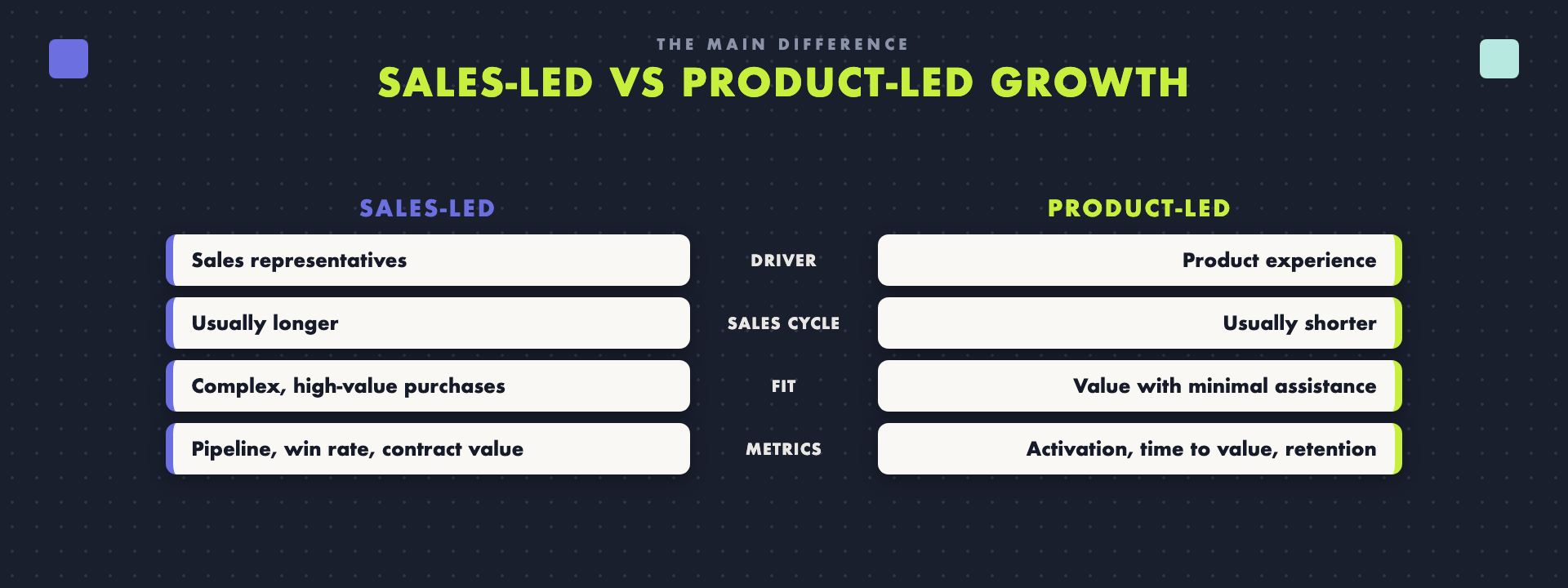
Product-led growth lets users find, try, and adopt a product through self-service options such as free trials or freemium plans. Sales-led growth suits complex purchases requiring human guidance, while product-led growth suits products that deliver value quickly with minimal assistance.
What Is Sales-Led Growth in SaaS?
Sales-led growth (SLG) in SaaS is a go-to-market strategy where sales representatives guide prospects toward purchase. Sales teams identify potential customers, conduct discovery calls and product demonstrations, manage evaluations, negotiate terms, and close contracts.
Sales-led growth suits complex software, high-value contracts, and purchases involving several stakeholders. Salesforce and Microsoft are examples of companies associated with sales-led models, where direct sales support helps customers assess products and buying requirements.
What Is Product-Led Growth in SaaS?
Product-led growth (PLG) is a SaaS strategy in which the product drives customer acquisition, conversion, retention, and expansion. Users find the software, sign up, and experience its value through a self-service path.
Product-led SaaS companies use free plans, free trials, intuitive onboarding, and in-product prompts to encourage adoption. Sales teams can support larger accounts after users demonstrate product interest or usage, usually through product-qualified leads.
Key Differences Between Sales-Led and Product-Led Growth
| Dimension | Sales-Led Growth | Product-Led Growth |
|---|---|---|
| Customer acquisition | Sales representatives, outbound prospecting, marketing campaigns, and account-based marketing engage target accounts. | Free trials, freemium plans, self-service sign-up, referrals, and product use attract and convert customers. |
| Sales cycle | Discovery, demonstrations, stakeholder reviews, negotiation, and procurement usually extend the buying cycle. | Users evaluate the product directly, usually shortening the initial purchase cycle. |
| Cost and CAC | Sales teams, commissions, and personalized support raise acquisition costs; larger contracts can offset the investment. | Product experience, onboarding, and lifecycle marketing drive acquisition; product development and support still require investment. |
| Deal size | Sales teams pursue higher-value contracts and coordinate complex enterprise purchases. | Users usually begin with smaller subscriptions, then expand through more seats, usage, or sales-assisted upgrades. |
| Team structure | Account executives, sales development representatives, sales engineers, and account managers guide revenue growth. | Product, engineering, design, data, and lifecycle marketing teams improve adoption; sales may support qualified accounts. |
| Metrics | Pipeline value, win rate, sales-cycle length, average contract value, quota attainment, and CAC payback measure performance. | Sign-up conversion, activation, time to value, trial-to-paid conversion, product-qualified leads, retention, and usage measure performance. |
Product-led and sales-led growth can operate together: product usage identifies engaged accounts, while sales teams support complex purchases and expansion.
Customer Acquisition Differences Between Sales-Led and Product-Led Growth
Sales-led growth acquires customers through salespeople who identify, qualify, educate, and convert prospects. Prospects usually enter through outbound outreach, referrals, marketing-generated leads, or inbound inquiries before sales representatives guide them through discovery calls, demonstrations, and proposals.
Product-led growth acquires customers through direct product use, usually after search, content, referrals, or a free trial or plan. Self-service onboarding lets users experience product value, while activation and product engagement guide upgrades from free accounts to paid subscriptions.
Sales Cycle Differences Between Sales-Led and Product-Led Growth
Sales-led growth usually has a longer sales cycle because representatives guide buyers through discovery, demonstrations, security reviews, procurement, and negotiations. The median B2B SaaS sales cycle on won deals is 84 days, ranging from 14–30 days for SMB deals to 90–180 days or longer for enterprise deals, according to "Sales Cycle Length Benchmark" by Optifai, April 2026.
Product-led growth shortens or removes much of the buyer-led evaluation period through self-service sign-up, free trials, and in-product onboarding. Longer sales-led cycles require more spending on prospect research, meetings, technical validation, and proposals, while product-led companies direct more resources toward product development, onboarding, analytics, and customer education.
Cost and CAC Differences Between Sales-Led and Product-Led Growth
Sales-led growth usually has higher customer acquisition costs because sales representatives, account executives, and tools engineers guide prospects through evaluation and purchase. Product-led growth shifts much of customer acquisition into self-service signup, onboarding, and in-product conversion, but still requires investment in product development, infrastructure, and lifecycle marketing.
Benchmarkit reports a median New CAC Ratio of $2.00 of sales and marketing expense for every $1.00 of new-customer ARR in the "2025 B2B SaaS Performance Metrics Benchmarks". The same report shows median CAC payback rising with contract value, from 8 months below $5,000 ACV to 24 months at $50,000–$250,000 ACV, and states that PLG "is more expensive as measured by S&M to Revenue (%) over time". Those figures describe broad SaaS benchmarks, not fixed outcomes for either growth model; CAC varies by contract value, sales difficulty, retention, and customer segment.
Deal Size Differences Between Sales-Led and Product-Led Growth
Sales-led SaaS deals generally have higher annual contract values than product-led deals. The average freemium PLG product starts at $10–$100 per month in initial spend, according to "Your guide to SaaS product metrics" by Kyle Poyar, Growth Unhinged, July 2023.
Sales-led teams support larger contracts by guiding multiple stakeholders through evaluation, procurement, security, and implementation. Product-led companies usually convert users through free plans, trials, or self-service checkout, while product-led sales can add human support when enterprise adoption requires it.
Team Structure Differences Between Sales-Led and Product-Led Growth
Sales-led SaaS teams center growth on sales development representatives, account executives, sales engineers, and customer success managers. Those teams guide prospects through prospecting, discovery, demonstrations, negotiations, and account management.
Product-led SaaS teams center growth on product, engineering, design, growth, and product analytics. Sales and customer success teams support high-value accounts, product-qualified leads, expansion, and retention, while shared data and clear handoffs connect the customer path.
Metric Differences Between Sales-Led and Product-Led Growth
Sales-led growth metrics track pipeline performance and sales execution. Teams monitor qualified pipeline, opportunity-to-close rate, win rate, sales-cycle length, quota attainment, average contract value, customer acquisition cost, and new annual recurring revenue.
Product-led growth metrics track user behavior and product conversion. Teams measure sign-ups, activation rate, time to value, feature adoption, free-to-paid conversion, product-qualified leads, and retention and expansion; both motions track churn, customer lifetime value, net revenue retention, payback period, and recurring-revenue growth.
Where Do Sales-Led and Product-Led Growth Overlap?
Sales-led and product-led growth overlap in their goal of acquiring, converting, retaining, and expanding SaaS customers. Both motions depend on a clear ideal customer profile, effective positioning, strong onboarding, customer success, and revenue measurement. Product-led and sales-led growth are points on a spectrum, rather than mutually exclusive approaches.
Product usage data helps sales teams prioritize accounts, while sales conversations reveal customer needs, product friction, and opportunities for improvement. Product-led sales connects those feedback loops by using product engagement to identify buying intent and sales support to address customer requirements. The shared foundation for a combined motion is customer insight, product value, and coordinated revenue measurement.
How Does Product-Led Sales Combine Both Growth Motions?
Product-led sales (PLS) combines self-service product adoption with targeted sales assistance. Prospects sign up, try the product, or use a free plan, while sales teams monitor usage signals such as repeated activity, teammate invitations, and interest in advanced features.
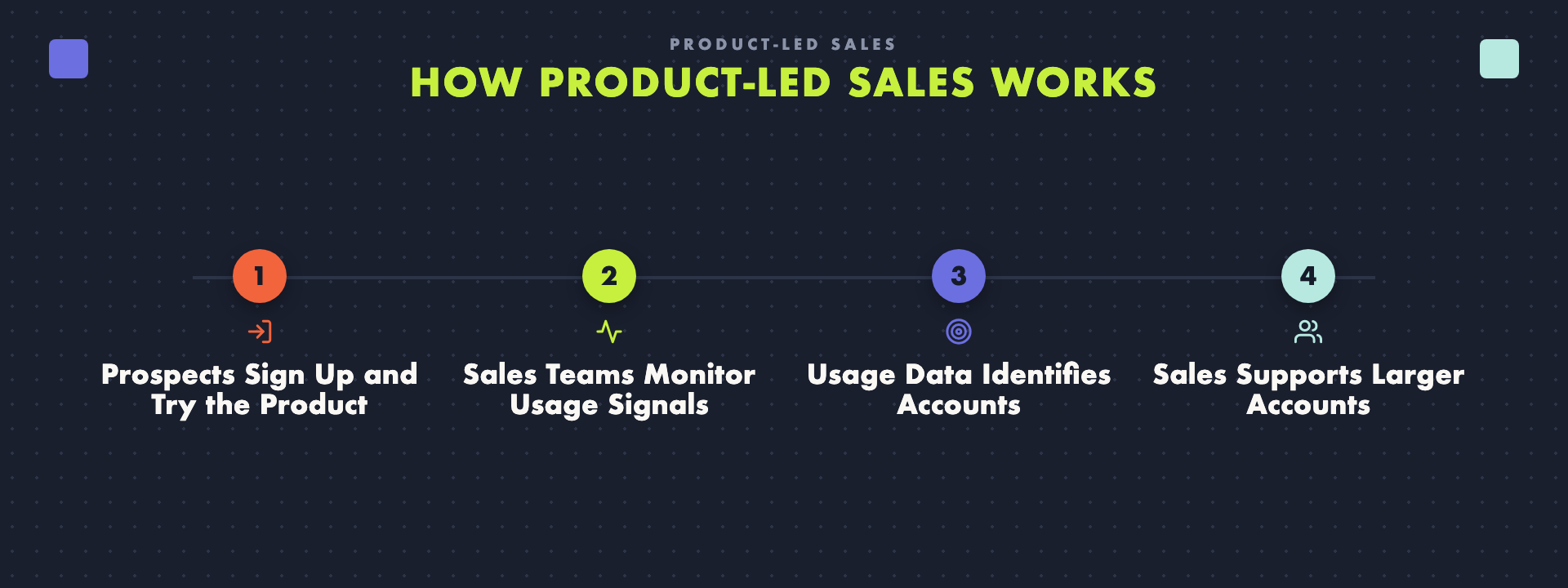
Product usage data helps sales teams identify accounts that may need guidance or have expansion potential. Smaller customers can continue through self-service, while sales representatives support larger accounts with complex requirements, procurement, security reviews, or enterprise contracts.
When Should a SaaS Company Choose Sales-Led or Product-Led Growth?
A SaaS company should choose sales-led or product-led growth based on product difficulty, customer needs, and purchasing requirements. Sales-led growth fits products that require executive approval, customization, security reviews, or implementation support. Product-led growth fits products that users can find, adopt, and use to reach value independently.
The choice does not need to be exclusive. McKinsey reports in "Five fundamental truths: How B2B winners keep growing" that B2B buyers split their time across in-person, remote, and digital self-serve channels in roughly equal thirds at each stage, which supports growth strategies that match customer preferences across the buying process. SaaS companies can combine self-service product adoption with sales support when larger accounts need help evaluating, purchasing, or expanding the product.
When Sales-Led Growth Fits a SaaS Product
Sales-led growth fits SaaS products that need guided evaluation, implementation, or enterprise approval.
- Complex products require demonstrations, configuration, integrations, or implementation support.
- High-value contracts need budget approval, procurement, or executive sponsorship.
- Enterprise purchases involve multiple stakeholders across IT, security, finance, or legal.
- Compliance-sensitive products require human guidance through security and risk reviews.
When Product-Led Growth Fits a SaaS Product
Product-led growth fits SaaS products that let users find, try, and gain value independently. A self-service product supports fast onboarding and adoption by individuals or small teams.
- Products that deliver core value within minutes or a short first session.
- Products that users can sign up for, onboard, and upgrade without sales assistance.
- Products that solve a clear problem for an individual user or small team.
- Products with low or moderate contract values that support scalable self-service sales.
When Should a Product-Led SaaS Company Add Sales?
A product-led SaaS company should add sales when self-service adoption reveals high-value accounts that need help converting or expanding. Common signals include users reaching plan limits, requesting custom contracts, requiring security or procurement reviews, or asking for advanced features.
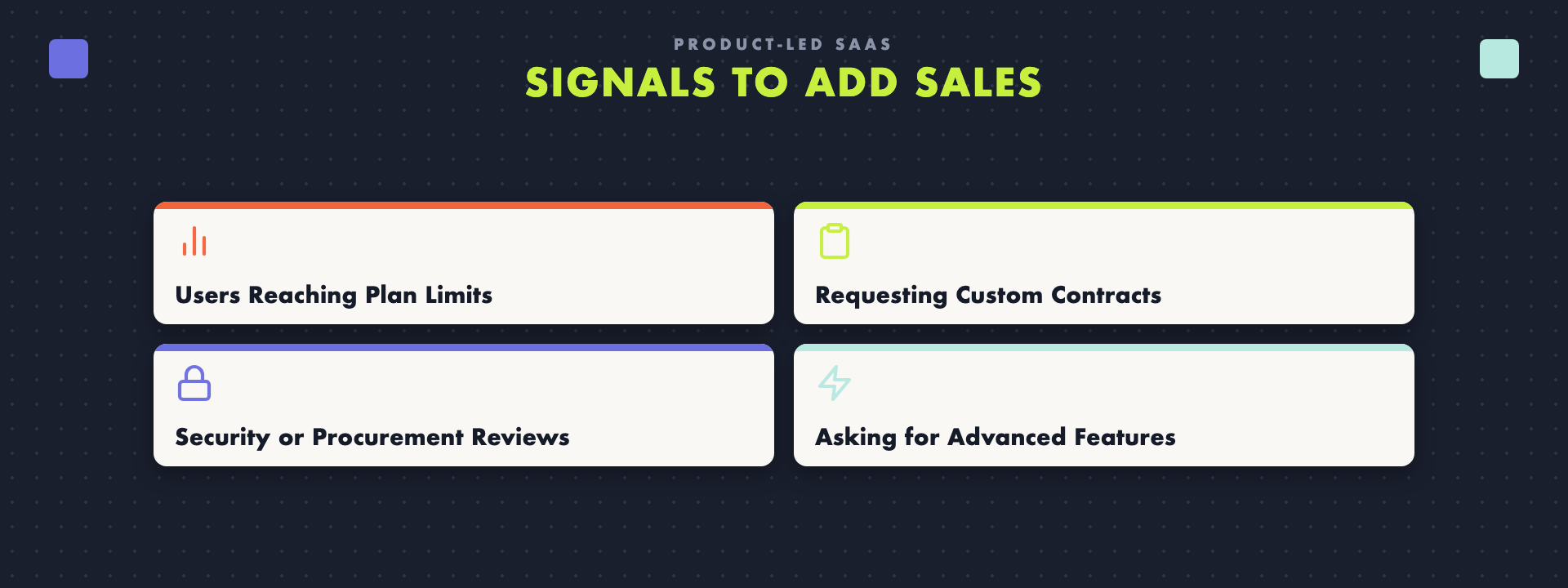
A sales team can prioritize product-qualified leads using product usage data, while smaller customers retain a self-service path. Targeted sales support helps larger accounts evaluate the product, coordinate stakeholders, and expand adoption.
How Does Account-Based Marketing Support Sales-Led and Hybrid Growth?
Account-based marketing supports sales-led growth by focusing marketing and sales resources on a defined list of high-value accounts. Teams use company data and buying signals to fit content, advertising, and outreach for decision-makers involved in complex purchases.
In hybrid growth, account-based marketing combines account targeting with product usage signals. Marketing engages target accounts, while sales prioritizes accounts showing activity such as frequent product use, colleague invitations, or broader feature adoption.
How Does a SaaS Marketing Agency Support Sales-Led and Product-Led Growth?
A SaaS marketing agency supports sales-led growth by generating qualified demand through SEO, content, paid campaigns, account-based marketing, and lead-nurturing workflows. The agency connects marketing activity to demos, opportunities, pipeline, and revenue, helping sales teams prioritize promising channels and accounts.
For product-led growth, a SaaS marketing agency improves free-trial and freemium funnels, onboarding, lifecycle email, and conversion rates. The agency tracks signups, activation, trial-to-paid conversion, retention, and expansion, while hybrid teams use consistent messaging and product-usage signals to identify accounts ready for sales assistance.
What Are the Pros and Cons of Sales-Led vs Product-Led Growth?
The pros and cons of sales-led vs product-led growth follow from how each motion sells. Sales-led growth supports complex, high-value purchases through direct sales guidance. Product-led growth enables self-service adoption, with trade-offs in support needs and enterprise conversion.
- Sales-led growth pros: Guides complex evaluations; supports larger contracts; enables personalized negotiation and onboarding.
- Sales-led growth cons: Extends sales cycles; raises customer acquisition costs; ties growth to sales-team capacity.
- Product-led growth pros: Reduces adoption friction; accelerates time to value; scales self-service acquisition efficiently.
- Product-led growth cons: Struggles with complex enterprise deals; depends on users reaching product value; may require sales support for account expansion.
What Are the Advantages of Sales-Led Growth Compared to Product-Led Growth?
The advantages of sales-led growth compared to product-led growth are listed below:
- Sales representatives explain technical features, integrations, security, and business value.
- Sales teams guide enterprise buyers through procurement and multi-stakeholder decisions.
- Account executives negotiate larger contracts and custom pricing.
- Direct conversations help teams personalize demos and resolve purchase concerns.
- Sales teams pursue named accounts and coordinate hands-on onboarding.
What Are the Advantages of Product-Led Growth Compared to Sales-Led Growth?
The advantages of product-led growth compared to sales-led growth are listed below:
- Self-service trials and freemium plans reduce friction during customer acquisition.
- In-product evaluation helps users reach value without waiting for a sales demonstration.
- Scalable onboarding can serve more users without adding sales staff at the same rate.
- Product usage data helps teams identify engaged users and product-qualified leads.
- Shared workflows and collaboration can bring new users into existing customer accounts.
- Lower reliance on sales conversations can reduce customer acquisition costs when retention and conversion remain strong.
How Do SaaS Companies Transition Between Sales-Led and Product-Led Growth?
SaaS companies transition between sales-led and product-led growth by adding the second motion gradually, rather than replacing the first. Sales-led companies can introduce free trials, self-serve onboarding, in-product education, and usage analytics, while product-led companies can add account executives, enterprise plans, security support, and assisted purchasing.
A successful transition maps customer path, tests changes incrementally, and assigns a cross-functional team to guide growth decisions. Product usage, account fit, team size, and commercial potential then define when self-serve accounts receive sales support.
How Do Product Qualified Leads Change Sales-Led Handoffs?
Product-qualified leads (PQLs) shift sales handoffs from broad outreach to behavior-based follow-up, using meaningful product engagement to indicate buying intent. When users complete onboarding, adopt core features, invite teammates, or reach usage limits, sales teams receive the account’s activity history and can fit outreach to demonstrated needs.
How Does a Hybrid GTM Motion Blend Sales-Led and Product-Led Growth?
A hybrid go-to-market motion uses product-led growth for self-service discovery, onboarding, and initial adoption, then engages sales when product usage, account size, or buying difficulty signals a need for human support. Sales teams guide larger accounts through procurement, implementation, and expansion while smaller customers continue converting through self-service.
Why Do Most Scaling SaaS Companies Need Sales-Led and Product-Led Growth?
Most scaling SaaS companies benefit from combining product-led growth and sales-led growth because customers have different buying needs. Product-led growth supports self-service adoption and product-driven expansion, while sales-led growth helps buyers work through complex purchases, security reviews, procurement, and multiple stakeholders.
A hybrid approach lets the product create initial value and usage signals, then directs sales support toward accounts needing guidance or offering expansion potential. The combined model preserves the core difference between product-led growth, which scales through product use, and sales-led growth, which scales through human-guided selling.

About the team
SaaS Marketing Agency Digital Team
The in-house team at SaaS Marketing Agency Digital. We architect growth systems for B2B SaaS companies from Series A through pre-IPO.