To build a SaaS SEO strategy for organic growth, align technical SEO, buyer-focused keyword research, useful content, and authority building with measurable business goals. A SaaS SEO strategy is a coordinated plan to attract qualified organic visitors and convert them into trials, demos, pipeline, and revenue. Unlike traditional SEO, SaaS SEO connects search visibility to recurring revenue, product education, and usually complex buying decisions. SEO can reduce reliance on paid acquisition and support durable demand through technical accessibility, customer research, site structure, product-led content, on-page optimization, digital PR, and revenue measurement. The eight steps are to set goals and KPIs, define the ideal customer, build the technical foundation, research keywords, create structural pages, develop the content strategy, optimize on-page factors, and earn links and PR.
Measure success through qualified organic traffic, commercially relevant rankings, sign-ups, demos, product-qualified leads, pipeline, and customer acquisition efficiency. HubSpot, Zapier, Ahrefs, and Canva illustrate how SaaS companies use educational content, integrations, comparisons, and product-led pages to earn search visibility. SEO usually shows early technical or ranking improvements within 3–6 months, while stable growth commonly takes 6–12 months, depending on competition, site authority, content quality, and implementation speed. A company is ready to start when it can define its target customer, connect SEO goals to business outcomes, and provide resources for technical, content, and measurement work. Teams with those capabilities can manage SEO in-house; other companies can work with specialists. A SaaS SEO agency audits the site, researches customers and competitors, plans architecture and content, improves authority, and reports on conversions. A SaaS marketing agency connects organic visits to CRM stages, attribution, pipeline, sales enablement, and retention.
AI search changes how searchers find information, but Google’s guidance keeps crawlable pages, helpful content, accessible text, internal links, and accurate structured data central to visibility. Generative Engine Optimization and Answer Engine Optimization extend SaaS SEO by helping AI systems understand and cite a company’s knowledge, evidence, products, and answers. Programmatic pages, integration pages, comparison pages, and pillar content scale coverage across search needs. Google Search Console, Google Analytics, Ahrefs, and Semrush support measurement and research; content, digital PR, internal linking, and PPC support distribution and demand capture. As useful pages gain rankings, links, mentions, and conversions, they strengthen the wider site and compound organic growth. A SaaS SEO strategy is the repeatable plan that builds and sustains that growth.
What Is a SaaS SEO Strategy?
A SaaS SEO strategy is a structured plan for improving a software company’s visibility in organic search and converting that visibility into qualified trials, demos, sign-ups, and recurring revenue. The strategy aligns technical SEO, keyword research, content, site architecture, conversion optimization, and authority building with how software buyers evaluate products.
Unlike a traffic-only plan, a SaaS SEO strategy connects search intent to product value and subscription outcomes.
What Makes SaaS SEO Different From Traditional SEO?
SaaS SEO targets qualified buyers across a longer subscription buying process, while traditional SEO usually targets broader product, service, or local searches. SaaS content addresses problem, category, feature, integration, comparison, and alternative searches, then guides prospects toward trials, demos, and recurring subscriptions.
SaaS SEO measures qualified signups, pipeline, customer acquisition cost, and recurring revenue alongside traffic and rankings. Traditional SEO usually prioritizes actions such as purchases, calls, bookings, or inquiries; SaaS strategies instead connect search intent to ongoing customer value.
How Does SaaS SEO Differ for B2B and B2C Products?
B2B and B2C SaaS SEO share technical foundations but target different audiences, search intents, and buying processes. B2B SaaS SEO addresses business users and buying committees researching workflows, integrations, security, compliance, and product comparisons.
B2B buyers usually need detailed guides, case studies, ROI resources, and demo offers during longer sales cycles. B2C SaaS SEO targets individual consumers with product benefits, pricing, reviews, tutorials, and trial pages, measuring success through sign-ups, purchases, and customer acquisition.
Why Does SEO Matter for SaaS Companies?
SEO matters for SaaS companies because it helps buyers find relevant software while researching problems, tools, and vendors. Search accounts for 43.8% of website traffic by channel across about 35,000 sites, according to "AI Makes Up 0.1% of Traffic, but Clicks Aren't Everything" by Louise Linehan and Xibeijia Guan, Ahrefs, March 2025. First Page Sage reports that SEO turns SaaS visitors into leads at 2.1%, compared with 0.7% for PPC, in "B2B SaaS Funnel Conversion Benchmarks", June 2025.
A SaaS SEO strategy connects educational articles, product pages, and comparison pages to different buying stages. Useful content can attract qualified visitors over time, build trust before sales conversations, and reduce reliance on paid campaigns.
Is SaaS SEO Still Worth It in the Age of AI Search?
Yes, SaaS SEO remains worthwhile because search visibility can reach buyers researching problems, comparing products, and evaluating tools. A July 2025 Pew Research Center analysis, "Google users are less likely to click on links when an AI summary appears in the results" by Athena Chapekis and Anna Lieb, found that users clicked a traditional search result on 8% of visits when an AI summary appeared, compared with 15% when no summary appeared.
SaaS companies should measure SEO through qualified leads, product sign-ups, pipeline, and brand visibility, not traffic alone. Clear, authoritative pages that answer buyer questions can support discovery across traditional search results and AI-generated answers.
What Are the Pillars of a SaaS SEO Strategy?
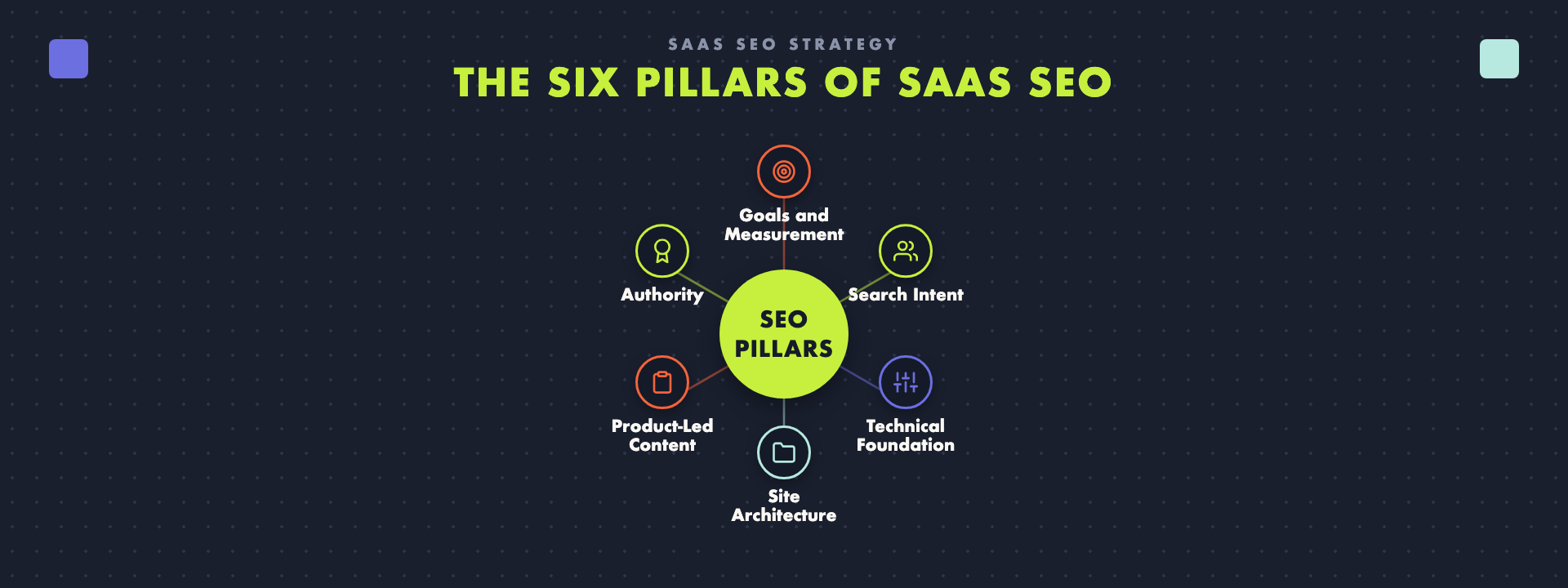
The six pillars of a SaaS SEO strategy, which link search visibility to qualified leads, sign-ups, and revenue, are listed below:
- Business goals and measurement: Set targets for qualified traffic, trials, sign-ups, pipeline, and revenue, then track progress against clear baselines.
- Audience, product, and search intent: Identify ideal customers, their problems, and the searches they use to find tools.
- Technical SEO foundation: Make the public website secure, fast, mobile-friendly, crawlable, and indexable.
- Keyword-led site architecture: Organize feature, solution, industry, use-case, integration, and comparison pages around search intent and buyer needs.
- Helpful, product-led content: Publish useful articles, guides, templates, and research that answer customer questions and show relevant product applications.
- Authority, distribution, and improvement: Earn relevant backlinks through useful resources, partnerships, and digital PR, then refine pages using performance data.
How to Build a SaaS SEO Strategy Step by Step
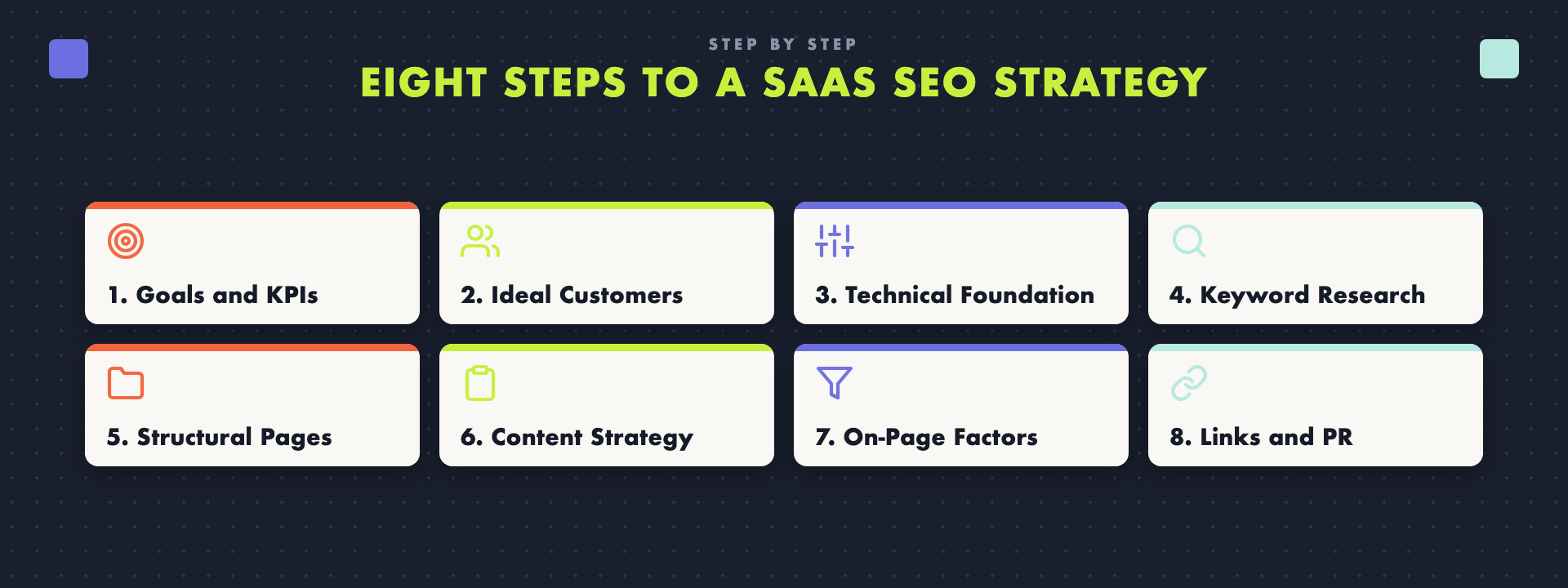
To build a SaaS SEO strategy, a SaaS team follows the eight steps listed below:
- Set SaaS SEO goals and KPIs.
- Identify ideal customers and their pain points.
- Build a technical SEO foundation.
- Research keywords across the buying stages.
- Build structural pages for products, features, use cases, and integrations.
- Create a content strategy around customer needs and search intent.
- Optimize on-page factors, including titles, headings, and internal links.
- Build relevant links and earn industry PR.
Step 1: Set SaaS SEO Goals and KPIs
A SaaS SEO strategy sets goals by connecting organic search activity to measurable business outcomes. Establish a baseline for organic clicks, qualified sessions, sign-ups, demo requests, trial starts, leads, pipeline, and revenue before setting targets for a defined period.
Track leading indicators, such as non-branded impressions and rankings, alongside conversion rate, sign-ups, and sourced or influenced pipeline. Google Search Console reports impressions, clicks, click-through rate, queries, and average position; analytics tools connect organic visits to conversions. Segment results by customer type and page group, then compare performance with the baseline. SaaS SEO goals depend on attracting buyers whose needs and purchasing behavior match the product.
Step 2: Identify Your Ideal Customer and Their Pain Points
Identify the ideal customer profile (ICP) and buyer personas using customer and sales evidence. The ICP describes organizations most likely to succeed with the SaaS product, while buyer personas represent the people who evaluate, use, or approve it.
Review CRM records, deal size, retention, product usage, support tickets, sales calls, win–loss data, and customer reviews. Interview customers, prospects, and former customers to confirm their goals, pain points, objections, decision criteria, and search language. Translate recurring problems into SaaS SEO topics and page briefs, then revisit the customer profile as the product and market change.
Step 3: Build the Technical SEO Foundation
A SaaS technical SEO foundation helps search engines find, crawl, render, and index public website pages. Use descriptive URLs, internal links, an XML sitemap, canonical tags, HTTPS, responsive layouts, and 301 redirects to support crawling and prevent duplicate-page issues.
SaaS teams should prioritize two crawl fixes: ensure public marketing pages display meaningful content without relying entirely on JavaScript, and keep private product-app routes out of search results. Verify important pages with Google Search Console, then address rendering and app indexing separately.
Make Sure SaaS Pages Render Without JavaScript
SaaS marketing pages should expose their main content in the initial HTML response through server-side rendering, static rendering, or prerendering. Google can render JavaScript, but rendering delays or unsupported scripts can prevent crawlers from seeing important page content. Keep headings, body copy, metadata, and internal links available in the rendered HTML, and use standard <a href> links. Test both the page source and rendered page with Google Search Console’s URL Inspection tool to confirm that search engines can access the intended content.
Keep the Product App Out of Search
Keep the SaaS product app out of search by requiring authentication for dashboards, account pages, and private workspaces. Google cannot crawl protected content as public pages. For public app URLs that should remain crawlable but not appear in results, add a noindex directive in the page’s HTML or an X-Robots-Tag: noindex HTTP header. Do not rely on robots.txt alone, because blocking a URL can prevent Google from seeing its noindex directive. Verify dashboard routes, per-user URLs, and internal search pages in Google Search Console.
Step 4: Do Keyword Research Across the SaaS Buyer Journey
Keyword research across the SaaS buyer journey identifies the search terms prospects use from problem discovery through product evaluation and purchase. SaaS teams should use sales calls, support questions, product use cases, and keyword tools to find relevant topics, then determine each keyword’s search intent, business value, and buyer-buying stage.
SaaS keyword research should group related searches by shared intent and assign each group to a suitable page, such as an educational article, comparison page, or product page. Search result analysis helps teams select the right content format, prevent pages from competing for the same terms, and guide qualified visitors toward a signup or demo.
Understand Search Intent for SaaS Keywords
Search intent is the reason a person searches and the result they expect to find. SaaS keywords usually signal informational, navigational, commercial, or transactional intent. Search results reveal intent through their dominant page types, related questions, and SERP features. SaaS content should match the expected result, such as guides for informational searches, comparisons for commercial searches, and pricing or signup pages for transactional searches.
Prioritize SaaS Keywords by Business Value
Prioritize SaaS keywords by product fit, buyer intent, conversion potential, and realistic ranking difficulty, not search volume alone. Give higher priority to commercial searches such as pricing, comparisons, alternatives, and solution-led queries that can lead to trials, demos, or sales conversations. Score each keyword from 1 to 5 for business fit, intent, conversion value, and rankability, then compare the total with traffic potential. Validate keyword priorities against paid campaign results, website analytics, and CRM outcomes.
Map SaaS Keywords to Buyer Journey Stages
Map SaaS keywords to awareness, consideration, and decision stages according to the searcher’s purchase readiness. Awareness queries, such as “how to reduce churn,” suit educational guides, while consideration queries, such as “best customer-support software” or “X vs. Y,” suit buyer’s guides and comparison pages. Decision queries containing “pricing,” “demo,” “free trial,” or “alternative” suit product, pricing, case-study, or demo pages. Record each query’s intent, buying stage, target URL, and content format, then validate the mapping against current search results and link related pages toward conversion.
Step 5: Build Structural SaaS Pages
Structural SaaS pages connect a product with defined audiences, use cases, features, integrations, and buying decisions. Build product, feature, industry, role, pricing, comparison, alternative, and integration pages around distinct search intent.
Organize related pages under clear category hubs, keep priority pages within a few clicks of the homepage, and link them with descriptive anchor text. Use scalable templates only when each page offers distinct details about a real product capability, integration, competitor, or use case.
Step 6: Build a SaaS SEO Content Strategy
Build a SaaS SEO content strategy by connecting customer problems, search intent, and business value to a focused publishing plan. Choose topics that match the product’s capabilities and the ideal customer’s needs, then prioritize them by search demand, ranking difficulty, and potential to generate qualified leads or sign-ups.
Organize selected topics into clusters with pillar pages and supporting content for buyer questions, use cases, comparisons, and implementation challenges. Add relevant product examples and calls to action where they help readers, then review rankings, engagement, and conversions to update or consolidate content.
Build Topic Clusters and Pillar Pages
Topic clusters organize SaaS SEO content around one core subject. A pillar page gives a broad overview, while focused cluster pages answer related questions, use cases, and long-tail queries. Plan the pages around customer needs and business priorities, then connect the pillar and cluster pages with descriptive internal links. Keep each page distinct, update outdated information, and measure organic visibility, internal-link engagement, and conversions across the cluster.
Create Product-Led SEO Content
Product-led SEO content solves one customer problem while showing how a SaaS product supports the task. Choose topics tied to product features, workflows, integrations, or templates rather than search volume alone. Demonstrate the solution with instructions, screenshots, examples, or walkthroughs, and mention the product only when it fits the reader’s needs. Connect each page to a relevant next step, such as a free trial, demo, template, or interactive tool.
Step 7: Optimize On-Page SEO Elements
SaaS on-page SEO aligns each page with its target keyword and search intent. Write a distinct title tag and meta description, use a clear URL and one prominent H1, and organize supporting copy with descriptive subheadings.
Use natural keyword phrasing in page copy, image alt text, and descriptive internal links to relevant product, feature, comparison, and educational pages. Add structured data only when it accurately describes visible page content; on-page optimization should make each SaaS page useful and easy to interpret, not repeat keywords unnaturally.
Step 8: Build Links and Earn PR for SaaS
SaaS link building earns relevant editorial links through original research, expert commentary, useful guides, digital PR, and industry partnerships. Guest posts, media mentions, and resource-page outreach can strengthen site authority when publications cover topics relevant to the product and its audience.
A SaaS SEO strategy should prioritize trustworthy links and natural anchor text rather than purchased links or manipulative schemes. Strong internal links connect earned-coverage pages to relevant product and content pages, while measurement tracks referring domains, linked-page rankings, organic traffic, trials, demos, qualified leads, and assisted revenue.
How Do You Measure SaaS SEO Success?
To measure SaaS SEO success, connect organic search visibility to qualified pipeline and recurring revenue, not by reporting traffic alone. Google Search Console tracks impressions, clicks, click-through rate, average position, queries, and landing pages; analytics and CRM data show whether organic visitors become leads, opportunities, and customers.
Use a consistent attribution model, such as first-touch, last-touch, or multi-touch, and report results by landing page, topic, and buyer stage. Track organic-sourced and organic-influenced pipeline, conversion rates, closed-won revenue, customer acquisition cost, and MRR or ARR; rankings and traffic help diagnose performance but do not prove revenue impact.
Which SaaS SEO Metrics Prove Pipeline Impact?
The SaaS SEO metrics that prove pipeline impact track qualified leads, sales opportunities, and recurring revenue attributed to organic search. Track the metrics below by landing page, content cluster, and keyword intent.
- Organic-sourced and organic-influenced pipeline value
- Organic-sourced MQLs, SQLs, and sales opportunities
- Lead-to-SQL and SQL-to-opportunity conversion rates
- Closed-won revenue and ARR from organic search
- Pipeline value by page type
- Organic customer acquisition cost and cost per pipeline dollar
- Win rate and pipeline velocity for organic-influenced opportunities
- Organic share of new ARR and assisted conversions
Which SaaS Companies Run Successful SEO Strategies?
The SaaS companies that run successful SEO strategies through search-focused pages are listed below:
- Zapier: Publishes integration pages for connecting apps and automating workflows.
- Canva: Uses template pages to target searches for designs such as business cards.
- ClickUp: Builds comparison, alternative, feature, and template pages for software searches.
- Atlassian: Creates product-led pages for software use cases and team workflows.
How Long Does a SaaS SEO Strategy Take to Work?
A SaaS SEO strategy usually takes 3–6 months to show early measurable results, such as higher impressions, initial keyword rankings, and modest organic traffic growth. Only 1.74% of newly published pages rank in the top 10 within a year, according to "How Long Does It Take to Rank in Google? And How Old Are Top Ranking Pages?" by Patrick Stox, Ahrefs, May 2025.
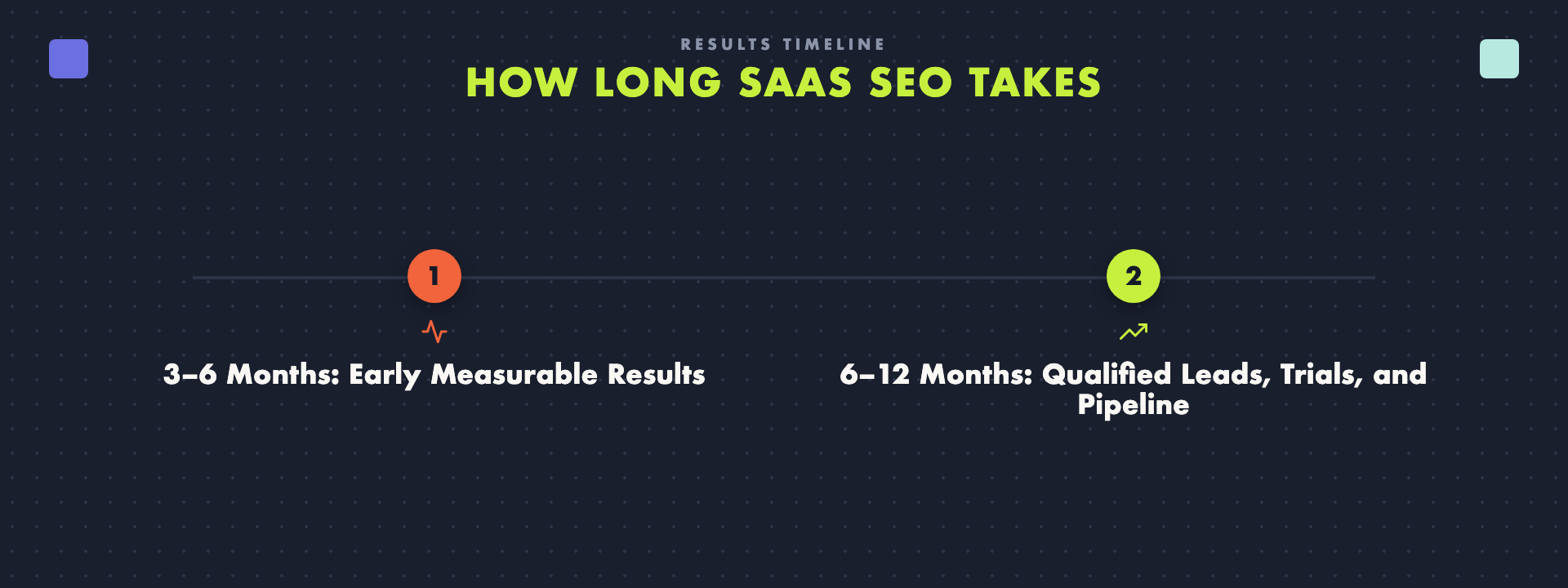
Meaningful results, including qualified leads, trials, demos, and pipeline, usually require 6–12 months. Domain authority, competition, technical health, content quality, publishing consistency, and link acquisition can shorten or extend the timeline, so the ranges serve as planning benchmarks rather than guarantees.
Are You Ready to Start a SaaS SEO Strategy?
Yes, a SaaS company is ready to start an SEO strategy when it has a defined audience, searchable customer problems, measurable goals, and resources for steady execution. The readiness checks below show whether the company can build and maintain a focused organic growth program.
- Defined business goals: Set SEO goals around qualified sign-ups, trial starts, demo requests, pipeline, or revenue. Rankings and traffic provide useful context, but business outcomes should guide priorities.
- Documented ideal customer profile: Record the industries, roles, company sizes, use cases, pain points, and buying constraints of target customers. Customer details help teams choose relevant topics and assess lead quality.
- Evidence of search demand: Confirm that prospective customers search for the problems, workflows, software categories, or alternatives your product addresses. Customer interviews, sales calls, keyword research, and support questions can reveal useful search topics.
- Control over the marketing website: Make sure your team can update page titles, headings, copy, URLs, internal links, templates, and technical settings. Website access lets marketers and developers improve pages as search opportunities change.
- Crawlable public pages: Check that search engines can access important marketing pages and render their main content. Clear internal links, descriptive metadata, an XML sitemap, and accessible HTML support discovery and indexing.
- Separation between public pages and the product app: Keep login screens, private account areas, and customer data out of search results. Access controls and appropriate indexing directives help protect private content while preserving public product pages.
- Reliable conversion paths: Give organic visitors a clear next step, such as starting a free trial, requesting a demo, creating an account, or downloading a relevant resource. Track each conversion action so SEO reports connect visits with meaningful engagement.
- Measurement and CRM tracking: Configure Google Search Console, an analytics platform, conversion events, and CRM attribution. Connected reporting helps teams follow organic performance from impressions and clicks through qualified leads and revenue.
- Content and subject-matter capacity: Assign experts, writers, editors, designers, or agency partners to produce accurate and useful content. A manageable publishing cadence supports consistency without relying on thin pages created only to target keywords.
- Relevant product proof: Prepare product features, use cases, integrations, templates, documentation, customer examples, or demonstrations that support content topics. Product evidence helps educational pages address buyer needs without turning every article into a sales pitch.
- Sales and marketing alignment: Agree on qualified-lead definitions, target segments, lifecycle stages, and attribution rules. Sales feedback helps marketing prioritize search topics that attract likely buyers and influence pipeline.
- Technical maintenance resources: Identify developers or technical specialists who can resolve rendering, indexing, redirect, canonical, sitemap, speed, and duplicate-content issues. Ongoing technical support keeps important pages accessible to search engines.
- A repeatable publishing workflow: Assign ownership for opportunity prioritization, content briefs, editorial review, publication, internal linking, performance monitoring, and updates. A defined workflow turns SEO into an operating program rather than a series of isolated articles.
- Original skill and a safe review process: Confirm that your team can contribute product knowledge, customer evidence, data, or practical examples. Editorial, factual, privacy, and compliance reviews help maintain trustworthy content.
- Time for sustained improvement: Plan for ongoing research, publishing, technical fixes, authority building, and measurement rather than immediate results from a few posts. A focused starting group of high-value topics can launch the strategy while the content library grows.
Should You Run a SaaS SEO Strategy In-House or With Experts?
A SaaS SEO strategy usually works best as a hybrid model: keep SEO strategy and product knowledge in-house, and use experts to fill skill or capacity gaps. The right choice depends on budget, growth stage, internal experience, and execution needs.
An in-house team suits companies with a senior SEO owner and access to product and engineering teams. An agency suits companies that need faster delivery or specialized support across technical SEO, content, digital PR, and analytics.
How Does a SaaS SEO Agency Execute an Organic Growth Strategy?
A SaaS SEO agency turns business goals and buyer intent into a prioritized organic growth roadmap. The agency audits crawlability, indexation, site performance, content, competitors, and conversion paths, then prioritizes technical fixes and opportunities by commercial value rather than search volume alone.
The agency improves existing pages, develops product, use-case, comparison, and educational content, and earns relevant links through digital PR and partnerships. The team tracks rankings, organic conversions, trials, demos, qualified leads, and pipeline, then adjusts the roadmap based on business results.
How Does a SaaS Marketing Agency Connect SEO Strategy to Revenue?
A SaaS marketing agency connects SEO strategy to revenue by linking organic search data with website analytics, product events, and CRM records. The agency tracks the path from search query and landing page to signup or demo, qualified opportunity, closed-won revenue, and retention.
CRM attribution reports show which pages and buying paths generate qualified leads, pipeline value, and customers. Agencies compare organic-sourced and organic-influenced revenue under a documented attribution model, because SaaS purchases usually involve multiple touchpoints.
How Does AI Search Change a SaaS SEO Strategy?
AI search expands a SaaS SEO strategy beyond traditional rankings and clicks to include visibility, citations, qualified visits, and conversions from AI-generated answers. Google states that its AI search features use existing SEO fundamentals, including crawlable pages, helpful content, and clear site structure; SaaS teams should strengthen those fundamentals while publishing original knowledge and credible customer evidence.
AI summaries can reduce clicks to standard search results. Organic click-through rate reached 2.36% on queries with an AI Overview in February 2026, compared with 3.82% without one, according to "AIO Impact on Google CTR: 2026 Update" by Seer Interactive, April 2026. G2 reports that 51% of B2B software buyers begin research with an AI chatbot more often than Google, in "In the Answer Economy, Don't Win the Click, Win the Answer" by Tim Sanders, April 2026. SaaS teams should track AI visibility and citations alongside branded searches, assisted conversions, qualified pipeline, and revenue.
How Does Generative Engine Optimization Extend SaaS SEO?
Generative Engine Optimization (GEO) extends SaaS SEO by improving content visibility in AI-generated answers, alongside traditional search rankings. GEO uses clear structure, credible sources, relevant data, structured markup, and freshly updated information so generative engines can interpret and cite SaaS knowledge. GEO can raise visibility by up to 40% in generative engine responses, according to "GEO: Generative Engine Optimization" by Pranjal Aggarwal and colleagues, KDD 2024, with results varying by domain.
How Does Answer Engine Optimization Extend SaaS SEO?
Answer engine optimization (AEO) extends SaaS SEO by organizing clear, authoritative content so AI-powered answer engines can extract and cite it in responses to user questions. SaaS SEO targets search rankings and clicks, while AEO adds visibility in synthesized answers, including responses that do not generate a website visit.
Which Page Types Scale a SaaS SEO Strategy?
The four page types that scale a SaaS SEO strategy target distinct search needs and product paths.
- Programmatic pages target long-tail searches with useful, original content.
- Integration pages explain connected workflows, features, and setup steps.
- Comparison pages evaluate products, alternatives, pricing, and use cases transparently.
- Pillar content organizes related articles around a broad topic or customer problem.
How Do Programmatic Pages Scale SaaS SEO?
Programmatic pages scale SaaS SEO by using repeatable URL patterns, structured data, and reusable templates to target relevant long-tail searches. Each page should provide distinct value, such as verified feature details, use cases, or pricing context, rather than swapping keywords in near-identical copy. SaaS teams should test a small page set, measure indexing and conversions, then expand useful formats while avoiding thin pages that may violate Google’s scaled-content-abuse policy.
How Do Integration Pages Scale SaaS SEO?
Integration pages scale SaaS SEO by targeting searches for genuine connections between a product and tools customers already use, such as “[product] Salesforce integration.” Each page should explain supported workflows, setup steps, use cases, and relevant limitations, then guide visitors toward connecting the tools or starting a trial. A structured integrations hub can link to accurate, distinct pages and help search engines find them.
How Do Comparison Pages Scale SaaS SEO?
Comparison pages scale SaaS SEO by targeting buyers evaluating products through searches such as “Product A vs. Product B” and “[Product A] alternatives.” Strong comparison pages assess features, pricing, integrations, security, support, and use-case fit with current evidence and clear product limitations. A focused demo or trial call to action helps convert organic visits, while ranking and conversion data guide updates.
How Does a Pillar Content Model Organize SaaS SEO?
A pillar content model organizes SaaS SEO around a full page covering a broad topic, such as a software category or customer problem. Supporting cluster pages answer related subtopic and long-tail keyword queries in greater depth. Internal links connect the pillar, cluster pages, and relevant product pages, strengthening site navigation and clarifying topical relationships for search engines.
Which Tools and Channels Support a SaaS SEO Strategy?
The tools and channels that support a SaaS SEO strategy track search visibility, website behavior, technical health, and conversions. Google Search Console reports queries, clicks, impressions, and indexing; Google Analytics measures organic sessions and conversions. Keyword research platforms, site crawlers, and Looker Studio dashboards support planning, audits, and reporting.
SEO content, product and comparison pages, email, LinkedIn, partner marketing, digital PR, communities, and PPC support distribution and demand capture. SaaS companies can use partner campaigns, such as integration pages and joint webinars, to reach relevant audiences beyond organic search.
Which SEO Tools Fit a SaaS SEO Strategy?
The SEO tools that fit a SaaS SEO strategy are listed below:
- Google Search Console tracks search queries, impressions, clicks, indexing, and page performance.
- Ahrefs supports keyword research, competitor analysis, rank tracking, and backlink audits.
- Semrush combines keyword research, technical audits, content optimization, and SEO reporting.
- Screaming Frog SEO Spider crawls websites to identify broken links, redirects, duplicate pages, and missing tags.
How Do SEO and PPC Work Together for SaaS?
SEO and PPC work together by combining long-term organic visibility with immediate paid search exposure. SaaS teams use PPC search-term and conversion data to validate keywords, test headlines, and refine offers before creating SEO content. Organic rankings and high-converting content then inform paid campaigns, landing pages, and measures such as qualified leads, pipeline, revenue, and blended acquisition cost.
Why Does a SaaS SEO Strategy Compound Organic Growth?
A SaaS SEO strategy compounds organic growth as useful pages earn rankings and attract qualified visitors repeatedly without payment for every click. Related content and internal links help search engines find pages, while relevant backlinks can strengthen site credibility and visibility.
New pages expand search coverage, and refreshed pages can improve existing rankings and conversion opportunities. The SaaS SEO strategy serves as the playbook for organic growth by coordinating technical accessibility, useful content, site structure, and earned authority.

About the team
SaaS Marketing Agency Digital Team
The in-house team at SaaS Marketing Agency Digital. We architect growth systems for B2B SaaS companies from Series A through pre-IPO.