To build a SaaS marketing funnel, map the buyer journey to funnel stages, then build content, channels, nurture, conversion, and retention for each stage. A SaaS marketing funnel is a structured path that guides prospects from awareness through conversion to retention, and it differs from a traditional linear sales funnel by managing the continuous customer lifecycle and recurring revenue. The funnel takes shape across six sequential steps: map the buyer journey and Ideal Customer Profile (ICP), create content per stage, set up top-of-funnel channels, build middle nurture and lead scoring, optimize bottom conversion, and add retention and expansion loops.
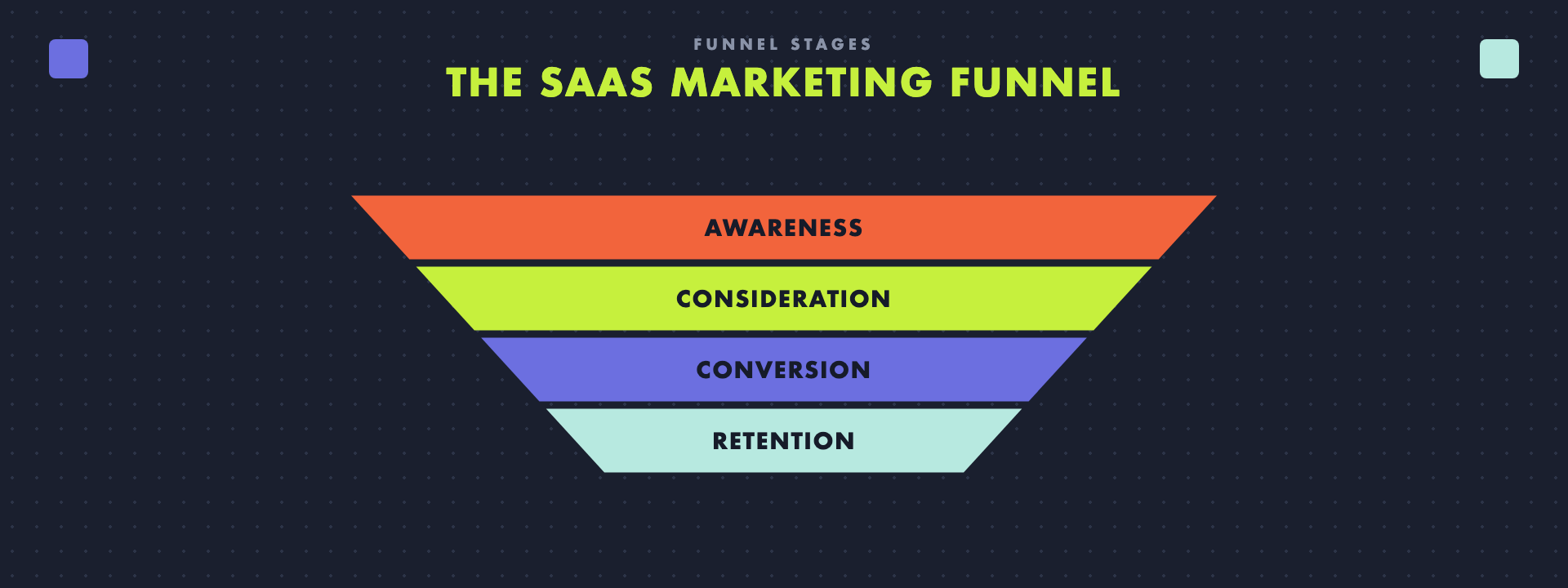
The SaaS marketing funnel runs across four stages, Top of Funnel (Awareness), Middle (Consideration), Bottom (Decision and Conversion), and Post-Purchase (Retention), framed by the AARRR model (Acquisition, Activation, Retention, Revenue, Referral). Funnel performance comes from tracking conversion rates, customer acquisition costs, and average deal size, while sales and marketing alignment holds funnel definitions and processes consistent. Common funnel leaks come from misaligned content and weak targeting, and problem-first landing pages and behavior-triggered emails fix them. SaaS marketing agencies build and optimize funnels by analyzing data, setting SMART goals, and running experiments, while future trends center on AI-driven personalization and product-led growth. Predictable funnel performance follows from understanding the SaaS marketing funnel and mapping the buyer journey.
What Is a SaaS Marketing Funnel?
A SaaS marketing funnel is a structured framework that guides potential customers from initial awareness of a software product through several stages to conversion and retention. A traditional sales funnel ends at the point of sale, but a SaaS marketing funnel extends past conversion to include retention and expansion, which reflects the subscription-based nature of SaaS businesses. This extended path raises customer lifetime value through ongoing engagement and renewals.
The funnel runs across four core stages: awareness, consideration, decision, and post-purchase. In the awareness stage, prospects first discover the product. During the consideration stage, prospects evaluate the product against competitors. In the decision stage, prospects convert to paying customers. In the post-purchase stage, the focus moves to retention, expansion, and advocacy. This full-lifecycle approach lets SaaS companies acquire new customers and hold long-term relationships, which drives sustainable recurring revenue growth.
How the SaaS Funnel Differs From a Traditional Sales Funnel
The SaaS marketing funnel differs from a traditional sales funnel in its cyclical nature and its focus beyond the initial sale. A traditional sales funnel follows a linear path from awareness to purchase, while a SaaS marketing funnel continues past conversion through activation, retention, and expansion. This structure reflects the subscription model of SaaS businesses, where the goal is long-term customer engagement and recurring revenue.
The SaaS funnel weighs ongoing customer relationships and value delivery. Traditional models end with a one-time transaction, while the SaaS approach sustains engagement through nurturing, onboarding, and customer support. This ongoing cycle holds customer loyalty and supports upsells, which contrasts with the single-purchase focus of a traditional sales funnel.
How to Build a SaaS Marketing Funnel Step by Step
To build a SaaS marketing funnel, follow a six-step process that aligns each stage with the buyer journey and Ideal Customer Profile (ICP). The process starts with mapping the buyer journey and defining the ICP, which lays the foundation for the steps that follow.
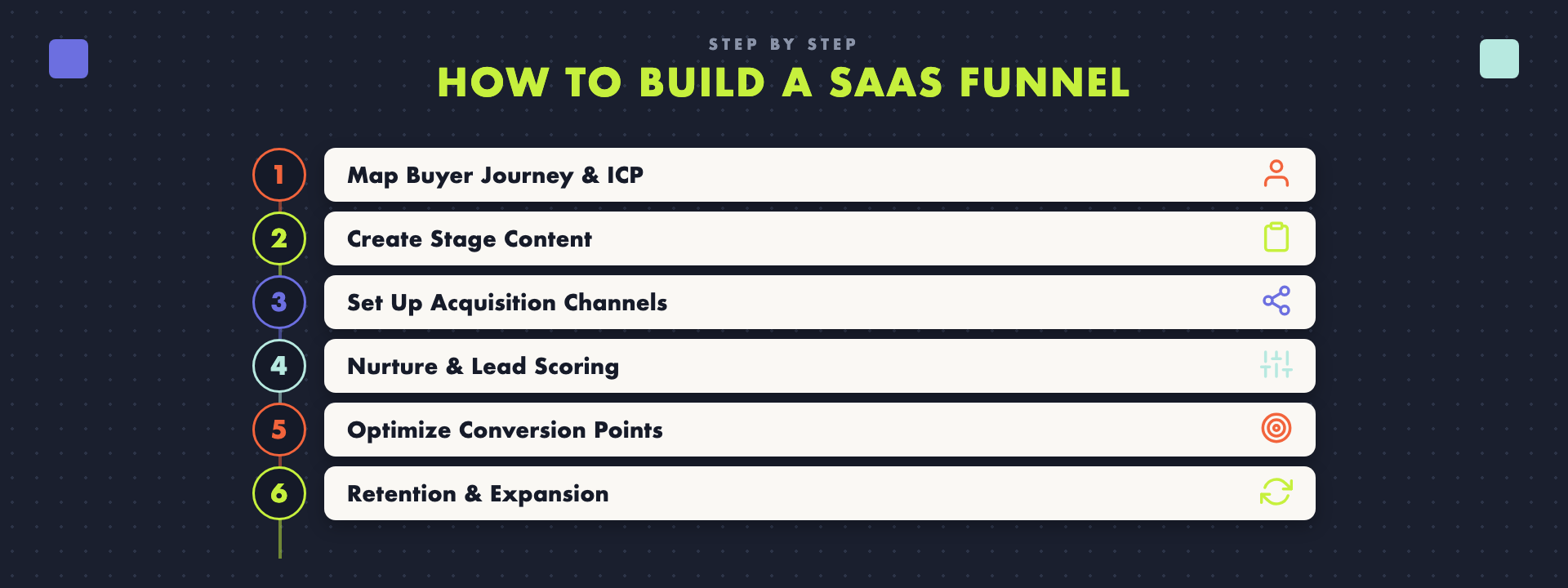
Step 1 — Map Your Buyer Journey and ICP
Mapping the buyer journey and defining the Ideal Customer Profile (ICP) are foundational steps in building a SaaS marketing funnel. The process starts with analyzing historical data to find successful customer paths and key engagement touchpoints. Defining the ICP documents firmographic details such as company size, industry, and revenue, alongside behavioral patterns including pain points and buying triggers. This step also documents demographic characteristics such as job titles and decision-making authority of the best-performing customers.
Once the buyer journey is mapped and the ICP is defined, teams document the specific needs and concerns at each stage of the decision-making process. The mapped journey works as a blueprint for every later funnel-building activity, guiding content creation and strategy for each funnel stage.
Step 2 — Create Content for Each Funnel Stage
Creating content for each funnel stage aligns the content with the buyer's journey and specific intent at each stage. During the Awareness stage, educational content such as blog posts, guides, and infographics addresses prospects' problems without promoting the product. This content builds trust and positions the brand as a credible expert. In the Consideration stage, content such as product comparisons, case studies, and webinars shows the solution's benefits and separates it from competitors. This content helps buyers evaluate options and builds trust through social proof.
At the Decision stage, conversion-oriented content such as pricing pages, ROI calculators, and free trial offers addresses final objections and encourages purchase. For the Retention stage, onboarding tutorials, feature announcements, and user guides help customers reach product value and find opportunities for expansion. This staged content strategy gives top-of-funnel acquisition channels a curated content library to distribute to incoming audiences.
Step 3 — Set Up Acquisition Channels for Top of Funnel
To set up acquisition channels for the top of a SaaS marketing funnel, run a mix of organic and paid approaches. Search engine optimization (SEO) and content marketing build long-term visibility and credibility through keyword optimization and content built around prospect questions. The acquisition channels are listed below:
- SEO and Content Marketing: Optimize the website for search engines with targeted keywords. Create informative blog posts, guides, and case studies that answer common customer questions.
- Paid Advertising: Run Google Ads for high-intent search terms and social media ads on platforms such as LinkedIn and Facebook to reach broader audiences. These ads state the product's value propositions.
- Social Media Engagement: Use social media channels to distribute content, run retargeting ads, and engage prospects through interactive posts such as polls and Q&A sessions.
- Referral Programs: Set up referral incentives that encourage current users to advocate for the product, which widens reach through word-of-mouth.
- Email Marketing: Run email campaigns that nurture leads with personalized content matched to their interests and stage in the buyer journey.
These acquisition channels move prospects into the middle of the funnel, where nurturing and lead scoring processes engage them further.
Step 4 — Build Nurture and Lead Scoring in the Middle
Building nurture and lead scoring in the middle of a SaaS marketing funnel guides prospects from consideration to conversion. The process starts with automated email workflows that deliver stage-specific content matched to the prospect's engagement level. Content includes product comparisons, case studies, and educational webinars that address the needs and interests of each lead.
A lead scoring model prioritizes prospects on their behavior and fit. The model assigns points to actions such as email opens, content downloads, and demo requests, which identifies high-intent leads. Integration with CRM and marketing automation platforms gives sales and marketing teams one shared definition of a qualified lead. Marketing-qualified leads (MQLs) that reach a set score move to sales, while others keep receiving nurturing until they show stronger buying intent. This system prepares leads for the conversion points optimized at the bottom of the funnel.
Step 5 — Optimize Conversion Points at the Bottom
To optimize conversion points at the bottom of a SaaS marketing funnel, streamline the purchase process and improve user experience. This work simplifies sign-up forms, states clear pricing, and offers flexible payment options. Conversion optimization also shows product value through demos and free trials, timed to raise engagement and interest.
High conversion rates depend on trust signals such as customer testimonials and case studies. These elements lower buyer hesitation and build confidence in the product. A/B testing on pricing pages and checkout flows finds the configurations that drive the most conversions. Once optimized, these conversion points move into retention and expansion loops, which nurture customer relationships and raise lifetime value.
Step 6 — Add Retention and Expansion Loops
Retention and expansion loops in a SaaS marketing funnel turn initial buyers into long-term customers and advocates. These loops hold customer loyalty through community building, strong customer service, and continuous product improvement. In SaaS models, retaining existing customers costs far less than acquiring new ones, so post-purchase engagement drives sustainable growth.
To build effective retention and expansion loops, companies run special renewal offers, personalized check-ins, and feature adoption campaigns. Referral programs with incentives encourage customer advocacy. Metrics such as churn rate, expansion MRR, and customer lifetime value measure the success of these loops. A cyclical system moves satisfied customers to advocacy, where they refer new prospects back to the top of the funnel and sustain growth.
How long does it take to build a SaaS marketing funnel?
Building a SaaS marketing funnel takes 3 to 6 months for initial setup. This timeframe covers mapping the buyer journey, creating content, and setting up channels. Stable performance often takes 6 to 12 months of ongoing optimization and data analysis. B2B SaaS deals that rely on these funnels can span 12 to 24 months because of budget cycles and relationship-building needs.
What is the cost of building a SaaS marketing funnel?
Building a SaaS marketing funnel costs from $5,000 to more than $300,000. The range depends on the complexity of the marketing technology stack, the scope of content creation, and the channels selected for acquisition. Startups focused on organic growth stay near the lower end, while enterprise implementations with advanced automation and large paid media budgets reach higher figures. Most mid-market B2B SaaS companies invest between $15,000 and $30,000 initially, with ongoing optimization of $3,000 to $10,000 monthly.
What are the Stages of a SaaS Marketing Funnel?
A SaaS marketing funnel runs across four primary stages that guide prospects from initial awareness to long-term retention and expansion. The four stages are listed below.
Top of Funnel — Awareness and Demand Creation
The top of the funnel (TOFU) in a SaaS marketing funnel drives awareness and demand creation. At this stage, prospects begin to recognize a problem or need, though most are not searching for solutions. SaaS companies capture attention and build brand visibility through high-reach channels such as search ads, SEO, content marketing, social media, and paid media campaigns. The goals are to generate website visits, build brand awareness, and position the company as a trusted authority through educational content that addresses pain points without pushing for immediate conversion.
Effective TOFU strategies build valuable, discoverable content that attracts cold audiences and builds trust at scale. This content includes blog posts optimized for search intent, social media engagement, video content, and thought leadership that shows expertise in solving the problems the ideal customer profile faces. Key metrics at this stage include website traffic, impressions, reach, and early engagement signals such as content downloads or newsletter subscriptions. Once awareness-stage prospects engage with the brand and understand how the solution addresses their needs, they move into the consideration phase, where targeted nurturing takes over.
Middle of Funnel — Consideration and Lead Nurturing
The middle of the funnel, the consideration stage, is where prospects evaluate solutions and engage with the brand to judge fit. At this stage, leads have moved past awareness and compare options, research features, and seek proof that the SaaS product solves their specific problem. The consideration phase needs nurturing through targeted content and personalized communication that addresses pain points and states the product's value proposition.
Lead Nurturing Strategies Key strategies for the middle of the funnel include email nurture sequences that deliver educational content, product comparison guides, case studies that show real results, and interactive demos that let prospects use the solution firsthand. Lead scoring matters here, tracking engagement signals such as email opens, content downloads, webinar attendance, and website revisits to find which leads are warming up. Retargeting campaigns keep the brand visible while leads deliberate, and personalized outreach from sales development representatives answers specific questions and builds relationships. The goal is to build trust, prove ROI potential, and separate the solution from competitors by showing, rather than telling, how the product delivers value. These nurtured, qualified leads then move to the bottom of the funnel, where they engage with conversion points such as free trials, product demos, or direct sales conversations.
Bottom of Funnel — Conversion and Free Trial
The bottom of the funnel in a SaaS marketing funnel is where prospects move from interested leads to paying customers. This stage drives conversion through free trials, personalized demos, and transparent pricing. At this point, prospects have evaluated their options and are ready to use the product firsthand. A smooth, low-friction conversion process matters, including clear pricing policies, flexible payment options, and immediate access to trials or demos.
To raise conversion rates, companies address remaining objections or doubts. Clear communication and support raise the likelihood of conversion. Special offers, limited-time discounts, and clear value propositions motivate prospects to commit. Once customers convert, they enter the retention and expansion phase, where the focus moves to deeper engagement and long-term loyalty.
Post-Purchase — Retention and Expansion
The post-purchase stage of a SaaS marketing funnel retains existing customers and expands their use of the product. This stage carries weight because retaining customers costs far less than acquiring new ones. Retention efforts include strong customer support, continuous education, and regular product updates. These strategies raise customer satisfaction and reduce churn by keeping users on consistent value from the product.
Expansion strategies raise customer lifetime value by driving adoption of additional features or premium services. Upselling and cross-selling introduce customers to advanced functionality or complementary services that improve their experience. Personalized onboarding for new features and proactive customer success interactions support these expansions. Key metrics at this stage include customer retention rate, churn rate, and expansion Monthly Recurring Revenue (MRR). A focus on both retention and expansion builds a sustainable growth cycle where satisfied customers become advocates, drive organic growth, and feed back into the awareness stage of the funnel.
What is the AARRR funnel model for SaaS?
The AARRR funnel model for SaaS, also known as "Pirate Metrics," is a growth framework created by Dave McClure of 500 Startups. The model segments the customer journey into five stages: Acquisition, Activation, Retention, Revenue, and Referral. Each stage targets specific user behaviors to improve growth and engagement. The five stages are listed below:
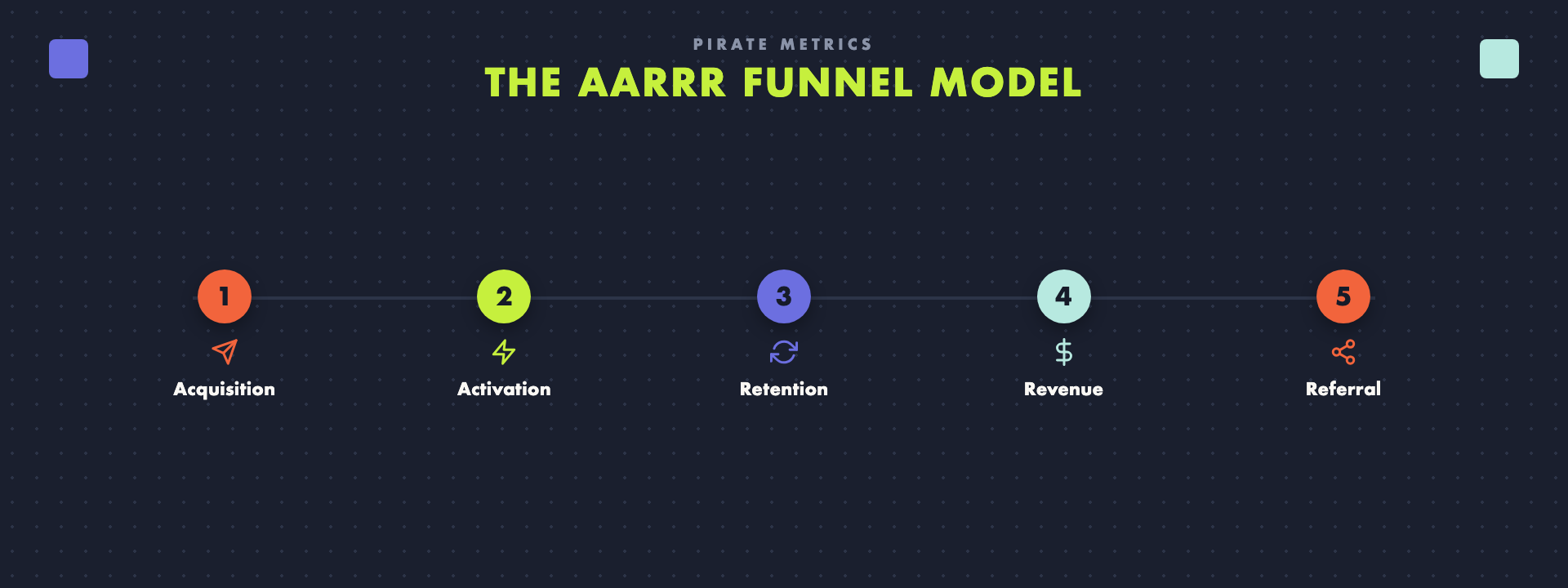
- Acquisition attracts new users through marketing channels. This stage raises visibility and interest in the product.
- Activation gives users a positive first experience. This stage measures how fast and how well users reach the product's value.
- Retention tracks ongoing user engagement and keeps users returning to the product over time. This stage reduces churn and raises user satisfaction.
- Revenue converts user engagement into financial gain by moving users to paying customers. This stage sustains the business model.
- Referral rewards users for recommending the product, which turns satisfied customers into a growth channel.
The AARRR model fits SaaS businesses because it weighs long-term user engagement and advocacy beyond the initial conversion. This full-lifecycle approach helps companies find key performance indicators (KPIs) and improve strategy at each stage, which sustains growth.
Why is a SaaS marketing funnel important for startups?
A SaaS marketing funnel matters for startups because it supplies a structured framework that converts limited traffic into paying customers efficiently. Startups run on constrained budgets, so every marketing dollar must return value. A well-defined funnel shows startups where prospects drop off and points optimization effort at the highest-impact areas. This systematic approach turns unpredictable lead generation into a repeatable growth engine that a team can measure, refine, and scale as the business matures. Acquiring a new customer costs anywhere from five to 25 times more than retaining an existing one, according to "The Value of Keeping the Right Customers" by Amy Gallo, published by Harvard Business Review in October 2014, which makes the retention stage of the funnel central to startup sustainability. A complete funnel that extends past initial conversion to include retention and expansion loops builds the recurring revenue foundation that investors and stakeholders expect from the SaaS model.
Is a marketing funnel necessary for every SaaS company?
Yes, a marketing funnel is necessary for every SaaS company. A structured marketing funnel, guided by a documented SaaS marketing plan, aligns the company's messaging with the customer journey, which drives predictable revenue growth. Full-funnel marketing strategies make a business more relevant to customers and map their path from awareness to advocacy. Without a structured funnel, a SaaS company risks misaligned messaging, inefficient resource allocation, and an inability to scale customer acquisition.
What is a marketing-led SaaS funnel?
A marketing-led SaaS funnel is a growth strategy where the marketing team drives customer acquisition and conversion. This model weights content creation, automated lead nurturing, and data-driven decisions to guide prospects from awareness to conversion. The funnel runs on self-service mechanisms and product-led content, which lowers direct sales intervention. A marketing-led SaaS funnel fits products with lower price points and shorter sales cycles, where customers understand and act on the value proposition on their own. This approach uses scalable acquisition channels such as SEO and content marketing, paired with conversion-optimized landing pages and free trials. The marketing team measures success through metrics such as trial signups and self-service conversion rates, and it owns revenue targets that sales teams traditionally hold.
What is the best SaaS funnel for B2B customers?
The best SaaS funnel for B2B customers is a high-touch, multi-stage funnel built on education, relationship-building, and trust. This approach matches the complexity of B2B buying decisions, which often involve multiple stakeholders and longer evaluation cycles. A precise Ideal Customer Profile (ICP) and buyer persona defined early in the process anchor this funnel.
Content matched to each stage matters, with case studies and whitepapers for the middle of the funnel (MOFU) and personalized demos for the bottom of the funnel (BOFU). Lead scoring prioritizes prospects ready for sales engagement. Successful B2B funnels align content and channels in a clear structure that guides leads toward conversion efficiently. This method lowers friction and maps the complex buyer journey from awareness through consideration to a trusted decision, the foundation of effective B2B SaaS marketing.
What is the best SaaS funnel for B2C customers?
The best SaaS funnel for B2C customers runs a self-serve, low-friction model that grants instant product access. This approach offers free trials or freemium versions, which fit B2C buying behavior built on quick decisions and immediate value perception. Successful B2C SaaS funnels lower barriers to entry and run automated onboarding to convert users fast, using high-volume digital channels such as social media ads and SEO for rapid adoption.
How to Measure SaaS Marketing Funnel Performance
Measuring the performance of a SaaS marketing funnel tracks key metrics across each stage to confirm efficiency. The steps for evaluating funnel performance are listed below.
1. Define Key Performance Indicators (KPIs): Identify specific KPIs for each stage of the funnel. These include conversion rates, lead velocity, and unit economics such as Customer Acquisition Cost (CAC) and Customer Lifetime Value (CLV). A healthy CLV:CAC ratio runs between 3:1 and 5:1, a range David Skok and OpenView identify as the SaaS sweet spot.
2. Track Top of Funnel Metrics: Focus on metrics such as website visits, traffic sources, and bounce rates. Bounce rate should stay below 40 to 50 percent for SaaS landing pages. Tools such as Google Analytics monitor these metrics and measure the awareness strategies.
3. Monitor Middle of Funnel Metrics: Evaluate lead generation rates, Marketing Qualified Leads (MQLs), and content engagement metrics such as time on page. Lead scoring progression and MQL-to-SQL conversion rates show how well prospects move through nurturing.
4. Analyze Bottom of Funnel Metrics: Measure free trial sign-up rates and trial-to-paid conversion rates. OpenView's Product Benchmarks report puts free-trial conversion rates in the 10 to 25 percent range for most SaaS products. Track sales cycle length and win rates to measure the efficiency of the conversion strategies.
5. Evaluate Post-Purchase Metrics: Focus on customer churn rates, Net Revenue Retention (NRR), and CLV. The Recurly Churn Report puts strong B2B SaaS annual churn under 5 percent, near a 3.5 percent median. Track product adoption rates and Net Promoter Score (NPS) to measure customer satisfaction and retention.
6. Implement Measurement Tools: Set up analytics infrastructure with CRM systems and marketing automation platforms. These tools show user paths and conversion metrics. Cohort analysis tracks the performance of customer groups over time.
7. Conduct A/B Testing: Run A/B tests on landing pages and calls to action to find areas for improvement. This testing raises conversion rates and reduces funnel leakage.
Measuring these metrics helps SaaS companies find bottlenecks, validate growth efficiency, and make data-driven decisions that improve funnel performance.
How to align sales and marketing in a SaaS funnel?
Aligning sales and marketing in a SaaS funnel requires precise coordination and shared objectives. Several practices raise collaboration and point both teams at common goals. The practices for aligning these two functions are listed below:
- Establish Shared Revenue Goals: Both teams focus on unified revenue targets rather than isolated metrics. This alignment points marketing campaigns and sales outreach at the same objectives.
- Create a Unified Playbook: Build a shared playbook that includes the Ideal Customer Profile (ICP), buyer personas, and qualification standards. This document holds messaging and strategy consistent for both teams.
- Implement Closed-Loop Reporting: Integrate CRM systems with marketing automation tools to build one central data source. This setup lets both teams track leads, monitor progress, and read real-time insight, which raises transparency and accountability.
- Share Key Performance Indicators (KPIs): Set KPIs that both teams influence, such as pipeline creation, conversion rates, and deal velocity. Review these metrics in joint meetings to measure performance and adjust strategy.
- Map the Buyer Journey Together: Build buyer personas that state pain points, motivations, and decision processes. This collaboration holds messaging consistent across the funnel stages.
- Standardize Lead Qualification: Agree on specific criteria for lead qualification to smooth the handoff between marketing and sales. Sales-qualified leads (SQLs) as a funnel proxy reduce rework and raise efficiency.
- Enable Cross-Functional Collaboration: Run practices such as cross-functional call listening, where marketing analyzes sales calls to understand objections and sales reviews marketing drafts to confirm alignment.
- Build Open Feedback Loops: Set up formal feedback channels, such as dedicated communication platforms, where sales reps share insight on lead quality and request specific content. This feedback lets marketing refine future strategy.
These practices remove friction, streamline processes, and drive growth through one buyer-centric strategy.
How to optimize a SaaS marketing funnel
Optimizing a SaaS marketing funnel raises conversion rates and reduces friction at each stage. The optimization steps are listed below:
1. Analyze Funnel Metrics and Identify Drop-off Points Use analytics tools to track user behavior through the funnel. Monitor conversion rates between stages, time spent at each stage, bounce rates, and engagement levels. This analysis pinpoints where prospects abandon the journey and points to targeted improvements.
2. Conduct A/B Testing on Critical Funnel Elements Run A/B testing on elements such as landing pages, CTAs, email subject lines, and trial sign-up flows. Focus on high-impact areas where small changes yield large conversion gains. Each test isolates one variable at a time to measure its effect.
3. Reduce Friction in the Onboarding and Activation Process Streamline trial sign-ups by minimizing required fields and cutting unnecessary steps. Deliver quick value by reducing time-to-value during onboarding. Build personalized flows that guide users to their first "aha moment," since faster activation raises conversion.
4. Implement Retargeting and Nurture Campaigns for Stalled Prospects Set up email sequences that re-engage users who have not completed desired actions. Use retargeting ads to bring back website visitors who did not convert. Match messaging to where users dropped off, addressing objections relevant to that stage.
5. Optimize Pricing Page and Checkout Experience State pricing information clearly. Offer multiple payment options and remove barriers to purchase. Include trust signals such as testimonials and money-back guarantees. Test different pricing structures to find what resonates with the audience.
6. Use Social Proof and Case Studies Strategically Place testimonials, case studies, and ROI demonstrations at key decision points. Use product comparisons to separate from competitors during the consideration stage. Share specific, quantifiable results that prospects relate to their own situations.
7. Continuously Refine Based on Customer Journey Data Review and update the funnel on customer behavior patterns and feedback. Find which journeys reach the highest conversion rates and replicate those patterns. Hold optimization effort aligned with evolving customer needs and market conditions.
These strategies turn a leaky funnel into a high-converting engine that drives sustainable growth.
What are common mistakes when building a SaaS funnel?
Building a SaaS marketing funnel carries several common pitfalls that hinder its performance. Finding these errors matters for optimizing funnel performance and smoothing the customer journey. The common mistakes are listed below.
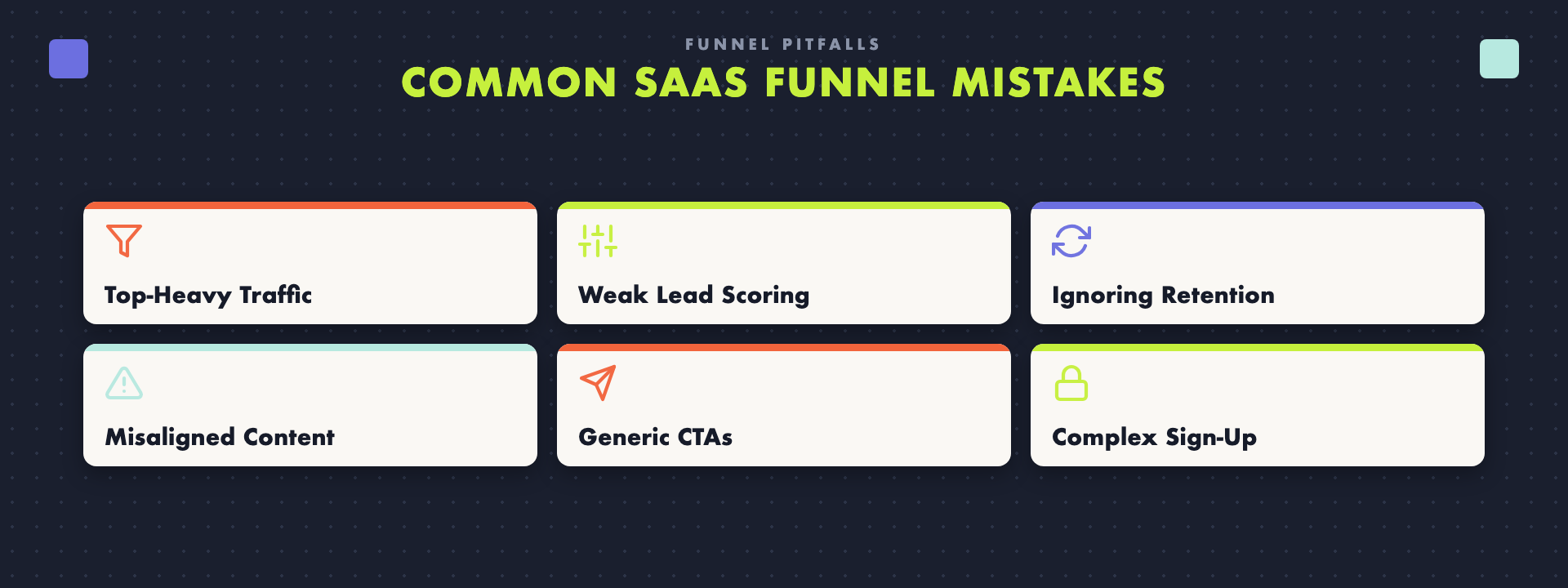
- Over-investing in Top-of-Funnel Traffic: Many companies focus on attracting new leads without nurturing them through the funnel stages, which produces low conversion rates.
- Improper Lead Qualification: Weak lead vetting lets unqualified prospects enter the funnel, which wastes resources and lowers sales efficiency.
- Neglecting Customer Retention: Companies often prioritize new customer acquisition over retention, though retention costs less and drives long-term growth.
- Misaligned Content with Buyer Intent: Content that does not match the buyer's journey produces messaging that fails to guide prospects to conversion-focused pages.
- Generic Call-to-Actions (CTAs): CTAs that do not match the user's stage in the journey lower engagement and conversion.
- Complex Sign-up Processes: Lengthy or complicated forms create friction, which raises abandonment rates.
- Lack of Follow-up SLAs: Without clear service level agreements for follow-ups, leads fall through the cracks, which lowers conversion.
- Data Silos in User Databases: Unsynced databases between sales and marketing automation platforms hinder lead nurturing and churn prevention.
- Poor Targeting and Messaging: Weak targeting and messaging at the top of the funnel attract the wrong audience, which causes leaks.
- Unclear Next Steps: Undefined next steps at each sales stage break lead routing and produce inconsistent deal progression.
- Failure to Clean CRM Data: Inaccurate or outdated customer relationship management data disrupts sales processes and funnel efficiency.
Addressing these common mistakes matters for repairing and optimizing a leaky SaaS marketing funnel.
How to Fix a Leaky SaaS Marketing Funnel
A leaky SaaS marketing funnel hinders growth and wastes resources. Addressing specific issues at each stage improves performance. The steps for fixing common leaks are listed below:
- Diagnose the Leak: Use analytics tools, heatmaps, and session replays to find where users drop off. Focus on conversion rates and time-to-convert metrics to pinpoint issues.
- Improve Top of Funnel (Awareness): Sharpen targeting and messaging to match user expectations. Refine buyer personas to attract the right audience and confirm that landing pages state value fast.
- Streamline Middle of Funnel (Nurturing): Run automated, value-driven nurture flows. Use educational content to build trust before pitching, and run retargeting campaigns to re-engage cold leads.
- Optimize Bottom of Funnel (Conversion): Simplify onboarding, clarify pricing, and align sales and marketing on the Ideal Customer Profile (ICP). Use personalized demos and strategic nudges to overcome objections.
- Enhance Post-Signup (Activation and Retention): Treat onboarding as a second conversion funnel. Simplify setup, show ROI continuously, and engage customers through education and community to reduce churn.
Addressing these areas turns a leaking funnel into a growth engine.
How a SaaS Marketing Agency Builds and Optimizes Funnels
A SaaS marketing agency builds and optimizes marketing funnels by mapping the client's buyer journey and Ideal Customer Profile (ICP). At our SaaS marketing agency, we treat this foundational step as non-negotiable, keeping every marketing effort data-driven and aligned with your target audience's needs. We then run a six-step process that creates stage-specific content, deploys top-of-funnel acquisition channels, builds middle-funnel nurture and lead scoring, optimizes bottom-funnel conversion points, and adds retention loops. We apply advanced tactics such as behavioral scoring, dynamic landing pages, AI-driven predictive analytics, and automated chatbots to personalize experiences and speed lead movement through the funnel.
Our optimization process runs continuous A/B testing of landing pages, email campaigns, and conversion points. We refine lead scoring and align your sales and marketing teams so qualified leads move efficiently through the funnel. We set up tracking systems that monitor key metrics, including website visits, lead generation rates, trial conversion rates, bounce rates, and click-through rates. We run quarterly funnel audits and tests on key elements such as CTAs and email subject lines to keep the funnel current with market change. This rigorous approach translates into predictable, recurring revenue by minimizing leakage and raising customer lifetime value from every stage.
How an Optimized SaaS Marketing Funnel Drives Recurring Revenue
An optimized SaaS marketing funnel drives recurring revenue by raising customer retention and reducing churn. This process aligns content, nurturing sequences, and conversion strategies with each stage of the buyer journey, which moves customers smoothly through acquisition, activation, and retention. Higher retention rates raise recurring revenue most, because retained customers generate more revenue through renewals and expansions without the high cost of acquiring new customers.
What are examples of successful SaaS marketing funnels?
Successful SaaS marketing funnels show how companies guide users from awareness to retention through content and channel alignment. Widely recognized examples are listed below:
- HubSpot: Uses free tools and educational content to move users from awareness to conversion with a clear freemium-to-paid model.
- Salesforce: Uses webinars and case studies to nurture middle-funnel leads and drives conversions with demos and transparent pricing.
- Slack: Focuses on viral product adoption and smooth onboarding, using social proof to speed bottom-funnel conversions.
- Zoom: Uses a frictionless free trial and strong referral mechanics to convert users fast and retain them through expansion loops.
These companies show best practices by integrating content, channels, and nurture strategies across every funnel stage, from Awareness through Consideration and Decision to Retention.
What are the future trends in SaaS marketing funnels?
SaaS marketing funnels are moving toward more dynamic and personalized systems. Artificial intelligence and real-time behavioral data are reshaping how companies interact with prospects. AI-driven automation delivers hyper-personalized content at each funnel stage, which raises engagement and conversion. Product-led growth strategies are moving to the center, placing the product experience at the core of acquisition and conversion. This shift weights self-service onboarding and in-app engagement, which lowers reliance on traditional marketing touchpoints.
Future SaaS funnels also prioritize integration between marketing, product, and customer success data. This integration builds a unified view of the customer lifecycle and moves away from siloed stage management. Intent-based marketing and account-based strategies are reshaping B2B SaaS approaches, with detailed tracking of buying committee interactions. Even with these advances, the fundamentals of mapping the buyer journey and aligning content to lifecycle stages remain central to building effective SaaS marketing funnels.

About the team
SaaS Marketing Agency Digital Team
The in-house team at SaaS Marketing Agency Digital. We architect growth systems for B2B SaaS companies from Series A through pre-IPO.