A SaaS go-to-market playbook is a repeatable plan for launching and scaling a product to its market. The playbook aligns motion, channels, and teams around efficient 2026 growth through a structured approach to executing a go-to-market strategy. The SaaS go-to-market playbook details the definition, components, requirements, step sequence, and stage variants that a product launch needs. Chaining these elements lets the playbook carry a product from launch to scale, adapting to different business stages and market conditions.
The SaaS go-to-market playbook opens with a clear definition of its purpose and scope, then sets out its core components. The core components identify the ideal customer profile, select the right channels, and define sales and marketing motions. The playbook then states the requirements for success, such as aligning cross-functional teams and setting clear metrics for performance measurement. A step-by-step sequence guides companies from product validation to full-scale operations, with stage-specific playbooks built for early-stage, growth-stage, and enterprise SaaS businesses. This structure keeps all teams working toward predictable and scalable growth in 2026.
What is a SaaS go-to-market playbook ?
A SaaS go-to-market (GTM) playbook is a structured, repeatable framework that sets out how a software-as-a-service company launches and scales its product to market. The playbook translates high-level strategy into concrete steps and holds marketing, sales, product, and customer success teams in alignment. A SaaS GTM playbook documents the customer journey from awareness to retention, with the processes, tools, channels, and messaging that market penetration requires.
The playbook records ideal customer profile (ICP) definitions, buyer personas, value propositions, channel strategies, and success metrics. Each entry names the team responsible for a stage, the assets and tools that team needs, and the way performance gets measured. Documenting these components stops fragmentation and gives every team one shared understanding of the target market and customer engagement approach.
Within a broader SaaS GTM strategy, the playbook works as the tactical execution plan. The strategy sets direction and competitive positioning, and the playbook supplies the step-by-step actions that reach the strategic goals. The link between strategy and execution drives predictable revenue growth and efficient scaling in a competitive market.
What is saas go-to-market strategy?
A SaaS go-to-market (GTM) strategy is a high-level framework that defines how a company reaches its target customers, communicates value, and converts prospects into paying users. It is one type of SaaS marketing strategy, scoped to how a product enters and wins its market. A GTM playbook documents the repeatable execution steps, while the GTM strategy sets the direction, which markets to enter, which customer segments to prioritize, which value propositions to lead with, and which competitive positioning to adopt. The strategy answers the "why" and "what" before the playbook handles the "how."
A SaaS GTM strategy aligns every downstream decision around one vision. A well-defined GTM strategy weighs market opportunity, competitive dynamics, and internal capability to select the right motion, whether product-led growth (PLG), sales-led, or hybrid, and the channels that drive acquisition. For 2026, a SaaS GTM strategy folds in AI-driven insight, outcome-based selling, and precise ICP segmentation so that every dollar and effort points at the highest-value opportunities. Data-informed strategies that adapt to shifting buyer behavior and competitive pressure now replace undifferentiated approaches.
The split between strategy and playbook matters: the strategy provides the North Star, and the playbook turns that direction into repeatable, scalable execution. B2B SaaS companies especially must account for multi-stakeholder buying, longer sales cycles, and alignment across marketing, sales, and customer success. Without a sound GTM strategy, even a detailed playbook loses focus and fails to deliver predictable, efficient growth.
What is a b2b saas go to market strategy?
A B2B SaaS go-to-market strategy is a structured plan for selling software to business clients, built around committee-based buying and long sales cycles. B2B SaaS strategies work through extended evaluation periods that run from weeks to months, unlike B2C models. B2B SaaS strategies manage multiple stakeholders, including end users, technical evaluators, procurement teams, and executive sponsors, each of whom needs specific validation and tailored content.
The motions that fit B2B SaaS GTM include sales-led growth for high-ticket, complex deals, product-led growth for self-service adoption, and hybrid strategies that blend inbound, outbound, and partner-led approaches. Enterprise deals often call for dedicated sales teams and personalized demos, while mid-market segments gain from hybrid approaches that pair self-service trials with sales assistance at key conversion points. Account-based marketing and persona-specific content engage buying committees. A B2B SaaS strategy also builds in customer success from the start, since B2B relationships depend on retention, expansion, and advocacy for sustainable growth and healthy unit economics. It works hand in hand with a broader B2B SaaS marketing strategy that nurtures every stakeholder across the long buying cycle.
What are the core components of a SaaS GTM playbook?
A SaaS go-to-market (GTM) playbook contains several connected core components for launching and scaling a product. Each component performs a distinct job within one system that guides a SaaS product from inception to market penetration. The core components are listed below:
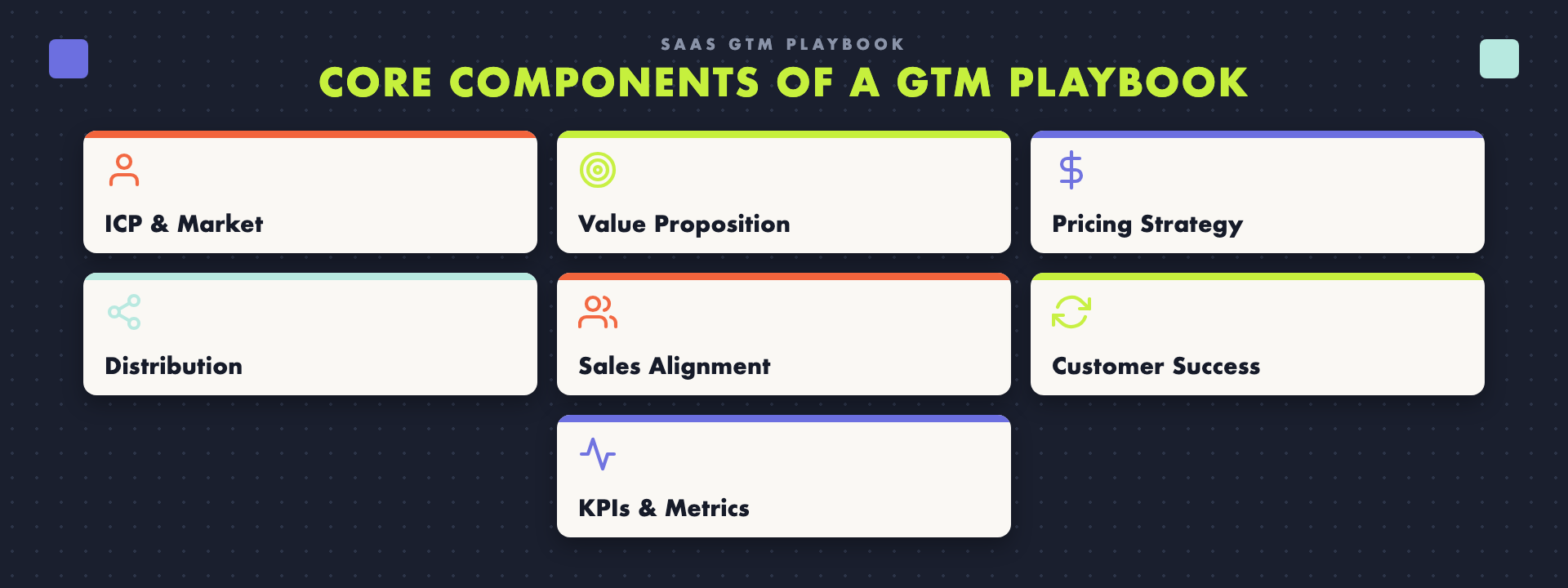
These components connect into one system that turns a SaaS GTM strategy from a conceptual direction into an executable, measurable growth plan. A well-structured playbook keeps each element aligned with business objectives and opens a repeatable, scalable path to market success.
Why is a go-to-market playbook important for SaaS?
A SaaS go-to-market playbook matters because it supplies a repeatable framework that protects runway and keeps every effort inside one data-driven strategy. Without a documented playbook, SaaS companies burn budget on ineffective marketing channels and misaligned tactics. In the competitive market of 2026, where many traditional GTM approaches fail, the playbook directs resources toward proven acquisition and retention activities.
A go-to-market playbook also aligns cross-functional teams around one motion. When marketing, sales, and customer success teams work from the same playbook, friction drops and operational velocity rises. The playbook sets shared definitions of the ideal customer profile, consistent messaging, and clear handoff points between teams. This alignment turns GTM execution from guesswork into predictable, scalable growth. As SaaS companies work through an AI-driven era where precision and speed decide outcomes, the playbook becomes the foundation for confident iteration and scaling.
What a SaaS Go-To-Market Strategy Requires?
A SaaS go-to-market strategy requires several foundations in place before launch. These foundations support efficient execution and prevent wasted resources. The critical foundations for a SaaS GTM strategy are listed below:
These foundations turn a go-to-market strategy from a theoretical plan into a coordinated growth engine. This groundwork lowers the risk of misaligned effort and raises revenue predictability.
Defining Your ICP and Market Segment
Defining the Ideal Customer Profile (ICP) and market segment anchors a successful SaaS go-to-market strategy. An ICP is a detailed description of the customer who gains the most from the product or service. An ICP names specific attributes such as industry, company size, revenue, and pain points. Precise targeting spends resources efficiently and keeps marketing relevant, which prevents wasted effort.
Defining an ICP produces a data-driven profile that guides every later decision, from messaging to channel selection. The ICP profile feeds demand generation, prioritizes opportunities, and tailors sales approaches. Market segmentation focuses the business on the most promising groups and raises return on investment. A defined ICP and market segment lay the groundwork for positioning and messaging, the next steps in a SaaS go-to-market strategy.
Positioning, Category, and Messaging
Positioning, category, and messaging define how the market perceives a SaaS product. Positioning clarifies the space a product holds in the buyer's mind and explains why a buyer should choose it over alternatives. Positioning identifies the problem the product solves, for whom, and why the product is the best solution. Category selection sets whether the product competes in an existing market, creates a new category, or repositions an existing one, which shapes how prospects evaluate the solution. Messaging turns positioning into a clear narrative that speaks to the Ideal Customer Profile's pain points and desired outcomes.
Sharp positioning requires a precise Ideal Customer Profile plus three to five provable points of difference relevant to that ICP. These points of difference focus on specific, outcome-based use cases rather than generic claims. A messaging hierarchy operationalizes positioning by layering the headline value statement, the pain points addressed, the solutions, and quantified proof points. Teams deploy this hierarchy across every customer touchpoint so prospects grasp the product's relevance and differentiation. Without sharp positioning and messaging tied to a clear category, even a strong product struggles to gain traction, because prospects may not see its value or uniqueness.
Choosing a GTM Motion: PLG, Sales-Led, or Hybrid
Choosing the right go-to-market (GTM) motion aligns a SaaS company's growth strategy with its product and market dynamics. The three primary GTM motions, Product-Led Growth (PLG), Sales-Led, and Hybrid, each offer distinct advantages based on product complexity, target audience, and sales cycle length.
The SaaS Go-To-Market Playbook Step by Step
A SaaS go-to-market playbook is a structured sequence of steps that guides a product from launch to scale. This step-by-step framework completes each phase before the next, building a solid foundation for growth. The sequence starts with validating product-market fit and pricing, then creates acquisition channels, designs conversion paths, aligns teams, and measures performance.
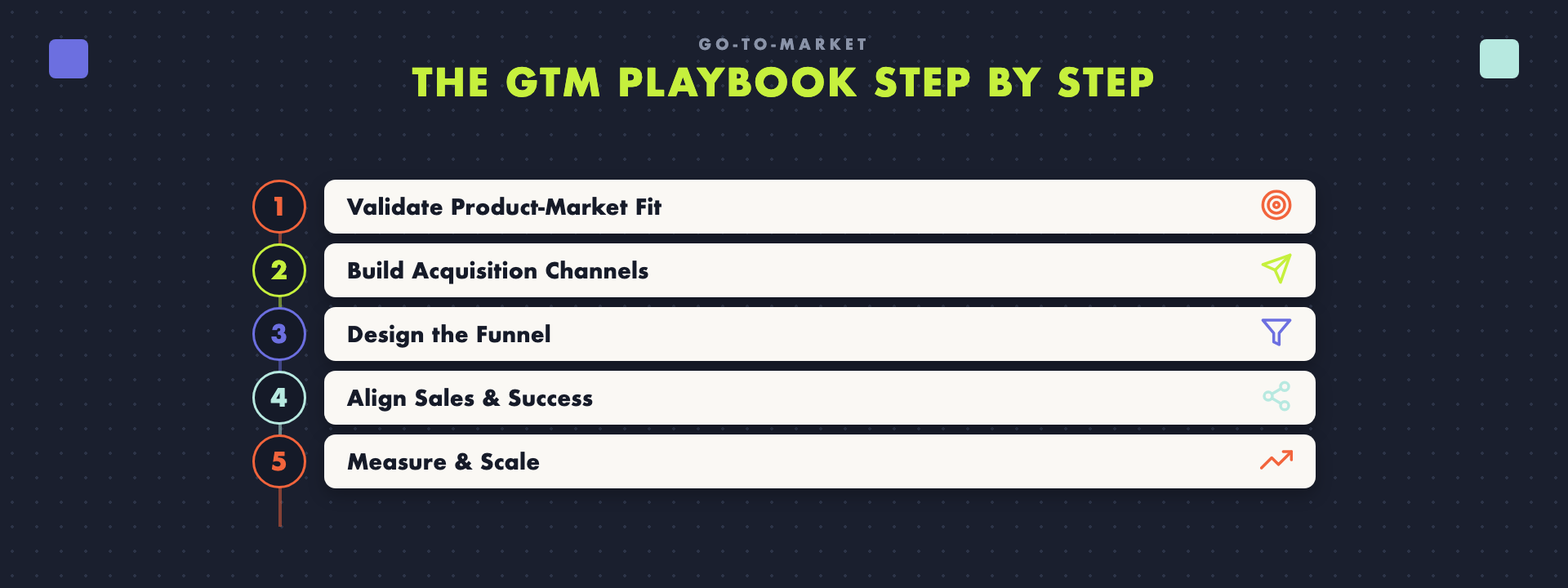
- Validate Product-Market Fit and PricingThe first step confirms that the product meets market needs and carries the right price. Teams gather feedback from early adopters and adjust the offering on that input. Validation produces a clear read of the target audience and pricing model, which sets up the next steps.
- Build the Acquisition Engine and ChannelsOnce product-market fit and pricing hold, the focus moves to building an acquisition engine. Teams select channels and strategies, such as product-led growth or sales-led approaches, to attract and retain customers. The goal is a reliable pipeline that brings in qualified leads.
- Design the Funnel and Conversion PathWith acquisition channels in place, a conversion funnel comes next. Teams map the customer journey from awareness to purchase and optimize each touchpoint to raise conversions. A well-designed funnel moves prospects through the buying process and lowers drop-off.
- Align Marketing, Sales, and Customer SuccessAligned internal teams deliver a consistent customer experience. Marketing, sales, and customer success teams share information and coordinate effort. Alignment raises customer satisfaction and retention through one message across every interaction.
- Measure, Iterate, and Scale the MotionThe final step measures the go-to-market strategy and makes the needed adjustments. Teams track key performance indicators, such as customer acquisition cost and net revenue retention, to find areas for improvement. Continuous iteration and scaling keep the strategy effective and adaptable to changing market conditions.
This step-by-step approach builds a repeatable, efficient go-to-market strategy that supports sustainable growth.
Step 1 — Validate Product-Market Fit and Pricing
Validating product-market fit and pricing is the first step in a SaaS go-to-market strategy. This step confirms that the product solves a specific problem for a defined customer segment. Teams conduct customer interviews, analyze early adopter usage patterns, and test pricing tiers against willingness to pay. The step outputs a validated ideal customer profile (ICP) and confirmed product-market fit signals, such as strong retention among key cohorts.
Product-market fit validation produces evidence of a monetizable problem, which guides the steps that follow. Validation confirms that the product matches market needs and informs pricing models and acquisition channels. With validation secured, the team builds an acquisition engine on confirmed customer needs, which spends resources efficiently and prevents wasted budget on ineffective campaigns.
Step 2 — Build the Acquisition Engine and Channels
Building the acquisition engine and channels drives a SaaS go-to-market playbook. This step constructs a repeatable system that attracts, engages, and converts users into paying customers. The acquisition engine works when a company selects one to three primary channels that match the Ideal Customer Profile (ICP). These channels include content marketing, paid advertising, targeted email campaigns, or referral programs.
Teams map the customer journey from awareness to advocacy and set up tracking that measures Customer Acquisition Cost (CAC) and Lifetime Value (LTV). Early-stage companies master one to two channels before expanding, which keeps the approach focused. Growth-stage firms apply a 60-30-10 budget split: 60 percent on proven performers, 30 percent on testing, and 10 percent on experimental channels. This step outputs a validated, data-driven acquisition engine that feeds the next phase, designing the funnel and conversion path.
Step 3 — Design the Funnel and Conversion Path
Designing the funnel and conversion path is a core step in the SaaS go-to-market playbook. This step maps the customer journey from awareness through conversion and activation. The objective is to find and improve each touchpoint so prospects move from one stage to the next. The funnel stages are listed below:
- Awareness Stage
- The awareness stage captures the attention of prospects. Teams create engaging content and run targeted advertising to reach a broad audience. The goal is to generate interest and drive traffic to the website or platform.
- Interest Stage
- The interest stage engages prospects with informative content that speaks to their needs and pain points. This stage uses blog posts, webinars, and case studies that show the product's benefits.
- Consideration Stage
- During the consideration stage, prospects weigh the product against competitors. Detailed product information, demos, and free trials help prospects see the value the solution offers.
- Decision Stage
- The decision stage is where the prospect decides to buy. Personalized sales pitches, discounts, and testimonials turn interest into commitment.
- Retention and Renewal Stage
- After conversion, the focus moves to retention and renewal. Strong service and regular engagement sustain customer satisfaction and support long-term success.
A carefully designed funnel raises conversion rates and moves prospects smoothly from one phase to the next. This structure aligns marketing, sales, and customer success teams and improves the go-to-market strategy.
Step 4 — Align Marketing, Sales, and Customer Success
Aligning marketing, sales, and customer success delivers a smooth customer journey. This step gives all teams one shared understanding of qualified leads, service level agreements (SLAs), and consistent messaging. Alignment prevents revenue leakage from mismatched expectations or dropped leads.
Teams build a revenue operations framework that includes lead scoring criteria, handoff protocols, and shared dashboards. Regular cross-team rituals such as pipeline reviews and business reviews keep the teams in step. Marketing supports sales in closing deals, sales gives customer success the onboarding information it needs, and customer success shares product insight with marketing. This alignment sets up Step 5, where measurement systems evaluate the efficiency of these coordinated efforts.
Step 5 — Measure, Iterate, and Scale the Motion
The final phase of the SaaS go-to-market playbook measures, iterates, and scales the motion. This step sets up measurement systems that track key performance indicators (KPIs) across the sales and marketing funnel. Metrics such as Customer Acquisition Cost (CAC), Monthly Recurring Revenue (MRR) growth, Churn Rate, and the LTV:CAC ratio validate performance and surface areas for improvement. Tracking these indicators pinpoints conversion bottlenecks and improves revenue efficiency.
Once measurement systems run, the iterative process begins. Teams analyze data to refine messaging, reallocate budget from underperforming channels, and adjust the Ideal Customer Profile (ICP) on performance data. The iterative cycle keeps the GTM motion agile and responsive to market signals and supports data-driven decisions for sustainable growth.
Scaling the motion depends on confidence in the repeatability and efficiency of the established processes. Once unit economics hold and the motion shows consistent success across a large sample, a company raises investment in top-performing channels. This strategic scaling turns the GTM playbook from a static plan into a dynamic system that adapts to market change and delivers predictable, capital-efficient growth.
SaaS Go-To-Market Playbook by Company Stage
A SaaS go-to-market playbook by company stage aligns marketing and sales effort with a company's level of maturity. Each stage-specific GTM playbook fits the constraints and opportunities of a company's growth phase. This approach directs resources to the most impactful strategies.
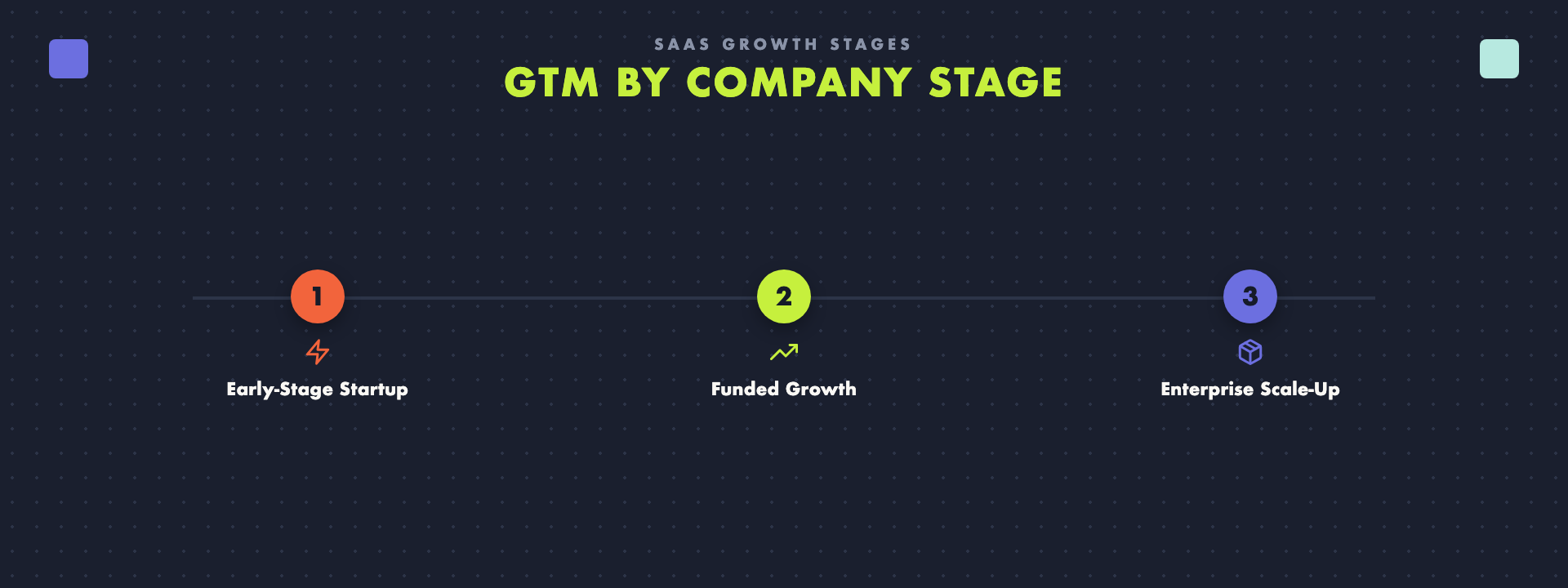
GTM for Early-Stage and Bootstrapped Startups
Early-stage and bootstrapped SaaS startups run lean, founder-led motions because resources stay limited. These startups use direct customer validation channels such as outbound email, founder-led social platforms like LinkedIn, and niche community engagement. The defining constraint at this stage is severe resource limitation, which requires a Customer Acquisition Cost (CAC) under $10K and a payback period under 80 days, along with an LTV:CAC ratio above 3:1, the minimum David Skok established as the threshold for viable SaaS unit economics.
The stage-specific playbook validates product-market fit with 10 to 20 paying customers who are not personal connections. This validation comes before any investment in scalable acquisition channels or team expansion. As the startup builds its initial market presence, it lays a foundation for the next level, where venture capital and specialized teams scale proven acquisition channels.
GTM for Funded Growth-Stage SaaS
Funded growth-stage SaaS companies run a sophisticated go-to-market (GTM) strategy that balances aggressive customer acquisition with operational efficiency. At this stage, companies have validated product-market fit and secured capital to accelerate growth. The GTM playbook often runs a hybrid motion that blends product-led growth for initial engagement with sales-led conversion for higher-value accounts. Multi-channel acquisition supports this motion, including paid advertising, content marketing, partnerships, and outbound sales development.
The primary constraint for growth-stage SaaS is proving unit economics at scale, which keeps Customer Acquisition Cost (CAC) sustainable as spending rises. Companies show strong Net Revenue Retention (NRR) through expansion revenue and systematize the sales cycle with repeatable playbooks. Investment in infrastructure, such as marketing automation platforms, CRM systems, and analytics dashboards, carries real weight. Aligning marketing, sales, and customer success around a single operating model turns rapid hiring and spending into predictable, scalable revenue growth.
GTM for Enterprise and Scale-Up SaaS
Enterprise and scale-up SaaS companies run a go-to-market (GTM) playbook built on efficiency and cross-functional alignment. This stage prioritizes customer retention to hold position in competitive markets and sustain product-market fit as the team grows. Unlike earlier stages that lean on rapid experimentation, the enterprise stage demands clear positioning and a strategy that adapts continuously to address internal alignment and differentiation.
The GTM motion for enterprise SaaS runs efficiency-driven operations. These operations treat the product as the primary marketing asset and push it to buyers with less friction to drive scalable growth. Success at this level builds self-funding loops where the GTM machine pays for itself before expanding. Expansion moves through the customer's existing workflow rather than into random adjacencies, which deepens integration and reduces churn. This approach keeps the SaaS company responsive to market demand while it sustains customer satisfaction and retention.
Each stage-specific GTM playbook evolves as the company grows, which keeps strategy aligned with resources and market position. This progression from validation to growth and scale prevents costly misalignment and supports sustainable expansion.
Go-to-market strategy for startups
For resource-constrained startups, the most effective go-to-market (GTM) strategy runs a lean, high-velocity approach. This strategy leans on founder-led sales and outbound motions to secure early traction. Startups conduct 20 to 30 customer discovery interviews to refine positioning and confirm willingness to pay, which keeps the product tied to a specific, urgent problem for a narrow segment. A focus on one to two primary channels, such as organic social or direct outreach, produces fast feedback loops and protects runway.
Product-led growth (PLG) delivers early traction well. PLG lets users reach value fast, which lowers customer acquisition cost and speeds feedback loops. PLG works when the product solves a clear pain point and shows value within the first session. As startups confirm product-market fit and early win rates, they prepare to move into broader, scalable acquisition. This transition bridges the startup GTM phase to measurement, where time-to-first-value and early win rates within the niche gauge success.
How to measure your GTM strategy success
Measuring a SaaS go-to-market (GTM) strategy tracks metrics that gauge efficiency and readiness for scale. Customer Acquisition Cost (CAC) measures how cost-effectively a company acquires new customers. Net Revenue Retention (NRR) measures the ability to retain and expand revenue from existing customers, which signals long-term growth potential. Lifetime Value (CLTV) shows the total revenue a customer generates over the relationship and balances acquisition cost.
Beyond these foundational metrics, product-market fit signals include Activation Rate, which tracks how fast users engage with the product, and User Retention, which reflects sustained usage over time. A high Net Promoter Score (NPS) shows that customers are satisfied and likely to recommend the product, which validates market fit. Revenue Growth Rate and CAC Payback Period show how profitably the business grows. The GTM Efficiency Ratio (Magic Number) measures how well spending converts into revenue.
Modern GTM frameworks weigh efficiency metrics alongside volume indicators such as Pipeline Velocity and Sales Cycle Length. These metrics confirm that the GTM strategy expands and does so efficiently, which opens a clear path to scale.
What are the advantages of a SaaS go-to-market strategy?
A documented SaaS go-to-market strategy delivers several advantages that support efficient, predictable scaling. These advantages are listed below:
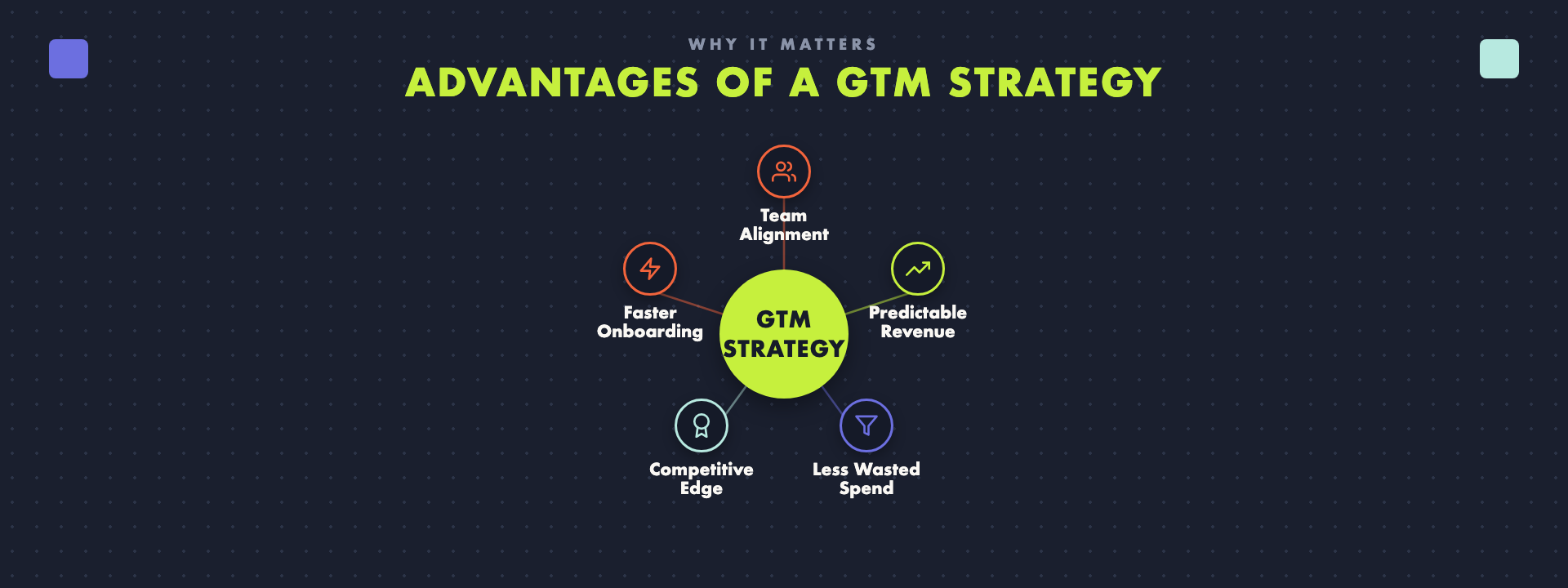
Each advantage compounds over time, which improves execution velocity and supports data-driven decisions. This iterative process refines the strategy and opens faster adaptation and more confident scaling.
How to create a SaaS marketing Plan
Creating a SaaS marketing plan turns a go-to-market (GTM) strategy into concrete marketing activity. The plan operationalizes the GTM strategy through specific campaigns, channels, budgets, and timelines. The plan names the content assets to develop, the paid channels to run, and the SEO and conversion tactics to apply. The plan keeps marketing qualified leads flowing into the sales pipeline. In 2026, the plan folds in AI-driven lead generation, autonomous ad buying, and data-driven measurement dashboards. These elements track metrics such as Customer Acquisition Cost (CAC) and attribution models.
A SaaS marketing plan prevents wasted budget and misaligned campaigns by anchoring every activity to the Ideal Customer Profile (ICP), messaging framework, and revenue goals set in the GTM strategy. This anchor keeps execution predictable and scalable as the company moves from early traction to the growth stage.
What is the importance of creating a SaaS marketing Plan?
A SaaS marketing plan turns strategic goals into concrete steps, which supports predictable execution. Alignment with the go-to-market strategy prevents wasted resources and misaligned priorities. The plan connects daily marketing activity to revenue objectives, which spends resources efficiently and sets clear team responsibilities. Without a marketing plan, an organization chases non-strategic metrics, which produces inefficiency and missed growth.
How does SaaS marketing agency help with Go-to-Market?
A SaaS marketing agency operationalizes the go-to-market (GTM) playbook with specialized expertise and frameworks that internal teams may lack. As a digital marketing agency for SaaS, we speed GTM deployment by building acquisition engines, conversion funnels, and measurement systems, which turns your strategic direction into live campaigns and optimized messaging. We apply AI-driven tactics, product-led growth mechanics, and outcome-based selling frameworks that match 2026 buyer expectations.
Sales-led and hybrid GTM motions gain the most from our partnership. We scale demand generation, align RevOps infrastructure, and run account-based marketing programs that need sophisticated orchestration. We supply modern MarTech stacks and data-driven attribution models, which lowers your GTM execution risk and prevents the budget waste common in trial-and-error internal builds. With us handling tactical operationalization, your founding team stays focused on product-market fit validation and strategic customer success, which compounds growth for 2026.
How a SaaS Go-To-Market Playbook Drives 2026 Growth
A SaaS go-to-market playbook drives 2026 growth by turning foundational requirements into a scalable execution system. This system holds validated Ideal Customer Profiles (ICPs), precise positioning, and chosen motions such as product-led growth or hybrid models. A defined sequence of steps lets each stage variant, from bootstrapped startups to enterprises, compound into sustained scale. This coordinated approach aligns market intelligence, buyer signals, and operational discipline, which prevents wasted resources and accelerates revenue in the AI-personalized, community-led 2026 market.
What are some SaaS go-to-market strategy example?
Successful SaaS go-to-market strategies show diverse approaches to scaling and market penetration. Notion runs a product-led growth (PLG) strategy through a strong free tier that drives user advocacy and viral adoption. HubSpot runs a sales-led strategy paired with educational content marketing, using a freemium CRM to attract small businesses and grow them into enterprise contracts. Figma runs a community-led growth model, where collaborative design features create a viral loop that challenges established tools such as Adobe. These strategies succeed because they align pricing, distribution channels, and messaging with target audience buying behavior.

About the team
SaaS Marketing Agency Digital Team
The in-house team at SaaS Marketing Agency Digital. We architect growth systems for B2B SaaS companies from Series A through pre-IPO.