The best B2B SaaS lead generation strategies build a predictable, sales-ready pipeline by weighting lead quality over sheer volume. High-quality lead generation attracts prospects who match the Ideal Customer Profile (ICP) and show genuine intent, rather than methods that generate unqualified traffic. This guide ranks twelve proven strategies and states each one's definition, role within the sales funnel, and success metrics. The twelve strategies build a chain from lead generation through pipeline growth to measurable revenue outcomes.
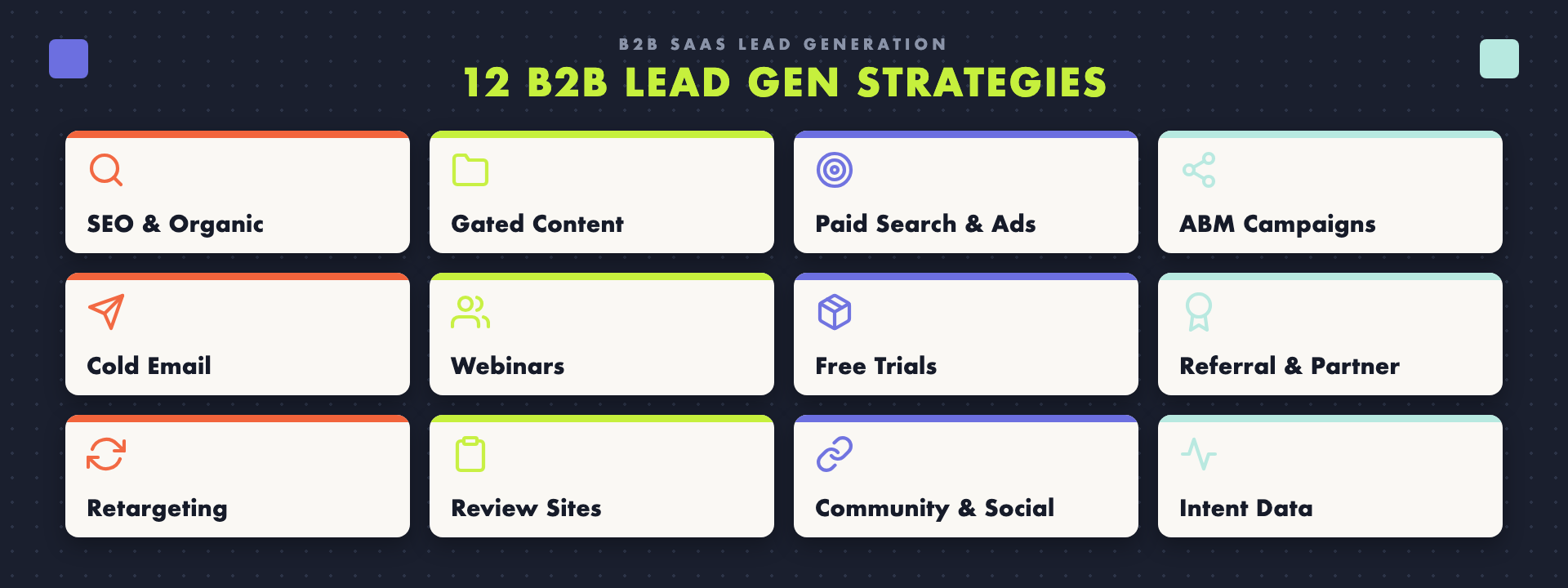
1. SEO and Organic Content for Inbound Leads
SEO and organic content are a key B2B SaaS lead generation strategy that attracts in-market buyers through search-optimized content. This approach generates leads by targeting high-intent keywords that prospects search while evaluating solutions, which captures demand at the research and consideration stages. Valuable, regularly updated content such as blogs, guides, and educational resources builds authority and drives qualified traffic to conversion points.
SEO and organic content move the traffic-to-lead conversion rate and raise the volume of Marketing Qualified Leads (MQLs). This strategy works best at mid-to-bottom funnel stages, where buyers are solution-aware or in vendor selection, and it supports higher Annual Contract Value (ACV) deals by building authority and reducing friction before the sales handoff. Our SaaS SEO services build the keyword strategy, content, and technical foundation that turn organic search into a durable lead channel.
2. Gated Content and Lead Magnets
Gated content and lead magnets are effective B2B SaaS lead generation strategies that capture contact information in exchange for valuable resources. These resources include whitepapers, webinars, templates, or industry reports, which prospects access by providing their details. This strategy qualifies leads by measuring their willingness to exchange information for insight, which signals genuine interest and a fit within the target market.
Gated content moves the Marketing Qualified Lead (MQL) volume and quality metric by converting anonymous website visitors into identifiable contacts. Lead magnets suit early- to mid-stage B2B SaaS companies, particularly those offering complex, high-consideration products where buyers conduct extensive research. Email databases built through gated content support nurture sequences and remarketing campaigns, and assets such as ROI calculators or implementation guides perform best when they address specific buyer pain points.
3. Paid Search and LinkedIn Ads
Paid search and LinkedIn ads are effective B2B SaaS lead generation strategies that target high-intent prospects. Paid search, primarily through Google Ads, captures demand by bidding on high-intent keywords such as "top SaaS project management tool." This approach moves leads from the consideration stage to conversion through optimized landing pages that state value propositions and customer testimonials. Paid search suits startups with an Average Contract Value (ACV) under $15K, where buyers self-educate before engaging sales representatives.
LinkedIn ads qualify leads by letting marketers segment audiences by job title, industry, and company size. This precision targeting delivers personalized content matched to the sales journey, which fits deals above $30K ACV or enterprise accounts that require committee-based buying decisions. LinkedIn ads move pipeline velocity and get measured by lead quality and revenue contribution in mid-to-bottom funnel campaigns. A minimum six-month commitment builds meaningful data and retargeting audiences.
4. Account-Based Marketing Campaigns
Account-Based Marketing (ABM) campaigns target high-value accounts through coordinated, multi-channel efforts that engage entire buying committees. ABM reverses traditional lead generation by identifying specific target accounts upfront, then running personalized outreach across multiple stakeholders within those organizations. This strategy generates leads by aligning sales and marketing to build customized messaging, content, and offers that address the pain points of each target account. ABM moves pipeline velocity and deal size metrics by concentrating resources on accounts with the highest revenue potential, which fits enterprise SaaS companies with complex, multi-stakeholder buying processes and high annual contract values (typically $50K+).
ABM qualifies leads through intent signals and engagement across the buying committee, which shortens sales cycles for strategic accounts. The strategy suits mid-to-late stage SaaS companies targeting enterprise clients where multiple decision-makers, from technical evaluators to C-suite executives, must align before purchase. ABM campaigns use account-level intent data, personalized landing pages, targeted LinkedIn advertising, direct mail, and coordinated sales outreach to nurture relationships across the buying committee at once. This approach raises conversion rates from marketing qualified accounts (MQAs) to sales qualified opportunities, since engagement concentrates on pre-qualified, high-fit accounts rather than a broad lead pool. The coordinated nature of ABM means that leads enter the pipeline with organizational buy-in already building, which moves closed-won revenue and customer lifetime value.
5. Cold Email Outbound
Cold email outbound is a targeted B2B SaaS lead generation strategy that reaches specific accounts with personalized messaging. This approach builds a sales-ready pipeline by directly engaging stakeholders who fit the ideal customer profile but have not yet interacted with the brand. Cold email outbound moves the opportunity creation metric by converting cold contacts into booked meetings, measured by reply rate, positive response rate, and meeting-to-opportunity conversion.
Cold email outbound suits mid-market and enterprise Annual Contract Value (ACV) motions, where longer sales cycles justify investment in account research and message personalization. The strategy generates an average 8.5 percent response rate with proper segmentation and personalization, which makes it one of the most cost-effective outbound channels for resource-constrained teams. Cold email outbound needs detailed ideal customer profiles, contacts sourced through lead databases, and multi-touch sequences that deliver value before asking for time.
6. Webinars and Virtual Events
Webinars and virtual events are effective B2B SaaS lead generation strategies that combine educational content with direct engagement. These events generate leads by requiring registration, capturing contact information, and identifying prospects interested in specific business solutions. Webinars move Marketing Qualified Leads (MQLs) into Sales Qualified Leads (SQLs) by showing product value and thought leadership, which lets sales teams gauge participant engagement through attendance duration and interaction metrics such as questions and poll responses.
Webinars suit mid-to-high Annual Contract Value (ACV) deals and later-stage pipeline development, where prospects need a deeper understanding of the product before committing. Live sessions converted into gated, on-demand content extend lead capture beyond the event date. Effective follow-up segments attendees by engagement level, prioritizes active participants, and nurtures less engaged leads through tailored content. Webinars advance leads through the sales funnel by providing relevant information and building direct interaction.
7. Free Trials and Product-Led Signups
Free trials and product-led signups let prospects experience a B2B SaaS product firsthand before committing financially. This strategy generates leads by letting users interact with the software, which moves the Product-Qualified Lead (PQL) metric. Free trials fit product-led growth motions and companies targeting mid-to-high Annual Contract Value (ACV) segments, where users validate product fit through actual usage. Free-trial motions convert near 20 percent of signups to paid for most SaaS products, according to OpenView's Product Benchmarks report.
Real product demos and trial environments pre-filled with example data reduce friction and raise user engagement. Personalizing the in-trial experience based on user needs lifts conversion rates, often by 20 to 30 percent. This approach keeps leads actively engaged and suited to the product, which shortens the sales cycle for buyers already educated on the product's functionality and fit.
8. Referral and Partner Programs
Referral and partner programs are effective strategies for B2B SaaS lead generation. These programs use existing customers and industry partners to generate high-quality, sales-ready leads. Referral programs reward satisfied customers for recommending the SaaS product to their networks, often through account credits or service upgrades. Partner programs pair the company with complementary businesses to widen reach and share leads through mutual promotion.
Referral and partner programs raise lead quality through the trust and credibility of referrers and partners. Leads from these programs carry higher conversion rates and lower cost-per-acquisition. Referral and partner programs suit mid-to-late funnel stages and companies raising Average Contract Value (ACV). Running these programs needs clear goals, attractive incentives, and efficient tracking systems for success and scale.
9. Retargeting and Conversion Optimization
Retargeting and conversion optimization re-engage prospects who interacted with a brand but did not convert. This strategy delivers tailored, segment-specific messages to these visitors, such as ROI-focused ads for prospects who viewed pricing pages or educational content for blog readers. The goal is to remove friction in the conversion process and raise the percentage of traffic that becomes sales-ready leads.
Retargeting raises the conversion rate and lowers cost per acquisition (CPA), which fits mid-to-late funnel stages where prospects evaluate fit and are ready to start a trial or book a demo. Retargeting suits companies with an established traffic base aiming to raise Annual Contract Value (ACV) from high-intent accounts. Success comes from the number of sales-qualified opportunities generated and the influenced pipeline, which ties retargeting effort to revenue rather than click-throughs.
10. Review Sites and Software Marketplaces
Review sites and software marketplaces are strong platforms for B2B SaaS companies to generate high-intent leads. Platforms such as G2, Capterra, and Software Advice give buyers a space to research and compare software solutions. An optimized presence on these sites attracts sales-ready buyers already in the decision-making process. The strategy builds clear product descriptions, high-quality visuals, and positive reviews from satisfied customers. These actions raise visibility and credibility, which capture leads at the top of the funnel.
Review sites suit mid-to-late annual contract value (ACV) deals. Buyers in this segment need extensive validation and social proof before purchase. Review sites provide the trust signals that shorten the sales cycle. Success comes from the volume of profile views, the number of reviews generated, and the conversion rate from marketplace visitor to sales contact. Consistent profile updates and marketplace advertising hold a strong presence and keep driving qualified leads.
11. Community and Social Selling
Community and social selling in B2B SaaS build trust and authority within niche digital spaces. This strategy qualifies leads by engaging in conversations, sharing valuable insight, and participating on platforms such as Slack, Discord, and LinkedIn. Community and social selling move the lead engagement and Marketing Qualified Lead (MQL) metrics by building relationships that convert community members into sales-ready prospects. Community and social selling suit mid-to-high Annual Contract Value (ACV) deals where committee buying needs multiple trusted touchpoints.
To run community and social selling, teams join relevant niche hangouts and contribute answers without immediately linking to their site. A strong LinkedIn social selling plan publishes original insight, comments on prospect posts, and monitors company signals to time personalized connection requests. Success comes from engagement rates, connection acceptance, and the volume of qualified conversations that progress to demos, which ties community activity to the pipeline rather than vanity metrics.
12. Intent Data and Lead Scoring
Intent data and lead scoring are core strategies in B2B SaaS lead generation. Intent data identifies prospects showing active buying signals by capturing external behaviors such as repeated visits to product pages and searches for related information. Intent data turns raw traffic into a predictable, sales-ready pipeline. Lead scoring ranks these prospects by fit attributes such as industry and company size, alongside intent actions such as page visits and email clicks. This ranking builds clear tiers, such as A, B, and C, which define marketing-qualified leads (MQL) and sales-qualified leads (SQL).
Intent data and lead scoring move the pipeline metric of conversion rate and Net New Annual Recurring Revenue (ARR) by keeping sales teams focused on high-intent, high-fit accounts. The strategy fits mid-to-large deal sizes and enterprise Annual Contract Values (ACV), where committee buying needs precise prioritization. Success comes from the correlation between scoring thresholds and actual deal outcomes, refined quarterly to raise accuracy.
What is the best lead generation strategy for early-stage B2B SaaS startups?
For early-stage B2B SaaS startups, the best lead generation strategies use low-cost, high-impact methods built on direct interaction and community engagement. Founder-led outbound sales and community-based discovery work well. These approaches rely on the founder's direct engagement with prospects, which provides immediate feedback and builds early pipeline without heavy financial investment.
Cold email with AI personalization and founder-led LinkedIn outreach suit startups with limited resources. These methods target specific accounts with high intent and produce rapid feedback loops. Engagement in niche communities, such as Reddit or specialized Slack groups, raises visibility and generates leads through authentic interaction. These strategies suit startups because they bypass the long ramp-up of SEO and the high cost of paid advertising.
The move from startup-fit strategies to scalable lead generation needs a clear definition of a sales-ready lead. Early-stage companies focus on channels that provide both volume and learning, which identifies the buyer personas that convert fastest. This foundational knowledge means each new strategy amplifies the organic efforts that validated product-market fit as the startup scales.
What is B2B SaaS lead generation?
B2B SaaS lead generation is the process of identifying and attracting business customers who show interest in and fit for a software-as-a-service product, then capturing their information to move them into a sales-ready pipeline. B2B SaaS lead generation covers building awareness, capturing intent signals, and qualifying prospects by organizational fit and behavioral engagement. Companies with active blogs generate 67 percent more monthly leads than companies that do not blog, according to research by Demand Metric. Conversion-focused strategies such as free trials convert near 20 percent of signups to paid, which OpenView's Product Benchmarks report documents.
Effective B2B SaaS lead generation weights quality over quantity and targets accounts that match ideal customer profiles. SEO accounts for a large share of B2B leads, while cold outreach reaches an 8.5 percent response rate when personalized, and email marketing delivers roughly a 2.4 percent conversion rate. These metrics show that B2B SaaS lead generation must balance multiple channels and tactics to build a predictable pipeline. A predictable pipeline feeds the revenue engine and delivers prospects ready for sales engagement.
What is a lead in B2B SaaS?
A lead in B2B SaaS is a prospect who has shown interest in a company's product or service, usually through actions such as filling out a contact form or requesting a demo. The progression from Marketing Qualified Lead (MQL) to Sales Qualified Lead (SQL) matters here. An MQL is a lead the marketing team identifies as a potential customer, based on criteria such as engagement with marketing materials. Once a lead holds the budget, authority, need, and timeline, it becomes an SQL, which signals readiness for direct sales engagement.
Lead qualification hinges on two factors: fit and intent. Fit measures how well the lead matches the company's ideal customer profile, including industry, company size, and geography. Intent measures the lead's actions, such as visiting a pricing page or attending a webinar, which show genuine interest in purchasing. This qualification process separates B2B lead generation from B2C, where individual purchasing decisions and shorter sales cycles often bypass such detailed scrutiny.
What is the difference between B2B and B2C lead generation?
B2B and B2C lead generation differ in their target audiences and buying processes. B2B lead generation engages a buying committee within organizations, which includes stakeholders such as procurement, IT, and executive teams. This committee-based approach needs tailored content that addresses diverse needs and pain points, which produces longer sales cycles and larger deal sizes. B2C lead generation targets individual consumers and weights quick conversions through emotional appeal and broad marketing tactics.
The sales cycle and deal size also vary between B2B and B2C lead generation. B2B sales cycles extend over weeks or months because of extensive evaluations and approvals from several decision-makers. These cycles justify higher average contract values and call for resource-intensive strategies such as account-based marketing and personalized outreach. B2C transactions close faster, with lower individual deal values, and rely on high-volume, low-touch strategies such as social media ads and time-limited offers to drive immediate conversions.
Despite these differences, B2B and B2C lead generation share the goal of driving revenue through effective prospect engagement. Both models use content marketing, paid advertising, and conversion optimization, though B2B effort weights educational content and relationship building, while B2C weights brand appeal and shareable experiences. These distinctions help marketers align strategy with the decision-making architecture of their target markets.
Why is lead generation important for B2B SaaS companies?
Lead generation matters for B2B SaaS companies because it builds a predictable pipeline that sets the growth ceiling for the organization. A consistent flow of qualified leads entering the sales funnel keeps revenue targets reachable, since it turns marketing effort into measurable pipeline value. Without effective lead generation, sales cycles stall, which makes growth unpredictable and hard to forecast.
Lead generation identifies, attracts, and qualifies prospects who match the ideal customer profile. This process feeds the revenue engine with high-intent prospects ready for conversion. In the B2B SaaS sector, where sales involve multiple stakeholders and longer evaluation cycles, quality leads carry even more weight. Lead generation delivers a steady volume of leads and confirms that these leads hold both the right fit characteristics and demonstrated buying intent. This dual qualification supports sustainable growth and lets companies scale efficiently toward their business objectives.
What is demand generation vs lead generation in B2B SaaS?
Demand generation in B2B SaaS builds awareness and educates buyers about their needs and available solutions. Demand generation produces content such as ungated blog posts, webinars, and thought leadership that attracts a broad audience by building market interest. Lead generation converts this awareness into identifiable prospects by capturing contact information through tactics such as gated content, demos, and trials. Lead generation is more targeted and secures high-intent leads ready for sales engagement.
The two processes run sequentially and complement each other within the sales funnel. Demand generation operates at the top, building authority and trust without requiring immediate conversion. As prospects move from awareness to evaluation, lead generation qualifies and captures these prospects and turns them into measurable, sales-ready opportunities. Effective B2B SaaS strategies integrate both approaches, so demand generation fills the funnel with educated prospects while lead generation converts that interest into a sustainable sales pipeline.
How to build a B2B SaaS lead generation strategy from scratch
Building a B2B SaaS lead generation strategy from scratch runs a structured sequence of actions. This process defines key components and builds a framework for consistent lead acquisition, and it fits inside a broader SaaS marketing plan that ties every activity to revenue goals. The steps are listed below.
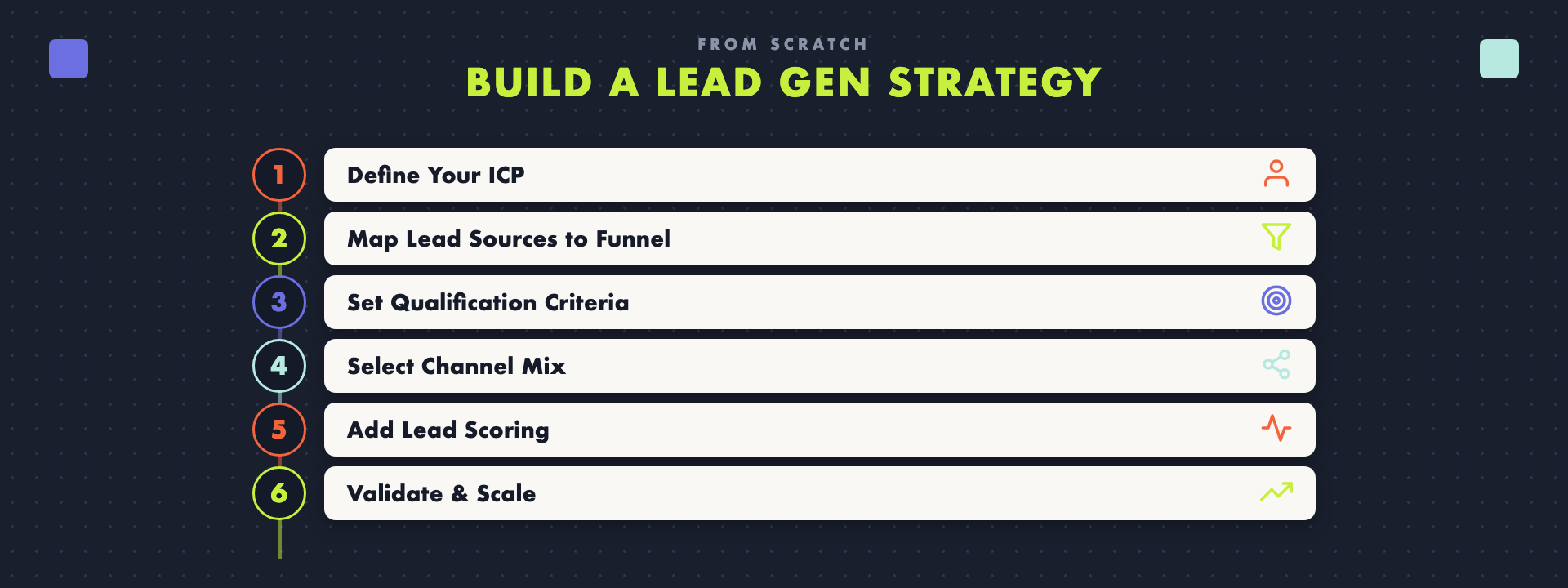
1. Define Your Ideal Customer Profile (ICP): Identify the Ideal Customer Profile (ICP) using firmographic data such as industry, company size, and revenue. This step targets accounts most likely to convert. Validate the ICP by testing it with a small sample of 50 to 100 companies before scaling.
2. Map Lead Sources to Funnel Stages: Organize lead sources by funnel stage: Top of Funnel (TOFU), Middle of Funnel (MOFU), and Bottom of Funnel (BOFU). This mapping matches each lead source to the customer journey and improves lead nurturing and conversion.
3. Establish Lead Qualification Criteria: Work with sales teams to define clear qualification criteria for leads. Distinguish Marketing Qualified Leads (MQLs) from Sales Qualified Leads (SQLs) by fit and intent signals. This alignment moves only sales-ready leads through the funnel.
4. Select Initial Channel Mix: Choose two to three initial strategies that match resources and growth stage. Early-stage companies gain from SEO content, cold outbound outreach, and product-led signups. These channels build a foundation before expanding to paid channels and account-based marketing.
5. Implement Lead Scoring and Infrastructure: Add lead scoring to prioritize high-intent prospects. Track engagement actions such as demo requests and content downloads. Connect the CRM, marketing automation platform, and analytics tools for clean data flow from first touch to closed deal.
6. Validate and Scale: Measure each channel by cost per lead and customer acquisition cost. Use A/B testing to refine messaging, landing pages, and outreach sequences. Scale spend or add complexity only once each channel produces qualified pipeline at a sustainable cost.
This sequential approach builds a lead generation strategy that is effective and scalable, which turns initial effort into a predictable pipeline engine.
Who can help building a B2B SaaS lead generation strategy?
Building a B2B SaaS lead generation strategy means selecting the right execution option for the company's stage and resources. Companies hold three primary options: in-house teams, individual consultants, or specialized agencies. Early-stage startups gain from founder-led initiatives that use personal networks and content marketing to build initial traction without heavy financial investment. As companies grow, hybrid models that pair internal strategy with agency execution work better, especially for complex channels such as SEO and account-based marketing. Established enterprises use specialized agencies to run multi-channel strategies efficiently and accelerate pipeline growth. This progression shows why agencies often fit best for scaling lead generation in growth-stage and enterprise companies.
Why Choose SaaS marketing agency for B2B SaaS lead generation?
Choosing a SaaS marketing agency for B2B SaaS lead generation turns lead generation into a predictable pipeline. At SaaS Marketing Agency, we bring expertise that many in-house teams lack, especially in scaling operations efficiently. We apply proven frameworks across clients and industries, which identifies high-converting tactics fast and avoids costly trial-and-error. This expertise carries weight for strategies such as account-based marketing and paid search optimization, which need sophisticated data handling and automation.
We give you immediate access to specialized tools and multi-channel execution, which builds a systematic approach to generating leads. Complex strategies such as intent data activation and conversion rate optimization gain from our involvement because of their technical demands and need for continuous testing. When we run these functions, your startup or growth-stage team stays focused on product development and customer success, which turns lead generation into a scalable revenue engine.
What is the lead generation funnel in B2B SaaS?
The lead generation funnel in B2B SaaS runs several sequential stages that guide a prospect from awareness to a sales-qualified opportunity. The funnel starts by capturing anonymous visitors through channels such as organic content, paid ads, and social media. As prospects move through the funnel, qualification tightens on engagement markers such as downloading gated content, attending webinars, requesting demos, or starting free trials. Each stage applies stricter qualification criteria and filters leads by fit, such as company size, industry, and role, and by intent, including product usage and buying signals.
This structured approach means only prospects showing both structural fit and active buying intent reach sales conversations, which limits wasted effort on low-probability contacts. The stages flow from Awareness to Interest, Consideration, Intent, Evaluation, and Purchase.
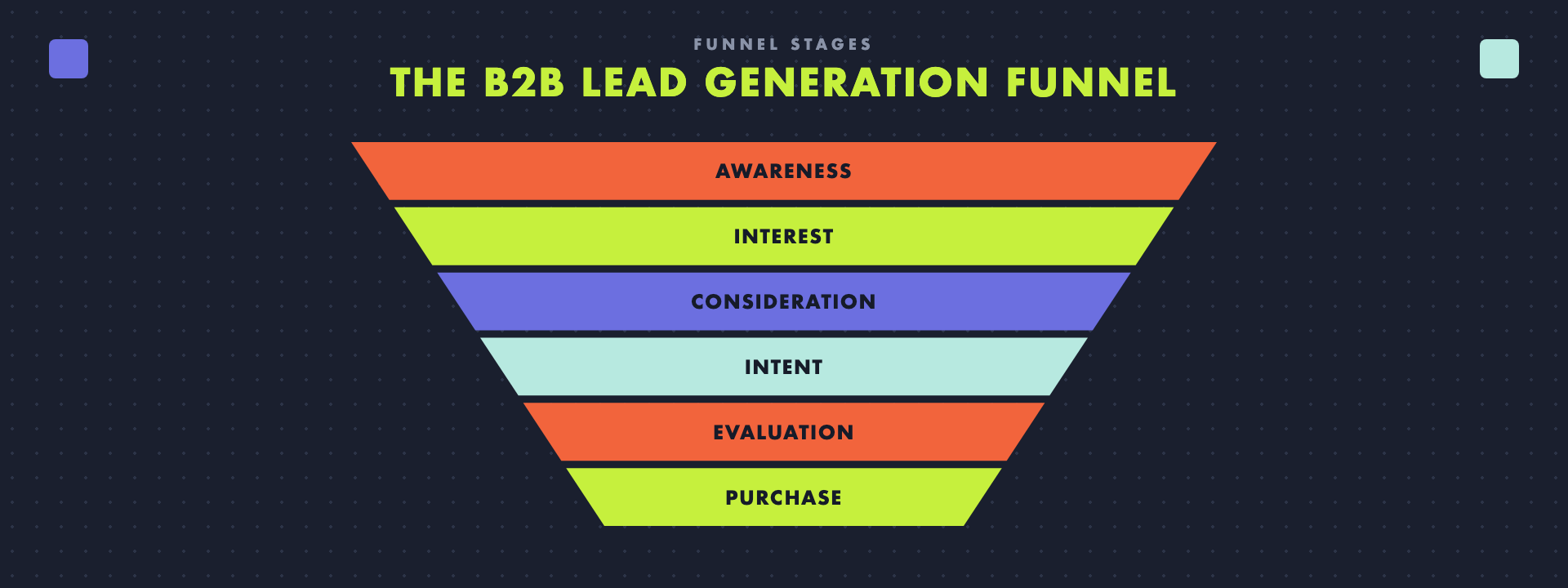
Knowing where leads concentrate or drop off shows which strategies need optimization, whether raising top-of-funnel content discoverability, strengthening mid-funnel nurture sequences, or refining bottom-funnel sales enablement. This process bridges initial inbound interest and the structured outbound motions that close complex enterprise deals.
What is inbound lead generation for B2B SaaS?
Inbound lead generation for B2B SaaS attracts in-market buyers by offering valuable content and experiences that draw prospects searching for solutions. This strategy positions a SaaS company as the answer to problems prospects are already trying to resolve, which captures existing market demand. The primary channels driving inbound leads include organic search through SEO-optimized content and blogs, gated content such as webinars and white papers, social media marketing (especially LinkedIn), online community engagement on platforms such as Reddit and Quora, review sites, software marketplaces, and free trials or freemium plans. These channels create a pull motion where qualified prospects voluntarily enter the sales funnel, which brings higher intent and often better conversion rates than outbound-sourced leads.
What are the benefits of inbound lead generation for B2B SaaS?
Inbound lead generation for B2B SaaS offers several advantages. This approach attracts high-intent buyers searching for solutions, which raises conversion rates. Inbound delivers a lower cost per lead over time as content assets keep generating traffic and conversions without additional spending. Inbound methods build long-term brand authority through valuable content, which raises credibility and trust in the marketplace. The cumulative effect of search-optimized content compounds inbound leads, which builds a sustainable, scalable pipeline. These leads often pre-qualify through their own intent signals, such as engaging with resources or visiting pricing pages, which raises sales efficiency.
What is outbound lead generation for B2B SaaS?
Outbound lead generation for B2B SaaS proactively reaches defined target accounts that match a company's Ideal Customer Profile (ICP) before those accounts seek a solution. This approach contrasts with inbound methods by directly engaging prospects through channels such as cold emails, LinkedIn outreach, cold calling, and direct mail. Outbound lead generation initiates contact with decision-makers who fit the desired customer profile, even before they show explicit buying intent.
Outbound strategies organize into multi-channel sequences that engage specific stakeholders within target organizations. Cold email campaigns anchor many B2B SaaS outbound programs and reach an average 8.5 percent response rate when personalized. LinkedIn also carries weight, with 40 percent of B2B marketers naming it an effective platform for lead generation. Intent data and lead databases let outbound methods control pipeline volume and target high-value accounts directly.
What are the benefits of outbound lead generation for B2B SaaS?
Outbound lead generation for B2B SaaS offers several distinct advantages that support growth and efficiency. The benefits are listed below:
- Proactive Pipeline Control: Outbound strategies engage specific high-value accounts and bypass the waiting period that inbound interest requires. This approach accelerates revenue by targeting decision-makers and buying committees directly.
- Predictable Meeting Volumes: Targeting defined Ideal Customer Profiles (ICPs) with precise messaging produces consistent meeting volumes and shortens the time from initial contact to qualified opportunity. This predictability helps SaaS products with higher Average Contract Values (ACV).
- Multi-Channel Engagement: Outbound methods pair cold email, LinkedIn, and phone outreach to raise engagement probability. This multi-channel approach reaches stakeholders before competitors and fills gaps that inbound strategies miss.
- Immediate Pipeline Creation: Inbound leads accumulate over time, while outbound efforts produce an immediate pipeline that sales teams act on. This immediacy carries weight for resource-constrained startups and companies entering new markets where brand awareness is still building.
Outbound lead generation reaches accounts that inbound methods overlook, which provides a strategic advantage in competitive markets.
How to measure B2B SaaS lead generation success?
Measuring B2B SaaS lead generation success tracks specific pipeline and cost metrics. Lead Velocity Rate (LVR) and conversion rates signal pipeline health, with LVR ideally exceeding 20 percent month-over-month to show growth potential. Cost metrics such as Cost Per Lead (CPL) and Customer Acquisition Cost (CAC) show financial efficiency. Small to medium-sized businesses hold CPL under $200, while enterprises target CPL under $400. In B2B SaaS, organic leads cost a median of $164 while paid channels average $310, according to First Page Sage's "Average Cost Per Lead by Industry" report, which confirms the economic gap between organic and paid channels. The Marketing Qualified Lead (MQL) to Sales Qualified Lead (SQL) conversion rate, aiming for 15 to 25 percent, confirms that leads are sales-ready and justify the associated costs.
What Makes B2B SaaS Lead Generation Effective?
Effective B2B SaaS lead generation produces a sales-ready pipeline at a sustainable cost. This efficiency comes from consistently delivering high-quality leads that match the ideal customer profile and show clear purchase intent. A strategy qualifies as effective when it targets decision-makers within the desired audience, which reaches the prospects most likely to convert. Measurable conversion rates from lead to opportunity justify acquisition costs and support scalable growth. Effective lead generation aligns closely with product value, so marketing messages match genuine customer needs and usage patterns.
How a SaaS Lead Generation Agency Builds Predictable Pipeline
A SaaS lead generation agency builds a predictable pipeline by operationalizing ranked strategies into one system. The agency starts by defining an Ideal Customer Profile (ICP) and selecting high-impact channels such as SEO and product-led trials. This approach ties every marketing dollar to measurable funnel stages such as cost per SQL or conversion rate. Intent data lets the agency target accounts actively researching solutions and move qualified prospects toward closed deals.
The agency integrates strategies such as account-based marketing (ABM), cold outbound, and retargeting into a unified engine. This engine delivers a sales-ready pipeline at sustainable cost. Specialized agencies bring expertise in technical SEO audits, content production, and multi-channel ABM orchestration. Agencies optimize paid search for cost-per-lead efficiency and build marketing automation systems that nurture and score leads. This operational model lets internal teams focus on product and sales execution while the agency scales the lead generation engine, which turns lead generation from a variable cost center into a growth driver with defined ROI.

About the team
SaaS Marketing Agency Digital Team
The in-house team at SaaS Marketing Agency Digital. We architect growth systems for B2B SaaS companies from Series A through pre-IPO.