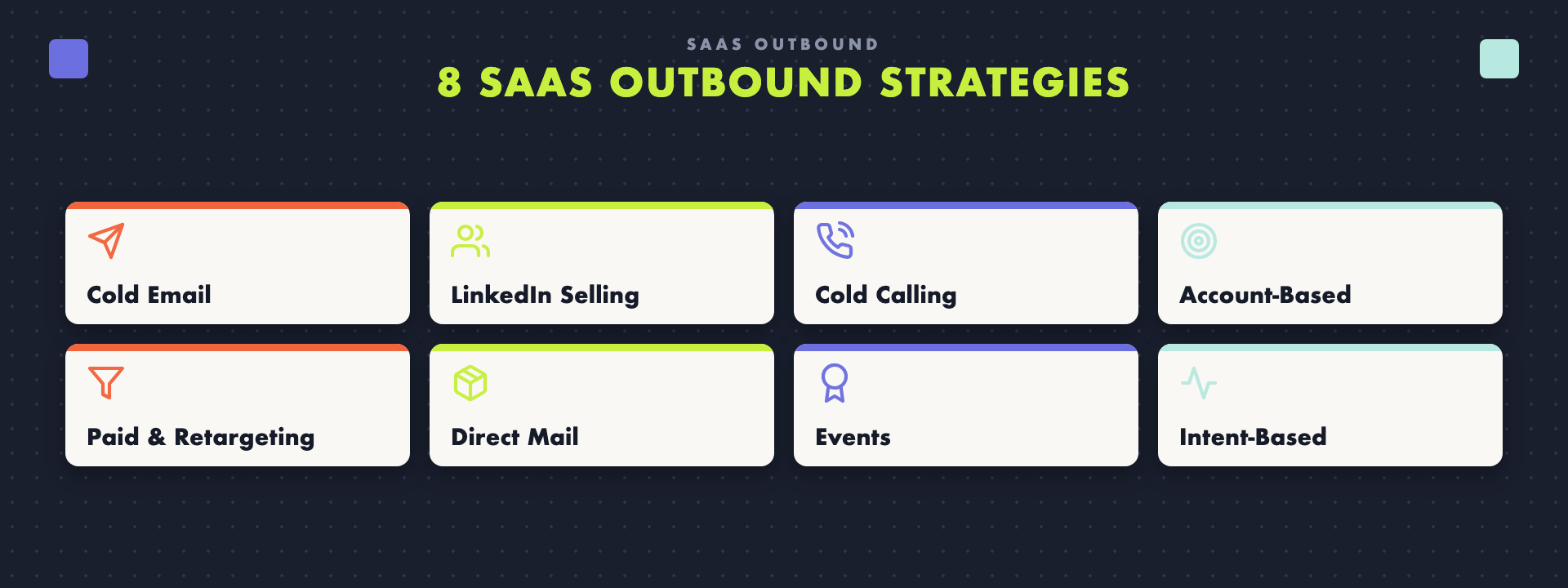
The most effective SaaS outbound marketing strategies proactively reach defined accounts to build a pipeline fast. Outbound marketing targets buyers before they self-identify, which lets companies initiate contact with high-value accounts. This approach keeps outreach relevant and timely, rather than generic, through specific buying signals. The eight ranked strategies include Cold Email Outreach, LinkedIn Outbound and Social Selling, Cold Calling and SDR Outreach, Account-Based Marketing, Outbound Paid Advertising and Retargeting, Direct Mail and Gifting, Event and Conference Outreach, and Intent-Based Outbound. Each strategy is defined by how it reaches target accounts, the pipeline metric it moves, and the deal size or segment it best suits. Chaining the flow from the list through the definition to execution lets SaaS teams accelerate pipeline speed, layering channels such as email, LinkedIn, and calls based on the account's tier and the complexity of the deal.
Outbound marketing strategies engage prospects through direct outreach rather than waiting for inbound interest. This direct motion lets SaaS companies control pipeline velocity and reach accounts that inbound methods cannot access. The effectiveness of each approach depends on deal size, sales cycle length, market maturity, and the segment targeted. Execution quality determines whether outbound delivers immediate pipeline impact or fails to generate meaningful conversations.
1. Cold Email Outreach
Cold email outreach is a prominent SaaS outbound marketing strategy that sends targeted, unsolicited emails to potential clients. This approach reaches and engages target accounts through concise, value-driven messages that address specific pain points or company events. Cold email outreach moves the reply rate and meeting-booked rate metrics and converts cold leads into sales-qualified leads (SQLs). Cold email outreach works well for mid-market and enterprise segments, where deal sizes justify the investment in personalized messaging. This method needs strong list quality, sharp copy, and technical infrastructure to hold sender reputation and reach rapid pipeline impact.
2. LinkedIn Outbound and Social Selling
LinkedIn Outbound and Social Selling is a SaaS outbound motion that uses LinkedIn's professional network to engage target accounts through personalized outreach. This approach optimizes profiles to serve as value-driven landing pages, engages with prospects' content, and sends targeted connection requests. These actions build familiarity and trust before a sales conversation begins. LinkedIn Outbound and Social Selling move the meeting booked and pipeline qualification metrics by converting accepted connections into demo invitations or peer-to-peer exchanges. This method suits mid-market to enterprise segments where trust-building comes before direct sales engagement.
The process begins with profile optimization, followed by soft engagement such as posting and commenting on prospect posts. A value-first connection request follows, referencing specific insights or industry challenges. An insight drop, such as a case study, comes next, and finally a demo invitation with a clear, low-friction call-to-action. This approach often reaches a 30 to 45 percent connection acceptance rate and a 10 to 15 percent conversion rate to booked demos. Aligning sales and marketing on ideal customer profiles and using engagement signals lets LinkedIn Outbound and Social Selling deliver faster pipeline velocity than cold channels.
3. Cold Calling and SDR Outreach
Cold calling and SDR (Sales Development Representative) outreach is a direct, proactive SaaS outbound strategy. This approach has SDRs initiate personalized phone conversations with decision-makers at target accounts. The goal is to engage these accounts, qualify buying signals, and secure meetings rather than sell the product immediately. Cold calling and SDR outreach reach accounts through well-researched insight about the lead's specific pain points. SDRs ask discovery questions, listen actively, and clarify next steps such as scheduling a demo or a follow-up call.
Cold calling and SDR outreach move the meetings booked pipeline metric. This strategy suits higher-ACV (Annual Contract Value) accounts or segments where human connection matters for working through complex buying committees. For SaaS deals with ACV between $10,000 and $100,000, the strategy works well. To run this campaign, SDRs pair cold calling with a coordinated multi-channel sequence that includes email and LinkedIn touches. Phone calls then reference prior email threads to build context and familiarity, which raises engagement and conversion.
4. Account-Based Marketing
Account-Based Marketing (ABM) is a SaaS outbound marketing approach that targets specific high-value accounts with personalized campaigns. ABM identifies and prioritizes these accounts by mapping the buying committee and tailoring messages to each stakeholder's pain points. This strategy runs multiple channels, including email, LinkedIn, direct mail, and ABM ads, to build full engagement.
ABM raises pipeline velocity and average deal size and accelerates account progression from initial contact to opportunity. This method suits enterprise deals or segments with high Annual Contract Value (ACV), where the investment in personalized, multi-channel engagement matches the revenue potential. Aligning sales and marketing around accounts most likely to convert lets ABM raise win rates for larger contracts and shorten sales cycles by 20 to 30 percent against traditional outbound methods.
5. Outbound Paid Advertising and Retargeting
Outbound paid advertising and retargeting is a SaaS outbound approach that uses digital channels to engage potential clients. This strategy places targeted advertisements on platforms such as Google, Meta, and LinkedIn, which holds consistent brand visibility across multiple touchpoints. Uploading Ideal Customer Profile (ICP) lists or Account-Based Marketing (ABM) lead lists lets businesses build "matched audiences" that deliver ads directly to decision-makers. "Engager retargeting" captures users who interacted with ads or viewed videos and routes them into outbound sequences fast.
Outbound paid advertising and retargeting raise pipeline velocity and awareness metrics by warming up cold prospects, which makes later outreach more familiar and effective. This method suits mid-market and enterprise deal sizes, from $10K to $50K or more in Annual Contract Value (ACV). The strategy works as "air cover" for high-ticket outbound-led initiatives, supporting direct engagement while capturing existing demand for smaller deals. A continuous presence accelerates prospects through the sales funnel and delivers immediate pipeline impact in competitive markets.
6. Direct Mail and Gifting
Direct mail and gifting is a SaaS outbound approach that sends personalized physical items to target accounts. This method breaks through digital noise and accelerates relationship-building in complex sales environments. Direct mail and gifting suit enterprise and mid-market segments with deal sizes above $15K to $25K, where the investment in curated gifts matches the pipeline potential.
Sales teams personalize packages with branded gifts or high-value content pieces that resonate with the recipient's interests or company milestones. Timing carries weight, and sends often trigger on signals such as intent spikes, event attendance, or stalled opportunities. Direct mail campaigns work best when paired with multi-channel outreach. Follow-up sequences include coordinated email and LinkedIn touches that reference the gift, which creates natural conversation starters and raises response rates 3 to 5 times over cold outreach alone. Teams use unique redemption codes or custom landing pages to monitor interactions and tie them to deal progression. Logging each send in the CRM measures the strategy's effect on pipeline velocity. Direct mail and gifting stand out in saturated digital environments, which makes them effective for re-engaging stalled opportunities or strengthening relationships with key decision-makers.
7. Event and Conference Outreach
Event and conference outreach is a SaaS outbound approach that uses industry events to engage high-value target accounts. This strategy secures meetings before, during, and after events to accelerate pipeline generation. Pre-event digital outreach lets companies book 8 to 12 specific meetings, followed by live qualification on-site. Event and conference outreach raise metrics such as meeting booking volume and pipeline velocity, which makes it ideal for mid-market and enterprise deals with an average contract value (ACV) of $50,000 or more.
To run an effective event outreach campaign, teams start planning 3 to 4 weeks in advance. Preparation identifies the top 100 target accounts, enriches attendee data with verified emails, and sends personalized invitations to secure venue slots. During the event, the focus shifts to conducting booked meetings and capturing real-time engagement data, such as session attendance and booth interactions. After the event, a segmented nurture sequence deploys within 24 to 48 hours to capitalize on demonstrated interest. Event and conference outreach work well when digital-only channels fall short, since strategic sponsorships, targeted networking, and exclusive experiences build deeper conversations and speed deal closure.
8. Intent-Based Outbound
Intent-based outbound marketing uses real-time behavioral signals to engage accounts actively seeking solutions. This strategy identifies prospects through digital footprints, such as content downloads or competitive website visits. Targeting accounts at the moment they show purchase intent raises conversion rates. Intent-based outbound accelerates pipeline velocity by aligning outreach with the buyer's research stage, which raises meeting acceptance rates. This strategy suits mid-market and enterprise segments with an Annual Contract Value (ACV) above $25,000, where timing and relevance decide complex sales cycles.
What Is SaaS Outbound Marketing?
SaaS outbound marketing is a proactive strategy where companies initiate contact with potential customers before they express interest. It is the outbound arm of a broader set of SaaS marketing strategies, pairing with inbound to cover the full demand spectrum. This approach reaches target accounts through channels such as cold email, LinkedIn outreach, and direct mail to build a pipeline without waiting for inbound interest. Inbound marketing attracts prospects through content, while outbound marketing pushes messages directly to decision-makers at companies matching the ideal customer profile.
The scope of proactive channels in SaaS outbound marketing is broad and covers both digital and traditional methods. Email sequences deliver personalized value propositions to buyers' inboxes, while LinkedIn messages use social proximity. Cold calls open immediate conversations with stakeholders, and account-based marketing coordinates multi-channel touches across a buying committee. Paid advertising targets specific companies with retargeting pixels, and direct mail breaks through digital noise with a physical presence. Event outreach uses in-person engagement opportunities, and intent-based outbound triggers sequences when prospects show buying signals. These channels form an integrated outbound motion that accelerates pipeline generation for SaaS companies.
What is the purpose of SaaS outbound marketing?
The purpose of SaaS outbound marketing is to build a targeted pipeline fast. This approach proactively engages high-fit accounts before they enter an active buying cycle. Inbound marketing waits for prospects to express interest, while outbound marketing lets sales and marketing teams control timing and account selection. Reaching decision-makers at companies that match the ideal customer profile lets outbound marketing generate immediate pipeline opportunities. This method helps SaaS companies pursuing predictable revenue growth or facing urgent pipeline gaps. Outbound marketing complements inbound demand by filling coverage gaps that content-driven strategies cannot address. Outbound marketing targets accounts in categories with low search intent, emerging markets without established awareness, or enterprise segments that need direct relationship-building. Inbound marketing builds authority and attracts self-identified buyers over time, while outbound marketing creates immediate conversations with named accounts. This complementary relationship accelerates pipeline velocity in the near term while inbound marketing builds sustainable, lower-cost acquisition channels over time.
Why is outbound marketing important for SaaS companies?
Outbound marketing matters for SaaS companies because it targets buyers before they self-identify and reaches accounts that inbound strategies cannot. This proactive approach lets SaaS businesses engage high-value accounts by ideal customer profile (ICP) criteria, so sales teams connect with decision-makers at companies that fit their product. This method carries weight for SaaS companies pursuing enterprise deals or operating in emerging markets with low search volume and intent signals.
Outbound marketing also delivers rapid pipeline velocity and often generates qualified opportunities within weeks, against the months inbound campaigns need to gain traction. This speed helps SaaS businesses with high annual contract values (ACV) or those entering markets with low brand awareness, where waiting for organic demand is inefficient. Outbound marketing provides the controlled, targeted approach that efficient pipeline generation needs, which complements the long-term benefits of inbound demand generation.
Is outbound marketing effective for SaaS companies?
Yes, outbound marketing is effective for SaaS companies under specific conditions. Outbound works well for high-ticket deals with Annual Contract Values (ACVs) from $15K to $100K. This strategy helps complex sales cycles that need direct engagement with enterprise accounts. Outbound marketing delivers immediate pipeline impact and generates results within 2 to 4 weeks, which helps companies that need quick revenue acceleration. Outbound holds an advantage in markets with low search intent, where prospects have not yet self-identified their needs. It works best as one channel within a complete SaaS marketing program rather than in isolation.
How does outbound marketing differ from inbound marketing in SaaS?
Outbound marketing and inbound marketing are two distinct approaches in SaaS demand generation. Outbound marketing runs a "push" strategy that proactively reaches customers before they express interest. This method includes direct outreach through channels such as cold emails and LinkedIn to build immediate pipeline impact. Inbound marketing runs a "pull" strategy that attracts prospects through content and SEO, which lets them self-identify their interest over time. The key difference lies in engagement timing and method: outbound marketing delivers speed by initiating contact with decision-makers early, while inbound marketing compounds by building authority and nurturing leads over a longer period.
Despite their differences, both strategies complement each other within a SaaS growth framework. Outbound marketing generates immediate results, particularly for high-ticket enterprise deals that need quick pipeline velocity, though it often faces lower conversion rates because of its interruption-based approach. Inbound marketing provides higher-quality leads from prospects actively seeking solutions, which suits product-led growth models. Integrating both strategies lets SaaS companies balance outbound for quick wins with inbound for sustainable growth. For a full breakdown of cost, speed, buyer intent, and measurement, see our SaaS inbound vs outbound marketing comparison.
How to Build an Outbound Marketing Campaign for SaaS
Building an outbound marketing campaign for SaaS runs a structured, sequential approach where each step enables the next.
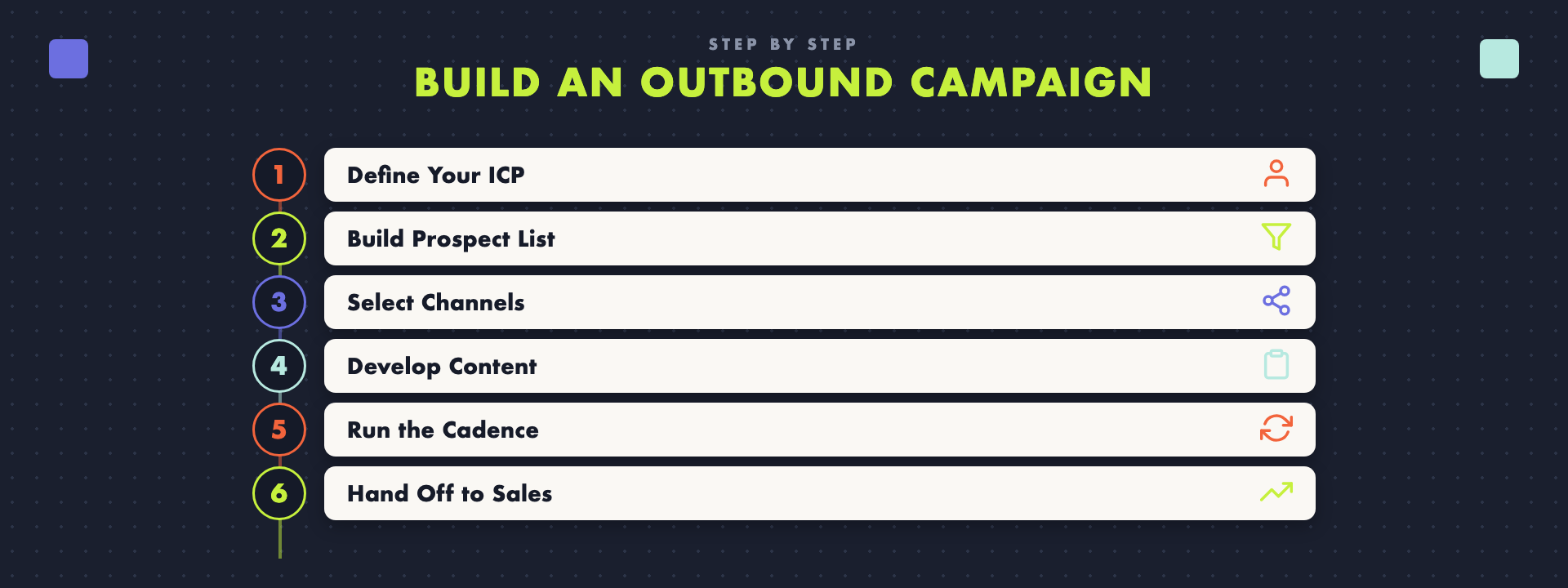
The process begins with defining the Ideal Customer Profile (ICP), which sets the foundation for targeting. The ICP includes parameters such as company size, industry, and budget. Once the ICP holds, the next step builds a high-quality prospect list. This list filters on firmographics and buying signals for accuracy and relevance.
After building the prospect list, teams select the channels for outreach. These channels include cold email, LinkedIn, and cold calling. The channel choice depends on the target segment and deal size. The campaign architecture then develops content that addresses specific buyer problems. This content stays concise and personalized and uses data-driven signals such as job roles and engagement activity.
The execution phase runs a structured cadence of four to seven touches over 14 to 21 days. This sequence starts with a problem-focused email opener, followed by LinkedIn interactions and follow-up emails with case studies. Cold calls and a final "breakup" email complete the sequence. Each step relies on the previous one, so messaging matches the triggers identified in the ICP. The campaign closes with a clean handoff to sales, where every qualified conversation includes clear notes on the problem and stakeholders before passing to the team.
How to build a prospect list for SaaS outbound
Building a prospect list for SaaS outbound marketing runs a structured approach for high data quality and effective targeting. The process begins by defining precise Ideal Customer Profile (ICP) filters. These filters include firmographics such as industry, company size, and revenue, alongside technographics such as specific technology stacks and buyer roles such as seniority and department.
To source accurate accounts, teams use tools such as LinkedIn Sales Navigator, Apollo, or ZoomInfo. These platforms provide verified data for identifying leads. The prospect list needs rigorous data quality checks to hold its effectiveness. These checks reach an email verification rate above 92 percent, remove duplicate or role-based addresses, and exclude existing customers for accuracy.
Once the list is cleaned and segmented by industry or persona, it is ready for specific outbound channels. Tailored messaging then addresses the distinct pain points of each group, which raises engagement and conversion.
What are the core channels of SaaS outbound marketing?
SaaS outbound marketing uses several core channels to proactively engage potential customers. These channels reach target accounts before they express interest in a product or service. The core channels are listed below:
- Cold Email Outreach: Cold email outreach is a foundational channel for SaaS teams. It supports scalable, personalized communication with defined account lists and offers measurable reply and conversion rates. This channel works well for products with an annual contract value (ACV) under $10,000, which lets teams reach a broader audience.
- LinkedIn and Social Selling: LinkedIn outreach complements cold email through social engagement. It works well for reaching decision-makers in mid-market and enterprise segments, which makes it the preferred channel for larger deals over $50,000.
- Cold Calling and SDR Outreach: Cold calling delivers immediate conversations and suits high-touch sales cycles. It works best for enterprise deals above $50,000 ACV, where personalized, multi-threaded engagement matches higher acquisition costs.
- Account-Based Marketing (ABM): ABM orchestrates multi-channel engagement around high-value accounts. It aligns marketing and sales around personalized campaigns for specific accounts, which raises reply and meeting rates.
- Outbound Paid Advertising and Retargeting: Paid advertising extends reach to targeted segments through display, search, and social platforms. It delivers the best results when retargeting accounts already engaged through other outbound channels, which creates repeated touchpoints that accelerate pipeline velocity.
- Direct Mail and Gifting: Direct mail cuts through digital noise for executive-level engagement. It targets executive buyers in six-figure deals that need trust-building before engagement.
- Event and Conference Outreach: Event outreach uses in-person relationship-building opportunities. It holds particular value for mid-market to enterprise segments that need direct product demonstrations.
- Intent-Based Outbound: Intent-based outbound uses behavioral signals to time engagement when prospects show active research behavior. This channel matches outreach to the urgency and budget of the specific segment.
Each channel suits different deal sizes and sales complexities, which lets SaaS teams engage their target audience effectively.
Cold email outreach in SaaS outbound marketing
Cold email outreach is a foundational component of SaaS outbound marketing. Cold email outreach reaches potential clients directly through targeted, personalized emails. This strategy fits the outbound channel mix by letting businesses engage decision-makers with data-driven insight that shapes messages to resonate with recipients. Cold email outreach moves the reply and meeting-booked metrics and suits deals with an average contract value of $5,000 or more.
LinkedIn outreach for SaaS outbound marketing
LinkedIn outreach fits the outbound channel mix as an effective social selling strategy. LinkedIn outreach engages target accounts by optimizing profiles for credibility, sending personalized connection requests, and following up with value-driven messages. This approach moves pipeline metrics by generating qualified meetings and demo bookings, which suits mid-market to enterprise segments where multi-threaded engagement across stakeholders raises conversion.
Event-based outbound in SaaS marketing
Event-based outbound in SaaS marketing fits the outbound channel mix by engaging target accounts through conferences, workshops, and exclusive events. This strategy uses strategic sponsorship, targeted networking, and one-on-one invitations to position SaaS companies as thought leaders. The follow-up sequence after the event decides meeting bookings and converts attendance into pipeline.
How to align sales and marketing for SaaS outbound
Aligning sales and marketing for SaaS outbound needs shared account lists and clear handoff protocols. Both teams define Ideal Customer Profiles (ICPs) together and prioritize accounts for smooth transitions from marketing outreach to sales engagement. This alignment reduces friction and prevents duplicated effort, which raises the overall efficiency of outbound marketing.
Shared rituals hold alignment and keep outbound converting. Weekly pipeline reviews find conversion blockers and refine strategy. These reviews let sales and marketing leaders examine conversion metrics from initial outreach through closed deals. Joint campaign debriefs after major initiatives help both teams understand what worked and what needs improvement. This collaborative analysis supports continuous optimization of messaging and targeting.
Integrating technology stacks and building shared revenue dashboards support alignment. These tools give both teams a unified view of funnel data and enable real-time adjustments to outreach. Compensation structures that reward both teams for pipeline creation, rather than individual metrics, encourage collaborative behavior. This approach turns outbound marketing into an integrated revenue engine where sales and marketing share learning and co-own outcomes.
When Outbound Beats Inbound for SaaS Growth
Outbound marketing outperforms inbound strategies in specific scenarios for SaaS companies. The conditions where outbound excels include targeting high-value deals, working through complex sales cycles, and entering immature markets. Outbound strategies work well for enterprise and mid-market segments with average contract values (ACVs) from $15K to $100K. In these cases, direct engagement with decision-makers accelerates a buying process that can stall in the passive content consumption typical of inbound methods.
The length and complexity of the sales cycle also shape the effectiveness of outbound marketing. For companies that need immediate pipeline impact, outbound marketing delivers faster results, within 2 to 4 weeks, against the 6 to 12 month ramp-up common with inbound strategies. This immediacy makes outbound ideal for high-ticket SaaS products that gain from building relationships before prospects self-identify. In emerging markets with limited search volume or brand awareness, outbound marketing lets SaaS companies educate and engage target accounts that might not discover the solution through inbound channels.
Market maturity further decides when outbound marketing fits. In new or less mature markets, outbound approaches let companies build a presence and educate potential clients who may not yet seek solutions. This strategy holds an advantage when selling into defined account lists, such as specific industries or technographic segments, where precision targeting matters. Outbound marketing proves stronger when sales cycles demand personalized, consultative engagement, since direct outreach addresses objections, shows return on investment, and works through procurement processes that content alone cannot influence.
Who can help on creating outbound SaaS marketign campaign?
Creating an outbound SaaS marketing campaign needs the right execution model for the company's stage and resources. Options include building an in-house team, hiring freelancers, or partnering with a full-service SaaS marketing agency. Each option holds distinct advantages for the company's current needs and capabilities. The options are listed below:
- In-House Team: Established companies with existing sales infrastructure gain from dedicated Sales Development Representatives (SDRs) and marketing operations specialists. This approach gives direct control over campaigns but needs significant investment in hiring and training.
- Freelancers or Consultants: Early-stage companies or those testing initial outbound strategies gain from freelancers. Freelancers provide tactical support in areas such as copywriting or list building without the overhead of a full team.
- Full-Service SaaS Marketing Agency: Agencies offer full solutions for companies that need immediate pipeline impact. Agencies manage everything from strategy to execution and provide expertise in multi-channel campaigns with consistency. This option suits mid-market and growth-stage companies looking to scale fast.
Selecting the right execution model keeps the outbound strategy effective and sustainable and matches the company's goals and market position.
Why choose SaaS marketing agency for Outbound and Full marketing?
A SaaS marketing agency operationalizes outbound marketing at scale through specialized infrastructure and resources. At SaaS Marketing Agency, we deploy dedicated systems, such as domain rotation and verified contact databases, that often sit beyond the reach of small in-house teams. This setup accelerates your time-to-pipeline and delivers immediate impact within 2 to 4 weeks, which matters for high-ticket sales. The key benefits of working with us are listed below:
- Infrastructure and Expertise: We offer pre-built systems and proven playbooks that streamline your outbound processes.
- Advanced Targeting: We run multi-channel sequencing and signal-led targeting, which raises engagement with high-value prospects.
- Scalability: We manage complex campaigns such as Account-Based Marketing (ABM), which need coordination across multiple channels and stakeholders.
- Real-time Adaptation: We integrate data from intent providers and enrichment tools, which lets campaigns adapt to real-time buying signals.
We help companies that need rapid pipeline development, lack technical capabilities, or seek precise personalization at scale.
What are the key metrics in SaaS outbound marketing?
SaaS outbound marketing relies on specific metrics to gauge effectiveness and optimize strategy. These metrics include pipeline and cost indicators that tie outreach activity to revenue outcomes. The key metrics are listed below:
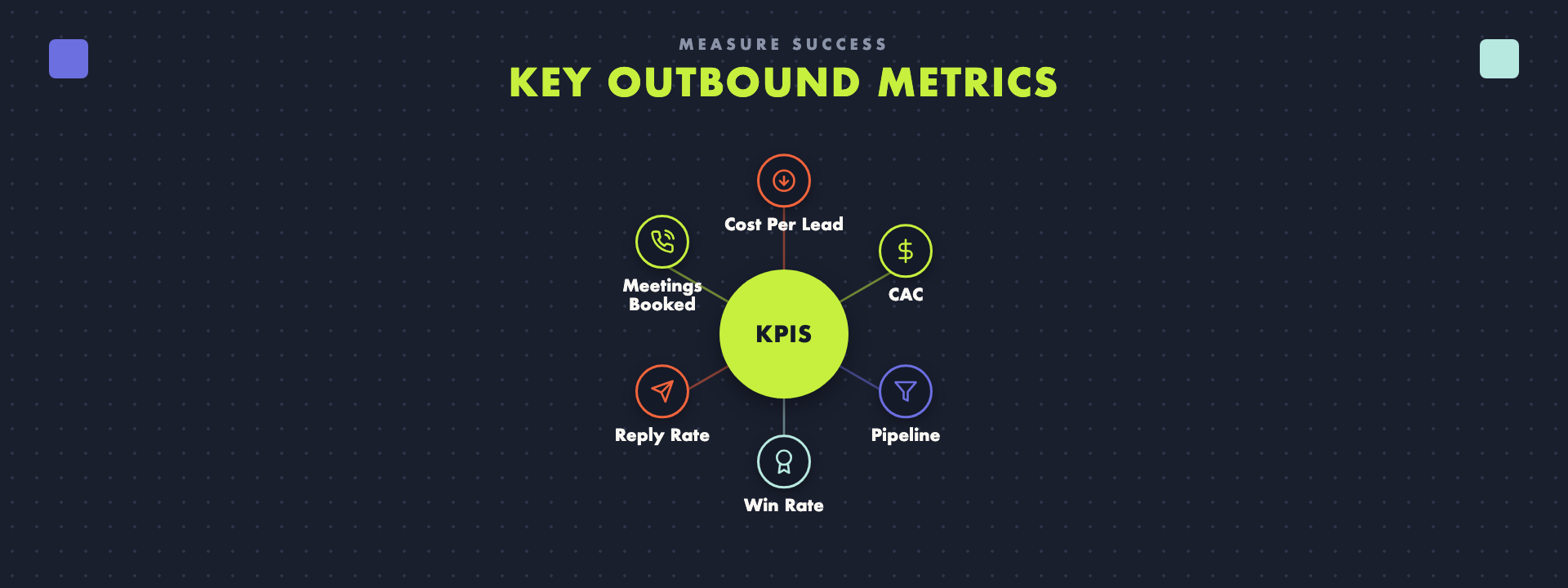
- Cost Per Lead (CPL): CPL measures the total cost of generating a lead through outbound effort. A healthy CPL runs from $80 to $250, which keeps lead generation cost-effective.
- Customer Acquisition Cost (CAC) by Outbound: CAC measures the expense of acquiring a customer through outbound channels. For high-ticket sales, CAC runs between $1,200 and $2,000, which reflects the investment larger deals need.
- Pipeline Generated: This metric tracks the volume of potential revenue opportunities created by outbound activity and shows how well campaigns generate interest and engagement.
- Win Rate on Outbound Deals: This indicator measures the percentage of deals closed from outbound-generated opportunities and shows the quality and conversion potential of leads.
- Reply Rates: Modern reply rates for cold emails run from 2 to 8 percent, with positive reply rates between 30 and 50 percent, which signals initial engagement success.
- Meeting Booked Rates: This metric reflects how well initial contacts convert into scheduled meetings, with rates from 0.8 to 2.5 percent.
- Meeting Show Rates: A show rate above 70 percent signals strong follow-through and prospect interest, which confirms that scheduled meetings lead to meaningful interactions.
These metrics confirm the success of outbound marketing campaigns by showing the ability to identify and engage the right accounts while holding cost efficiency relative to deal value and customer lifetime value.
Is Outbound Marketing Still Effective for SaaS in 2026?
Yes, outbound marketing remains effective for SaaS companies in 2026, especially with precision targeting and compliance with deliverability standards. Outbound strategies succeed when they use hyper-specific Ideal Customer Profiles (ICPs) and intent signals, which keep outreach targeted and relevant. Deliverability and privacy rules, such as email authentication standards SPF, DKIM, and DMARC, shape modern outbound effort. These measures hold inbox placement and avoid reputation penalties, which lets companies reach immediate pipeline impact, particularly for high-ticket enterprise deals.

About the team
SaaS Marketing Agency Digital Team
The in-house team at SaaS Marketing Agency Digital. We architect growth systems for B2B SaaS companies from Series A through pre-IPO.